

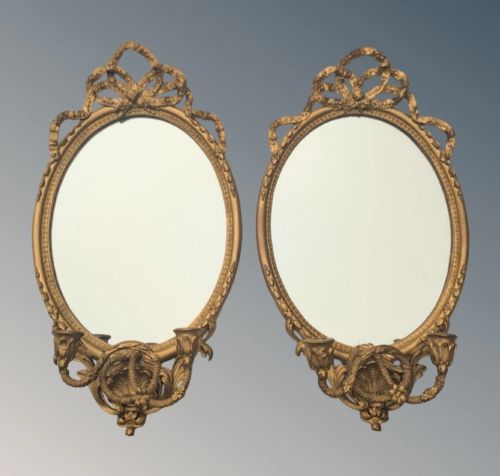
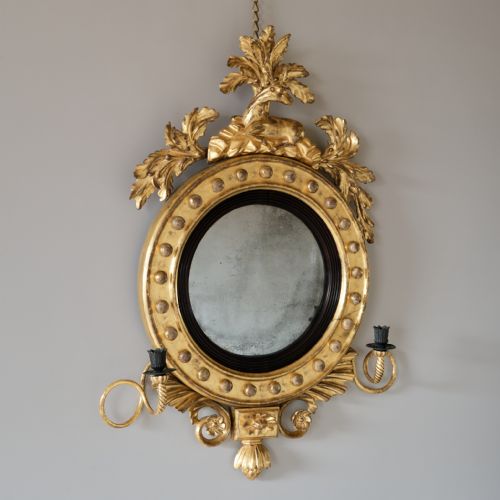
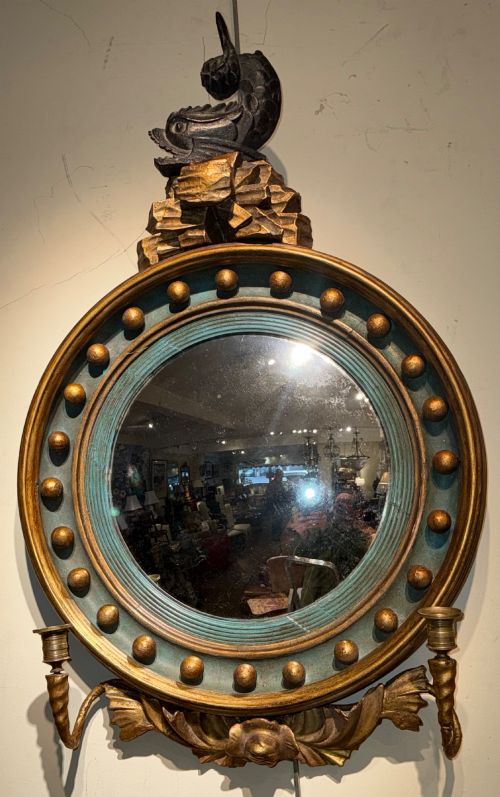


Regency Candle Sconce Mirror
These regency candle sconce mirror designs bring candle-lit brilliance and optical depth to a room through gilded frames and convex glass.
Regency Candle Sconce Mirror
When searching for a regency candle sconce mirror, you encounter convex mirrors, girandole mirrors with candle arms, and wall sconces spanning the nineteenth century alongside later nineteen-twenties interpretations. These objects combine reflective glass with functional lighting provisions to illuminate interior spaces.
The pieces listed on this page appear predominantly as circular convex forms housed in giltwood frames, together with paired wall sconces and cheval mirrors fitted with brass candle holders. Styles range from strict Regency and Grand Regency to French Chateau influences.
Origins trace back to nineteenth-century workshops producing giltwood girandoles and convex glasses, supplemented by later twentieth-century revival pieces that adopt the same decorative vocabulary.
How they were made
Maker construction relies heavily on carved wood finished in giltwood, paired with specialist mirror glass that curves outwards to capture a wide field of view in a domestic interior.
Metal components such as brass form the structural candle holders and articulated arms found on cheval mirrors and girandoles, securing the candles safely beside the reflective surface.
Regency Candle Sconce Mirror Retail Price Guide 2026
Typical asking prices for regency candle sconce mirror among the pieces listed under this phrase on Sellingantiques today, from the lower quarter to the upper quarter. They describe what is for sale here now, not the wider market.
Current listings feature materials including giltwood, brass, glass, painted wood, and ebonised wood across nineteenth-century and nineteen-twenties items.
What varies in quality
Quality reveals itself in the crispness of the giltwood carving and the depth of the gilding applied to the wooden frames, which separates standard production from finer decorative work.
The clarity and integrity of the mirror glass, whether flat or convex, dictate the visual fidelity of the reflection and the overall preservation of the piece.
The Regency Candle Sconce Mirror Glossary
- Convex mirror
- A round mirror with an outward-curving glass surface that projects a wide-angle reflection of the room. These pieces concentrate light and distort perspective delightfully.
- Girandole
- A branched wall mirror or sconce designed to hold candles on arms attached to the frame. The polished metal or glass multiplies the flickering candlelight.
- Giltwood
- Wood that has been coated with a thin layer of gold leaf or gold paint. This finish creates a luminous border that catches ambient light.
- Cheval mirror
- A full-length freestanding mirror supported in a frame that allows it to tilt. Certain examples incorporate articulated candle holders for supplementary illumination.
Regency Candle Sconce Mirror: Frequently Asked Questions
What is a regency candle sconce mirror used for?
These items serve primarily to decorate walls while amplifying natural and candle light through their reflective glass surfaces.
Positioned above mantelpieces or in dark hallways, they bounce light around the room to brighten the space.
How do I date a regency candle sconce mirror?
Dating relies on examining the construction methods of the wood frame, the formulation of the mirror glass, and the style of gilding.
Nineteenth-century originals display distinct joinery and wear patterns compared to nineteen-twenties revival pieces.
Where should I hang a convex mirror?
Convex mirrors work best in reception rooms, dining areas, or entrance halls where they can command attention as focal points.
Hanging them at eye level allows viewers to appreciate the panoramic reflection of the interior.
Are girandoles different from standard wall mirrors?
Girandoles specifically incorporate candle holders attached directly to the mirror frame or sconce backing.
Standard wall mirrors lack these integrated lighting arms, focusing purely on reflection rather than illumination.