
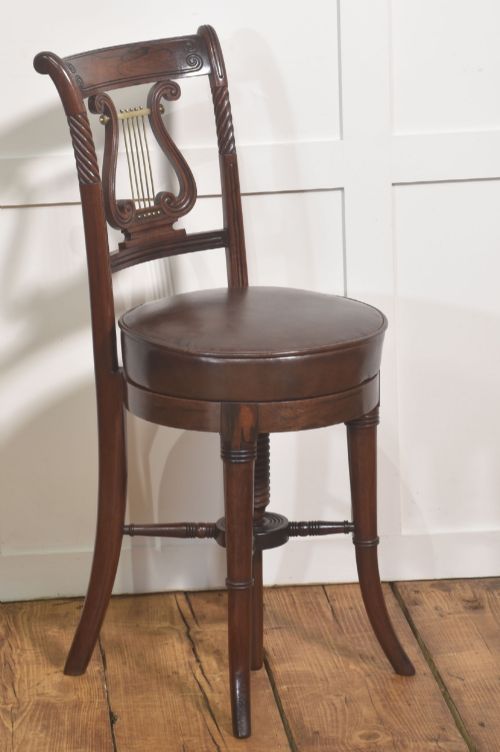


Regency Adjustable Desk
A regency adjustable desk provides flexible working heights and book positioning, combining mechanical ingenuity with period cabinet-making.
Regency Adjustable Desk
A regency adjustable desk encompasses items designed for reading, writing, and drafting with mechanical height or angle adjustment. These pieces originate predominantly from the nineteenth century, spanning periods from George III through to William IV and Victorian iterations.
The forms vary widely across the selection, featuring music stands, duet stands, reading tables, and architect's desks alongside writing tables and occasional tables. Mahogany and rosewood form the core of these constructions, often paired with satinwood inlay and leather inserts.
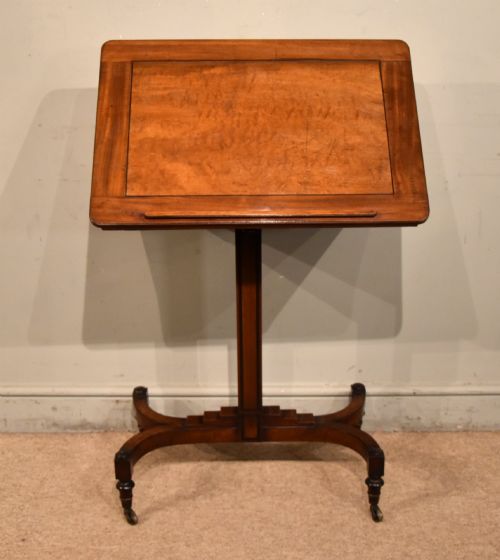
Buyers encountering this phrase most frequently meet mahogany reading tables and music stands featuring adjustable ratchets or pillars. These items served scholars, musicians, and draughtsmen who required adaptable surfaces for their work.
Materials and construction
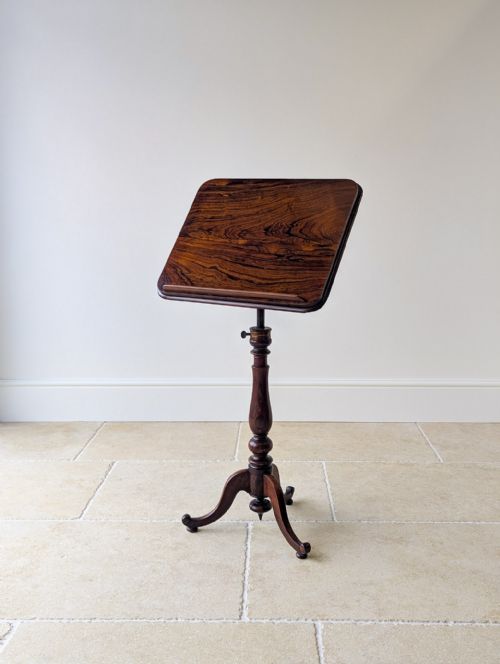
Cabinet-makers relied heavily on dense timbers such as mahogany and rosewood, occasionally utilising exotic woods like gonçalo alves and coromandel for striking grain patterns. Satinwood inlay added subtle decorative contrast to surfaces and borders.
Functional metalwork played an essential role, incorporating brass ratchets, hinges, and steel mechanisms to permit smooth height and angle adjustments. Leather inserts frequently surfaced on writing and reading slopes to provide a suitable texture for penwork.
Form variations include music stands, architect's riser desks, book slides, and double-sided reading tables.
Judging quality in adjustable pieces
The standard of a piece rests largely on the sophistication of its mechanical movement and the smoothness of its adjustment action. Superior examples integrate brass and steel ratchets or screw pillars that operate with precision and secure firmly into place.
Timber selection and secondary framing dictate durability, where well-figured mahogany or rosewood veneer applied to solid secondary woods demonstrates superior workshop practice. Finer items exhibit crisp inlay and balanced proportions without relying on excessive ornament.
Gillows of Lancaster
The Regency Adjustable Desk Glossary
- Rachet
- A notched mechanism used to support and adjust the angle of a reading slope or music stand. This device allows the user to alter the inclination of the surface securely.
- Duet stand
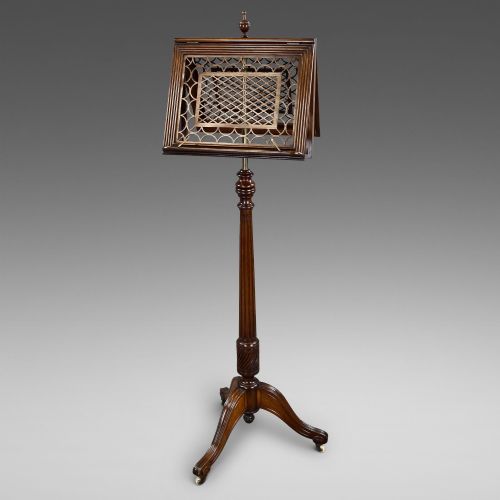
- A music stand wide enough to accommodate two scores simultaneously. These stands often feature dual adjustable desks on a central pillar.
- Gonçalo alves
- A dense exotic hardwood prized for its striking dark figuring. Makers utilised this timber for decorative occasional and reading furniture.
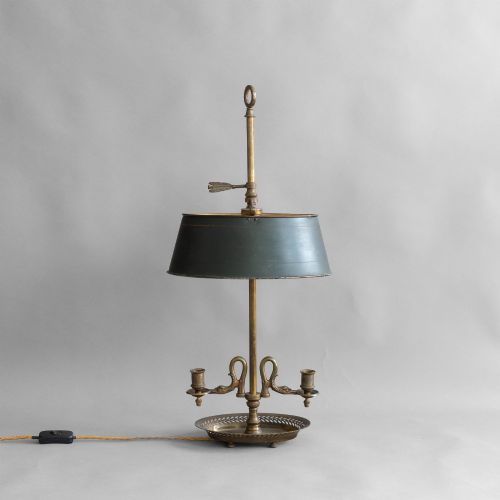
- Bouillotte
- A style of adjustable desk lamp featuring a shade raised or lowered on a central upright rod. These lamps combine bronze and painted metal elements.
Regency Adjustable Desk: Frequently Asked Questions
How do you adjust the height?
Adjustment typically relies on a central brass screw mechanism, a ratchet support, or a sliding pillar held by a thumb screw. Users simply loosen the securing device to raise or lower the surface before tightening it at the desired level.
Mechanical components were engineered to hold heavy folios and books securely in place without slipping during use. Regular gentle handling ensures these vintage brass and steel parts continue to function smoothly.
Were these desks used for writing?
Many pieces served multiple purposes, functioning as reading tables, architect's desks, and writing surfaces depending on the tabletop configuration. Tilting tops often lifted away or revealed stationary compartments underneath.
Writing surfaces frequently incorporated leather panels to provide a flat, cushioned area for ink and quill work. This versatility made them essential furniture for libraries and studies.
What is a duet stand?
A duet stand is an adjustable music or reading stand designed to hold two separate books or musical scores side by side. They typically feature a wider desk area supported by a sturdy tripod base.
Musicians and scholars utilised these stands for collaborative study or performance. The dual ledges could be angled independently depending on the user's requirements.
How do I identify the period?
Period identification relies on timber choice, hardware design, and stylistic motifs present in the woodwork. Pieces from the early nineteenth century often display restrained classical lines, reeded legs, and brass inlay.
Later Victorian iterations sometimes incorporated heavier proportions or alternative exotic timbers like gonçalo alves. Examining the construction methods inside drawers and beneath shelves confirms the manufacturing era.