
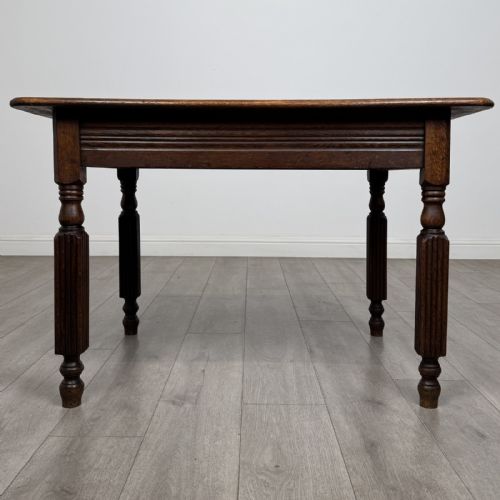

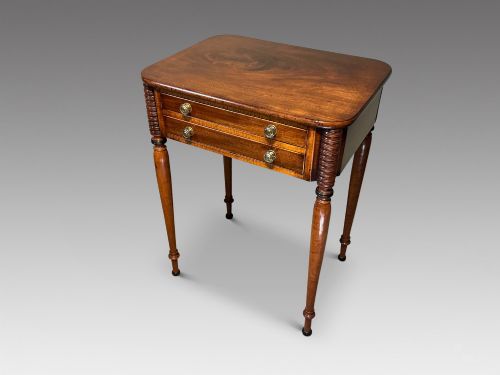
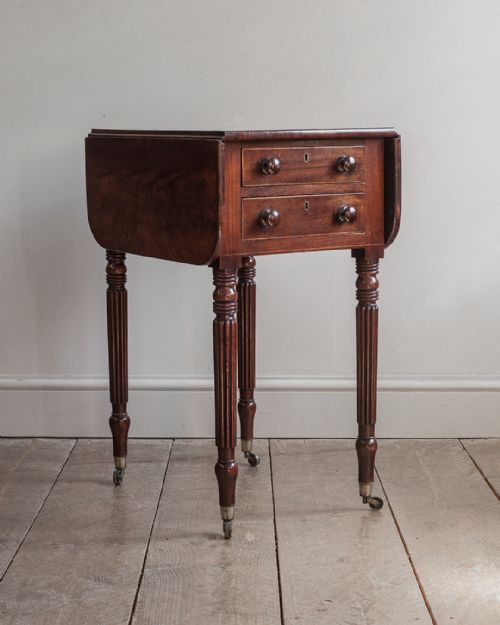


Reeded Leg Work Table
These reeded leg work table examples are functional sewing and occasional pieces that bring refined Regency and Georgian proportions to any sitting room.
Reeded Leg Work Table
A reeded leg work table combines a practical compartment for sewing materials with a compact footprint suited to domestic interiors. You will most frequently encounter mahogany and rosewood examples dating from the Regency and Georgian periods.
The form encompasses drop-leaf pembroke designs, games tables, and two-drawer variants. These pieces served as versatile side tables in nineteenth-century sitting rooms, accommodating needlework, writing, and small pursuits.
Origins span British workshops of the early nineteenth century alongside American federal interpretations. The defining characteristic across these forms remains the carved reeded decoration applied to the legs.
Materials and construction
Cabinetmakers utilised dense tropical hardwoods like mahogany and rosewood for their rich grain and stability. Secondary timbers such as oak, pine, and maple appear in internal drawer construction and framing.
The signature reeding is achieved through parallel convex mouldings carved directly into the solid wood of the leg. Drop-leaf actions and fabric work bags utilise traditional pivoting wooden brackets and hanging frames.
The object forms recorded include occasional tables, side tables, work tables, drop-leaf tables, and games tables.
Evaluating quality and execution
Quality rests in the crispness of the carved reeding and the selection of figured timber veneers. Superior examples display precise joinery in the drawer framing and harmonious proportions across drop leaves.
Manner of execution separates standard production from pieces reflecting high workshop standards. Subtle details such as original brass castors and well-figured mahogany tops distinguish the finest specimens.
The Reeded Leg Work Table Glossary
- Reeding
- A decorative moulding consisting of parallel convex strips resembling inverted fluting. This technique creates a textured columnar effect on furniture legs.
- Pembroke table
- A small occasional table featuring two hinged drop leaves on opposite sides. The form gained popularity during the Georgian period for breakfast or light writing tasks.
- Drop-leaf table
- A table with a fixed central section and hinged flaps that fold down. Brackets or swing legs support the leaves when raised.
- Games table
- A multipurpose table with a folding or reversible top designed for cards and board games. These often incorporated storage compartments for gaming paraphernalia.
Reeded Leg Work Table: Frequently Asked Questions
What is a reeded leg work table?
A reeded leg work table is a nineteenth-century small table designed for needlework and domestic tasks, featuring characteristic carved parallel mouldings on the legs.
These pieces typically include drawers or hanging fabric bags to store sewing implements while serving as decorative occasional furniture.
How were work tables used historically?
Gentlewomen utilised these tables in sitting rooms to hold embroidery, thread, and small reading materials close at hand.
The drop leaves and versatile tops also allowed the furniture to function as writing desks or lamp tables when sewing was put aside.
Which woods are most common?
Mahogany and rosewood dominate the surviving examples from the Regency and Georgian eras. Cabinetmakers occasionally incorporated maple or secondary woods for internal components.
The dense grain of these timbers provided a stable base for the intricate carving of the reeded legs.
How do I distinguish Regency from Victorian periods?
Regency pieces often display classical restraint, crisp carved reeding, and rich mahogany or rosewood veneers dating from the early nineteenth century. Later Victorian country and mid-nineteenth-century variants tend toward heavier proportions and simpler execution.
Examining the secondary woods and construction methods helps clarify the manufacturing era.