



Red Sultanabad Rug
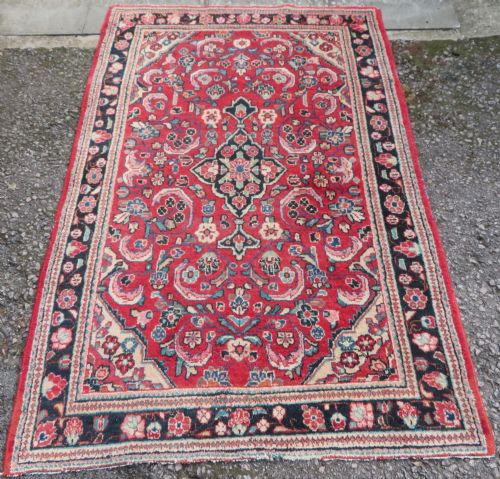
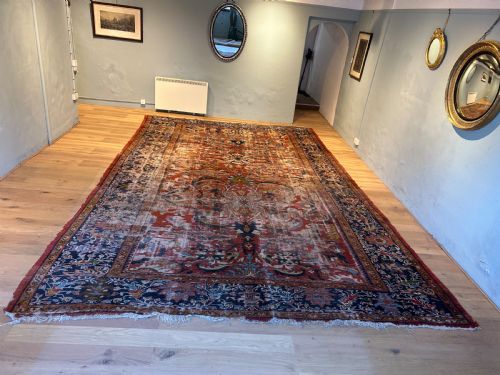
A red sultanabad rug brings grand Persian scale and softly muted floral motifs into a room, offering a richly weathered floor covering.
Red Sultanabad Rug
When you search for a red sultanabad rug, you encounter hand-knotted Persian carpets originating from the Arak region, often associated with workshops like Ziegler and Company. These floor coverings date from the late nineteenth century into the early decades of the twentieth century, encompassing related village and town weaving styles such as Mahal and Jozan. You are most likely to meet large room-size carpets and smaller area rugs featuring expansive floral and trellis patterns rendered in softer, oxidized vegetable dyes.
The aesthetic of a red sultanabad rug relies on oversized motifs and open fields that distinguish them from more densely patterned city carpets of the same era. Weaving traditions from this part of Persia adapted traditional designs to suit Western decorative tastes, creating grand proportions that anchor large interiors. These pieces bridge the gap between formal court production and rustic village weaving, utilising durable wool pile structures designed for heavy use.
How they were made
The construction of these carpets depends on a sturdy cotton foundation that supports a thick wool pile hand-knotted across the surface. Artisans utilised traditional hand-knotting techniques, securing rows of wool yarn onto cotton warp and weft threads before trimming the pile to an even depth. This combination of natural materials provides both structural stability and a soft underfoot feel.
Natural dye stuffs supplied the rich red tones and contrasting background shades seen across these rugs, often shifting in hue over time due to light exposure and wear. Workshops employed skilled dyers who created mellow terracotta, madder, and crimson shades by steeping wool in botanical baths before the loom setup. Hand-spun wool yarns absorbed these dyes unevenly, producing abrash variations that give the finished textiles their characteristic visual depth.
The available inventory records regional Persian attributions spanning Sultanabad, Mahal, and Jozan weaving traditions.
What varies in quality
The fineness of the knotting and the density of the wool pile dictate the structural integrity and definition of the pattern across different examples. Superior pieces display precise curvilinear drawing and tightly packed foundations that prevent the carpet from buckling or stretching under furniture weight. Weaving precision separates standard village output from master workshop productions.
The retention of original edge bindings and end finishes preserves the structural boundaries and historical integrity of older floor coverings. Rugs retaining their full outer borders and uncompromised side cords demonstrate careful preservation and superior initial craftsmanship compared to examples with extensive modern re-weaving. The harmony and subtlety of the faded dye palette also separate exceptional decorative pieces from simpler ones.
The Red Sultanabad Rug Glossary
- Sultanabad
- A regional carpet-producing centre in west Persia known for large-scale floral designs and muted colour palettes. These rugs were frequently exported to European and American markets during the nineteenth century.
- Mahal
- A term applied to carpets woven in the villages surrounding Sultanabad, sharing similar design traits and robust wool construction. They often feature all-over floral trellis patterns rather than strict central medallions.
- Ziegler
- A Manchester-based firm that established commercial dye works and design studios in Persia during the late nineteenth century. Their production set high standards for room-sized decorative carpets with soft palettes.
- Abrash
- Subtle colour variations within a field of a single hue, caused by changes in dye batches or hand-spun wool. This tonal shift is a natural characteristic of antique vegetable-dyed rugs.
- Warp
- The vertical foundation threads stretched tightly on the loom, running the length of the rug. Cotton forms the standard warp material in these Persian carpets.
Red Sultanabad Rug: Frequently Asked Questions
How do I clean a red sultanabad rug?
Professional dusting and specialist low-moisture washing remain essential for maintaining antique wool pile without damaging the delicate cotton foundation.
Regular gentle vacuuming without a beater bar prevents dust accumulation between the knots while protecting the aged fibres.
Can I use these rugs in high traffic areas?
The robust wool and cotton construction allows these carpets to withstand everyday foot traffic in living rooms and dining spaces.
Placing a quality rug underlay beneath the carpet prevents slippage and reduces friction against the floorboards during daily use.
What is the difference between a Mahal and a Sultanabad?
Mahal carpets typically originate from the smaller surrounding villages of the district, whereas Sultanabad refers to the broader regional output and major workshop commissions.
Both types share similar nineteenth-century design vocabularies and warm red dye palettes, though workshop pieces often show finer knot density.
How do I identify the age of these rugs?
Dating relies on examining the specific wool texture, natural dye composition, and structural characteristics typical of late nineteenth and early twentieth-century Persian weaving.
Comparing the design motifs against documented workshop styles from the region helps narrow down the production period.