



Red Sultanabad Carpet
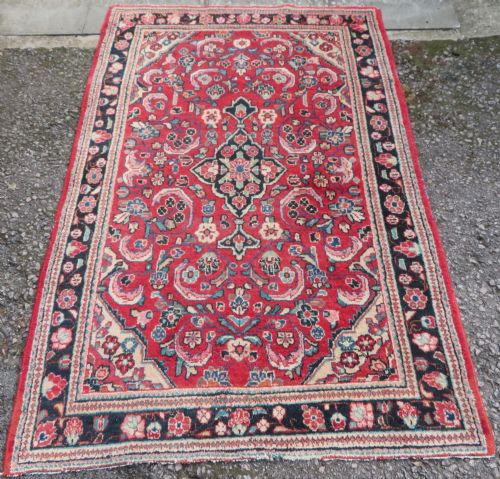
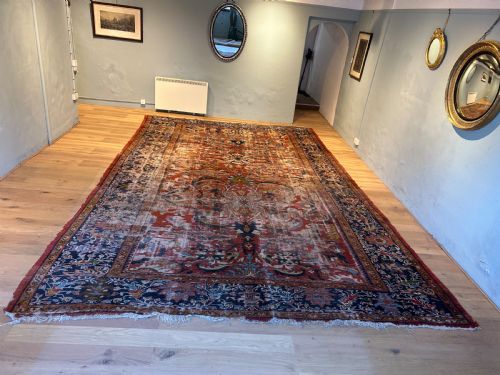
A red sultanabad carpet brings substantial Persian scale and earthy depth into a room.
Red Sultanabad Carpet
When you search for a red sultanabad carpet, you are looking at large-scale Persian floor coverings originating from the Arak region, often associated with the Sultanabad, Mahal, and Ziegler traditions. These pieces date from the late nineteenth and early twentieth centuries, spanning periods from eighteen-eighty through to nineteen-thirty.
You are most likely to meet room-size carpets and village rugs featuring traditional Persian designs, including all-over Mina Khani motifs. The listings on this page show examples woven across several decades, reflecting both commercial workshops and village production in west Persia.
How they were made
These carpets are constructed using wool pile knotted onto cotton foundations, a combination that provides both durability and structural stability for large room-size formats. The materials respond well to natural dye methods, resulting in the characteristic deep red tones seen across the inventory.
Weavers utilised traditional Persian knotting techniques, allowing for the execution of expansive, flowing floral patterns and large-scale botanical fields. The integration of wool and cotton supported both fine room-size carpets and village rugs produced in the Sultanabad region.
Listings span periods from eighteen-eighty to nineteen-thirty, featuring wool and cotton materials across Persian styles like Mahal and Ziegler.
What varies in quality
The distinction at the top of the range lies in the clarity of the drawing and the depth of the dye work within the red wool pile. Stronger examples display balanced proportions in large room-size formats, with sophisticated handling of traditional motifs across the central field.
Execution of the weave and the crispness of the secondary borders also divide standard production from finer workshop pieces. The handling of the cotton foundation and the integrity of the wool pile dictate the overall presence of the carpet in a room.
Ziegler and Co
The Red Sultanabad Carpet Glossary
- Sultanabad
- A carpet style and regional designation from west Persia known for large-scale floral designs and room dimensions. These pieces often feature muted or rich red palettes.
- Mahal
- A category of Persian rug and carpet produced in the same district as Sultanabad, typically displaying village or workshop patterns. They share the wool and cotton construction common to the area.
- Ziegler
- A type of nineteenth-century Persian carpet produced for the European market by foreign firms. These pieces often exhibit softer palettes and expansive floral fields.
- Mina Khani
- A traditional all-over repeating textile pattern composed of daisy-like flowers linked by delicate curved vines. It frequently appears across the field of large Persian carpets.
- Wool
- The primary pile material used in these rugs, prized for taking rich red natural dyes and withstanding heavy foot traffic. It forms the soft surface texture of the carpet.
Red Sultanabad Carpet: Frequently Asked Questions
How do I clean a red sultanabad carpet?
Professional specialist cleaning is essential for nineteenth-century wool pile carpets to protect the cotton foundation and natural dyes.
Regular gentle vacuuming without a beater bar helps remove surface dust without disturbing the wool fibres.
Where were these carpets woven?
These pieces were woven in west Persia, primarily around the Sultanabad and Mahal districts, which served as major carpet production centres.
Many workshops and villages in this region contributed to the output during the nineteenth and early twentieth centuries.
What is the difference between Mahal and Sultanabad?
Mahal carpets often feature slightly more village-oriented designs and varied scaling, while Sultanabad carpets frequently display grander, commercial floral patterns.
Both originate from the same broader region in Persia and share similar wool and cotton construction methods.
Can I use a room size carpet in a hallway?
Room-size carpets are generally proportioned for principal living spaces or dining rooms due to their expansive dimensions.
Placing a large carpet in a narrow hallway will overwhelm the floor space and conceal the border work.