





Red Marbled Table Clock
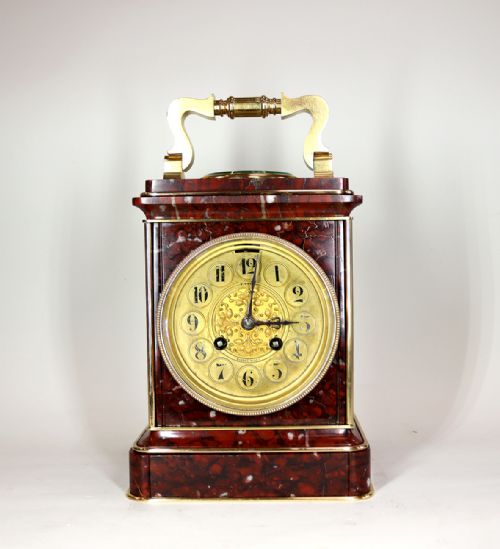
A red marbled table clock brings striking mineral pattern and rich metallic mounts to a mantelpiece.
Red Marbled Table Clock
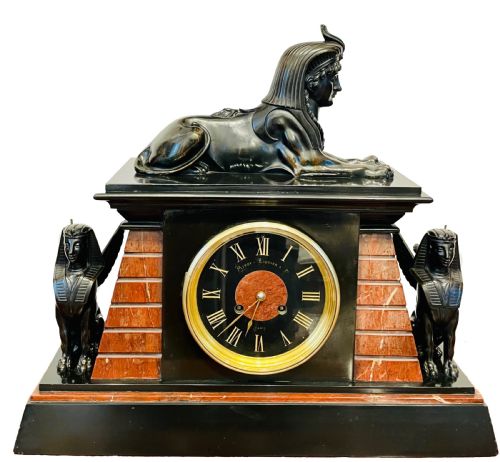
A red marbled table clock stands as a decorative timepiece defined by rouge marble cases paired with metallic mounts. These heavy stone clocks appear in forms ranging from French Empire designs to Art Deco interpretations.
The version most commonly met on this page is the nineteenth-century French mantel clock. These pieces combine rouge marble bodies with bronze, ormolu, or brass details.
Makers produced these works throughout the Victorian era and into the early twentieth century. Buyers encounter substantial mantel clocks, clock garnitures, and carriage clocks featuring rich red stone.
How they were made
Workers shaped dense rouge marble into architectural or architectural-revival cases to house mechanical clock movements. They mounted these stone bodies with cast bronze, gilt bronze, and ormolu ornaments.
Dials typically featured enamel for the chapter rings, protected beneath glass bezels. Movements often utilised silk suspension systems in earlier nineteenth-century examples to regulate timekeeping.
Listings feature pieces spanning the Victorian period, Art Deco era, and the mid-nineteenth century.
What varies in quality
Quality rests in the crispness of the bronze casting and the depth of figure in the rouge marble. Finer examples display detailed chasing on the ormolu mounts rather than plain or uniform surfaces.
The integration of sculptural elements, such as mounted figures or astronomical themes, separates standard production from ambitious studio pieces. The weight and selection of the stone itself dictate the upper tier of the range.
The Red Marbled Table Clock Glossary
- Rouge Marble
- A rich red decorative stone with white or dark veining used extensively for nineteenth-century clock cases. It provides a heavy, polished mineral foundation for metal mounts.
- Ormolu
- Gilt bronze created by applying a mercury and gold amalgam to cast bronze. This technique produced a durable golden finish on decorative clock mounts.
- Silk Suspension
- A method of hanging the pendulum from a fine silk thread inside the movement. This delicate mechanism is characteristic of better French clocks from the mid-nineteenth century.
- Garniture
- A set consisting of a central clock flanked by matching decorative objects such as urns or candelabra. These matched sets created a balanced arrangement for a mantelpiece.
Red Marbled Table Clock: Frequently Asked Questions
Where should I place a heavy marble clock?
Place these clocks on sturdy mantelpieces, heavy sideboards, or low console tables that can support significant stone weight. Ensure the surface is completely level to keep the mechanical movement ticking accurately.
Keep the clock away from direct sunlight and damp walls to protect the marble polish and the interior metal components.
How do I wind an antique mantel clock?
Use the correct winding key gently on the dial apertures, turning until you feel firm resistance. Do not overwind, as this can damage the delicate springs inside the mechanical movement.
Consult a professional horologist if the clock gains or loses time significantly rather than attempting heavy adjustments yourself.
What is a clock garniture?
A clock garniture is a matched decorative set featuring a central timepiece accompanied by side ornaments like urns or vases. These sets were designed to sit together on a mantelpiece for a unified display.
The side pieces often repeat the rouge marble and bronze mounting materials of the main clock.
How do I clean rouge marble cases?
Dust the marble gently with a dry, soft cloth to remove everyday particles without scratching the polished surface. Avoid harsh chemical cleaners or abrasive agents that can strip the natural stone finish.
Keep metal ormolu and bronze mounts free of moisture to prevent tarnishing and discolouration.