


Red Mahogany Conference Table
A red mahogany conference table is a grand dining or meeting surface built from rich timber, designed to anchor a large room with presence.
Red Mahogany Conference Table
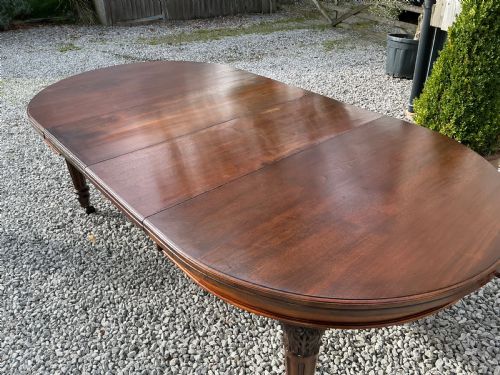
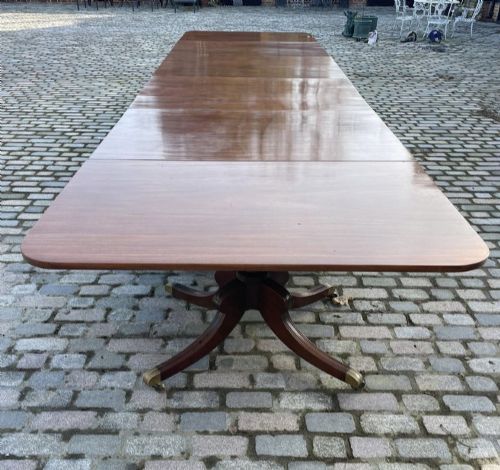
Buyers seeking a red mahogany conference table encounter large dining tables adapted from the Regency, Victorian, and William IV periods, alongside George III examples. These pieces typically take the form of extensive multi-pillar formats or extending designs with multiple leaves to accommodate numerous guests.
The versions most commonly met on this page span the nineteenth century, including monumental Irish Regency four-pedestal tables and extending imperial formats. Makers such as Gillows appear among these pieces, reflecting the high standard of period cabinet-making.
Dining tables form the primary object type seen under this category, repurposed to serve modern boardrooms and large dining spaces alike. Their substantial length, often supported by split bases or multiple pillars, defines their suitability for group gatherings.
Construction and Materials
These tables are constructed primarily from solid and veneered mahogany, selected for its deep colour and durability. Brass components, such as castors or mechanism fittings, frequently accompany the timber structure to aid mobility and extension.
Cabinet-makers utilised sophisticated pillar-and-base configurations, such as three and four-pedestal designs, to support expansive tops spanning significant lengths. Extending mechanisms integrated into the framework allowed tables to accept multiple leaves, adjusting capacity from ten to upwards of twenty-eight seats.
Object types seen exclusively here are large dining tables, ranging from three-pillar formats to twenty-eight-seater variants.
Judging Quality
Distinction between tiers of quality rests upon the sophistication of the pedestal architecture and the calibre of the timber figures in the mahogany top. Tables featuring multiple pillars, substantial leaves, and documented maker attribution stand at the upper end of the range.
The engineering of the extending mechanism and the stability of the split base structures further divide standard examples from exceptional ones. Finer pieces demonstrate seamless integration of additional leaves and robust brass support fixtures that maintain level surfaces across great lengths.
Gillows·Gillows of Lancaster
The Red Mahogany Conference Table Glossary
- Mahogany
- A durable tropical hardwood prized for its reddish-brown colour and fine grain. It serves as the primary material for high-status furniture of the Georgian and Victorian eras.
- Pedestal
- A central support column resting on feet, often carved or reeded. Multiple pedestals are necessary to support the immense weight of long dining tables.
- Extending table
- A table designed with a central mechanism and removable leaves to increase its overall length. This allows the seating capacity to expand significantly.
- Leaf
- A removable board inserted into a table top to extend its length. These are stored separately when the table is closed.
- Split base
- A table base designed to separate into distinct pillar sections when extended. This construction provides balanced support for tables fitted with numerous leaves.
Red Mahogany Conference Table: Frequently Asked Questions
How do I seat twenty people?
Tables of this scale utilise multiple pedestals and a series of removable leaves to achieve extreme lengths. Multi-pillar formats distribute weight evenly while providing uninterrupted legroom along the sides.
Inserting all available leaves transforms a standard dining surface into a grand boardroom table capable of hosting large assemblies comfortably.
Are these original dining tables?
Most examples originate as large domestic dining tables produced during the Regency and Victorian periods. Their substantial dimensions and modular leaf systems make them ideal for modern conference use.
Makers constructed these pieces using dense mahogany and robust pillar supports designed to endure heavy daily employment.
How do pedestals affect stability?
Tables featuring three or four pillars prevent the centre from sagging under heavy loads. Split base constructions offer additional structural integrity when the table is fully extended with multiple leaves in place.
Brass castors fitted to the feet allow these heavy wooden structures to move smoothly across floor surfaces.
How do I date a mahogany table?
Stylistic markers such as Regency reeding, William IV robust proportions, and Victorian craftsmanship provide clear chronological indicators. Documentary evidence, including maker stamps on brass fittings, further confirms the period of origin.
Timber selection and construction techniques also evolve from the George III era through to the late nineteenth century.