


Red Living Room Carpet
A red living room carpet brings warmth and deep pattern to a space, drawn from traditional Persian and Oriental workshops.
Red Living Room Carpet
A red living room carpet anchors a large floor space with traditional Persian and Oriental weaving styles dating from the late nineteenth century through to the mid twentieth century. These furnishings span grand country house proportions down to smaller roomsize formats, fulfilling a practical need for floor coverings with character.
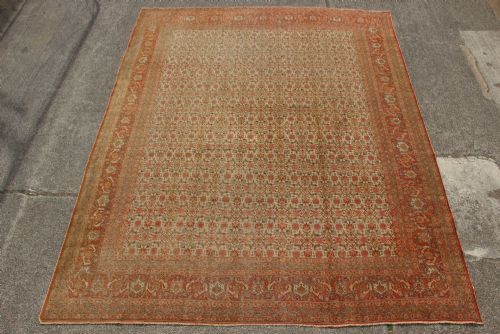
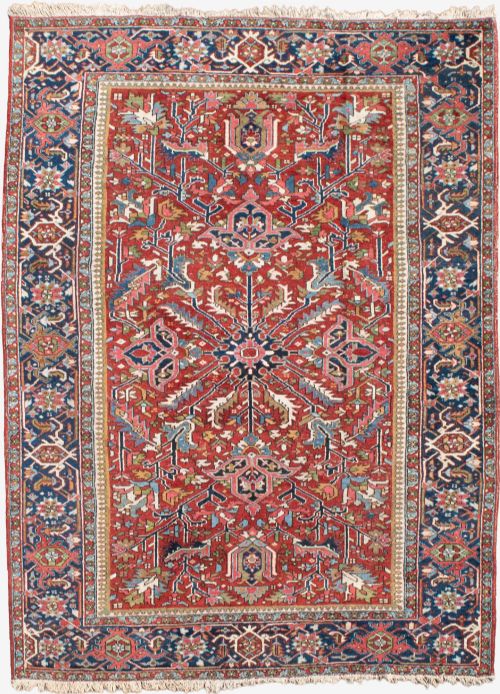
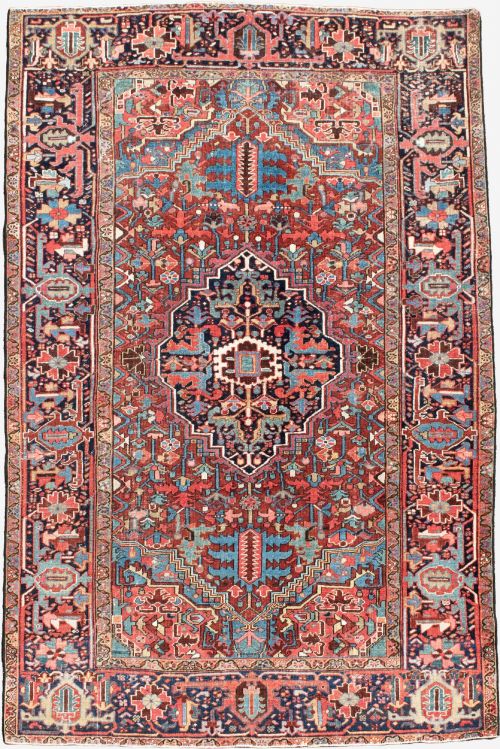
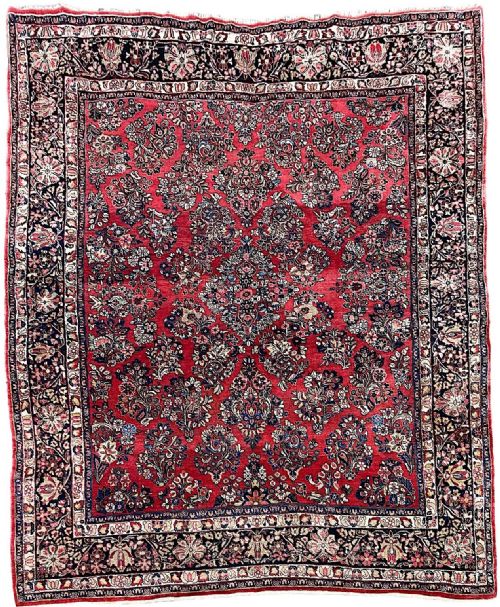
The version most commonly met on this page is the Heriz or Tabriz carpet from the early decades of the twentieth century, rendered in rich reds and deep indigos. Buyers encounter regional village and city pieces such as Hamadan, Sarouk, Mahal, and Qum carpets, each displaying distinctive traditional motifs.
The period scope covers Victorian and Edwardian examples up to the 1940s, offering a range of room dimensions suitable for sitting rooms. These floor coverings bridge centuries of weaving heritage, functioning as durable textiles for daily domestic use.
How they were made
The construction relies predominantly on wool, sometimes combined with cotton foundations or highlighted with silk elements in finer city examples. These materials are hand-knotted to create dense, resilient floor coverings capable of withstanding generations of foot traffic.
Weavers utilised natural dyes to achieve the deep reds, Terracotta tones and contrasting blues characteristic of Persian and Oriental production. The resulting pile provides both tactile warmth and structural longevity.
Listings span a chronological range from the Victorian era through the 1940s, featuring wool, cotton, and silk materials.
What varies in quality
Knot density and fineness of materials separate the finer city workshop pieces from robust village productions. City carpets from centres like Tabriz or Qum demonstrate intricate precision, whereas Heriz and Mahal carpets offer geometric boldness designed for hard-wearing utility.
The nuance of the wool and the depth of the red dye affect the visual richness of the surface. Superior examples maintain structural integrity and pile consistency across large floor dimensions.
The Red Living Room Carpet Glossary
- Boteh
- A traditional almond or paisley motif found across Persian and Oriental weaving. It often appears repeated in rows across the field of a rug.
- Pile
- The vertical yarn surface of a carpet formed by hand-knotting. It provides the texture and protects the foundational warp and weft.
- Warp
- The vertical foundation threads stretched tightly on the loom before knotting begins. The fringe of a carpet is typically formed by the extension of these threads.
- Weft
- The horizontal threads passed alternately over and under the warp threads to secure the knots in place. This structure gives the carpet its horizontal stability.
- Field
- The central background area of a carpet enclosed by the border. It usually displays the primary motifs and medallion designs.
Red Living Room Carpet: Frequently Asked Questions
How do I choose the right size?
Measure your living room floor space to ensure the furniture sits comfortably either entirely on the carpet or with front legs resting upon it. Consider room dimensions ranging from compact roomsize formats up to large country house proportions.
Allow clear wooden flooring or surround to show around the edges to frame the carpet properly within the room layout.
How do I clean an antique carpet?
Vacuum gently using a suction-only attachment without a rotating brush bar to protect the wool pile. Professional cleaning suited to antique textiles is recommended for deep maintenance.
Avoid excessive moisture and harsh chemical detergents that can affect natural dyes.
Are these carpets suitable for heavy traffic?
Traditional roomsize carpets from regions like Heriz and Mahal are constructed for hard-wearing domestic use. The dense wool pile absorbs daily wear while maintaining structural integrity.
Place a suitable underlay beneath the carpet to reduce friction against the floorboards and extend the lifespan of the textile.
How do I identify a Heriz carpet?
Heriz carpets typically feature bold geometric medallion designs with strong architectural lines and robust red fields. The wool is known for its durability, often produced in North-West Persia.
Look for sturdy construction and characteristic large-scale motifs that distinguish them from finer, curvilinear city carpets.