
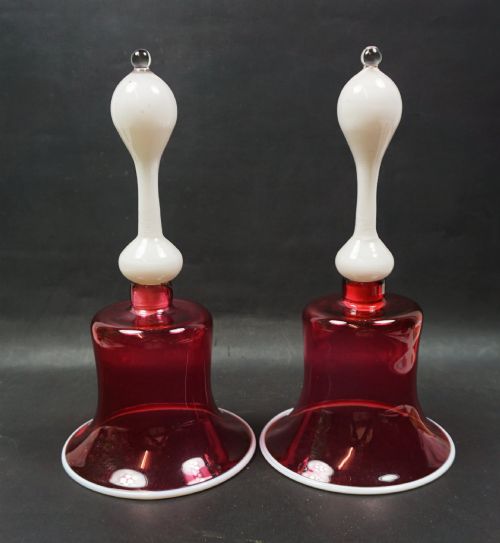


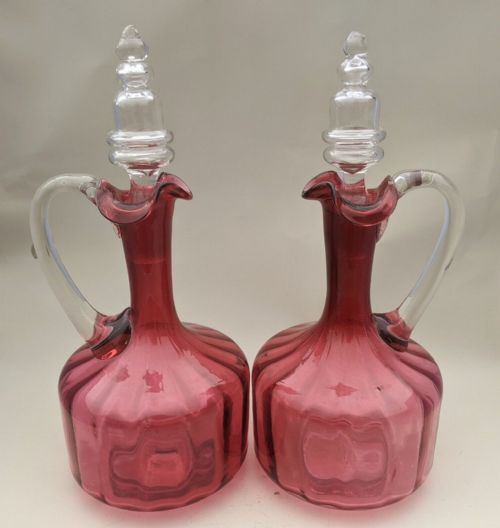
Red Cranberry Glass Pair
These red cranberry glass pair items deliver striking colour and decorative presence to a room, bringing vibrant hue and matched symmetry to a mantelpiece or table.
Red Cranberry Glass Pair
When you search for a red cranberry glass pair, you encounter matched groupings shaped primarily during the Victorian and Edwardian eras, stretching from the mid-nineteenth century towards nineteen hundred. These matched objects span practical domestic forms such as decanters, champagne coupes, tumblers, beakers, and salts, alongside purely decorative items including vases, floor trumpet vases, lustres, hand bells, candle holders, and table lamps.
The aesthetic impact relies on duality, as the pieces are designed to sit together on a surface, balancing colour intensity and form. You meet English and Bohemian origins frequently, reflecting the major glass-producing workshops of those regions during the nineteenth century.
Most examples you encounter date from the height of Victorian production around eighteen eighty, showcasing deep rich tones ranging from vibrant cranberry to darker ruby shades. Their persistence in pairs owes to their original function as mantel garnitures, table centrepieces, or matched service items for dining rooms.
How they were made
Makers achieved the distinct coloration by adding gold chloride to the molten glass batch during production, creating hues from pale pink to deep ruby. Overlay techniques, involving a layer of coloured glass fused over clear lead crystal, allowed artisans to cut through the outer red layer to reveal sparkling clear glass beneath.
Many surfaces feature intricate hand engraving and etching, depicting botanical motifs like convolvulus, vines, and birds, or geometric patterns that contrast against the translucent body. Additional elements such as applied white glass handles, enamel details, and cut glass facets demonstrate the high level of craftsmanship involved in shaping these paired objects.
Listings feature items spanning the mid-nineteenth century to nineteen hundred, encompassing Victorian and Edwardian periods alongside Bohemian and English origins.
What varies in quality
The depth and uniformity of the colour across both pieces determine much of the visual success, as inferior examples show patchy coloration or mismatched shades within the pair. The crispness of the cut or engraved decoration also distinguishes finer work, where wheel-engraved foliage remains sharp and well-defined rather than shallow or blurred.
The Red Cranberry Glass Pair Glossary
- Cranberry glass
- A transparent, pinkish-red glass produced by adding gold to the molten batch. It gained immense popularity during the Victorian period for tableware and decorative ornaments.
- Overlay glass
- A technique where a vessel is blown with an inner layer of clear crystal and an outer layer of coloured glass. Artisans then cut away portions of the outer layer to create contrasting patterns.
- Champagne coupe
- A shallow, broad-bowled stemmed glass designed for sparkling wines. Victorian examples in coloured glass often served decorative display purposes alongside drinking.
- Lustre
- A mantelpiece ornament featuring a bowl hung with glass prisms that catch the light. These paired decorative items often incorporate enamel and gilt detailing.
- Floor trumpet vase
- A tall, flared vessel designed to stand directly on the floor or a low hearth. These impressive pieces showcase the upper limits of nineteenth-century glassblowing scale.
Red Cranberry Glass Pair: Frequently Asked Questions
How do I clean them?
Wash these pieces gently in warm, soapy water using a soft cloth, avoiding abrasive sponges that might scratch the surface. Rinse thoroughly and dry with a lint-free cloth to maintain the clarity of the glass.
Take special care with examples that feature enamel decoration or gilt highlights, as harsh chemical cleaners can damage these delicate surface applications over time.
Are they safe for drinks?
Many items like decanters, tumblers, and champagne coupes were originally intended for beverage service during the nineteenth century. You can use them for serving drinks today provided the interior is clean and free from old residue.
Avoid exposing antique glass to sudden temperature changes, such as pouring boiling water into a cold vessel, to prevent thermal shock and cracking.
How do I date them?
Look closely at the pontil mark on the base, where the glassblower's pontil rod was snapped off, as rough or ground pontils typically indicate nineteenth-century manufacture. Stylistic clues such as Victorian engraving patterns, applied white handles, and Edwardian lamp fittings also help narrow down the period.
Comparing the weight and thickness of the glass against known nineteenth-century manufacturing standards provides further confirmation of the era in which they were produced.
Why do they come in pairs?
Nineteenth-century interior decoration placed a high value on symmetry, particularly for mantelpieces, sideboards, and dining tables. Items like vases, decanters, and lustres were manufactured as matched sets to create a balanced visual arrangement in a room.
Keeping two pieces together preserved their original decorative function as a coordinated display unit, which collectors still prize today.