
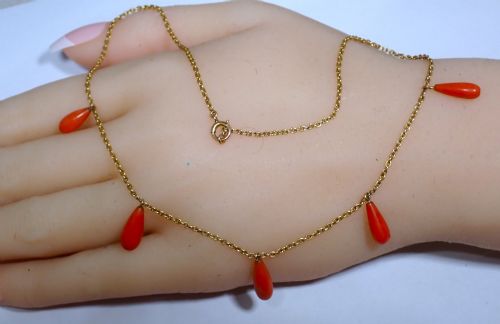


Red Coral Necklace
A red coral necklace brings deep organic warmth to the skin, capturing centuries of skilled lapidary work in vibrant scarlet branches and beads.
Red Coral Necklace
When you search for a red coral necklace, you are looking at organic jewellery formed from marine branching coral harvested across the Mediterranean and beyond. These pieces span Victorian, Edwardian, and mid twentieth-century eras, reflecting changing tastes in adornment from long un-dyed branch strands to shorter graduated bead lengths.
You will most frequently encounter variations featuring natural red coral paired with gold or silver clasps, alongside more elaborate Ottoman style pieces and pendants. The selection ranges from substantial multi-strand rods and stick branches to delicate carved cameos and bead combinations incorporating pearl, turquoise, or onyx.
The historical scope extends from nineteenth-century productions through Art Deco and 1940s designs, sometimes appearing in broader forms such as fine art portraiture depicting ladies wearing these exact ornaments. Each survivor records the distinct aesthetic of its period, whether through Dutch provincial clasps or traditional fine jewellery settings.
How they were made
Makers shaped the marine material using traditional lapidary techniques, cutting and polishing coral branches, rods, or beads by hand. These organic elements were then strung onto durable thread or mounted in precious metals like yellow gold, 15ct gold, and silver.
Gold and silver clasps were often cast, engraved, or set with subsidiary stones like pearls and turquoise to complement the vibrant red material. The construction of a necklace relied on secure knotting between beads or robust settings for pendants to support the considerable weight of natural coral branches.
One young lady in a 19th century oil painting holds her hat firmly while wearing her coral necklace in the landscape.
What varies in quality
Quality rests in the intensity and natural state of the coral, distinguishing un-dyed Mediterranean material with deep, uniform colour from lesser treated variants. The weight and length of the strand, whether a heavy multi-gram branch necklace or a shorter graduated bead piece, also dictate the calibre of the work.
The sophistication of the metalwork in the clasp or pendant mount signals the tier of the piece, with provincial settings differing from refined Victorian or Edwardian craftsmanship. Preservation of the original bead graduation and the integrity of the stringing further separate standard examples from exceptional survivals.
The Red Coral Necklace Glossary
- Coral
- An organic marine material formed from calcareous skeletons of coral polyps, prized in jewellery for its intense red and pink hues. It has been carved, beaded, and branched into ornaments for centuries.
- Graduated
- A term describing beads that systematically decrease in size from the centre to the clasp. This arrangement requires precise sorting and creates a balanced visual flow around the neck.
- Branch
- A natural, unshaped form of coral retaining its original twig-like growth pattern. These pieces are often drilled and strung directly to showcase their organic silhouette.
- Cameo
- A relief carving produced on a gemstone or shell, where the raised subject contrasts with a background layer. In these listings, carved coral cameos frequently form central pendants mounted in gold.
- Ottoman Revival
- A nineteenth-century design style drawing on Turkish motifs and ornamentation. Pieces in this aesthetic often incorporate rich silver work and distinctive geometric or floral flourishes.
Red Coral Necklace: Frequently Asked Questions
Are these corals dyed?
Many historical pieces feature natural un-dyed red coral, whilst others utilise treated or colour-enhanced material depending on the period and origin. Examining the internal grain and uniformity of the colour under magnification helps determine its natural state.
Un-dyed Mediterranean red coral typically commands greater interest among collectors. Listings often specify whether the material is natural and un-dyed.
What periods do these necklaces come from?
The pieces span from the nineteenth century through the Victorian and Edwardian eras, extending into the Art Deco period and the 1940s. Each era brought distinct mounting styles, from elaborate gold cameos to simple silver settings.
Victorian and Edwardian examples often showcase traditional fine jewellery techniques, whilst mid-century pieces lean towards bolder bead arrangements and mixed materials like onyx.
How can I tell a branch necklace from beads?
Branch necklaces utilise the raw, twig-like shapes of harvested coral, retaining irregular natural contours and varying thicknesses. Bead necklaces feature carefully rounded, polished spheres or olives that are uniform or evenly graduated in size.
Branch pieces offer a more organic, textured appearance, whereas graduated beads present a structured, symmetrical line around the neckline.