
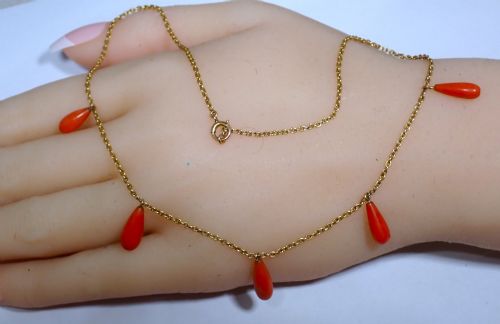


Antique Coral Necklace
An antique coral necklace brings organic warmth to the skin, formed from natural branches and beads shaped by decades of wear.
What an antique coral necklace is
When you search for an antique coral necklace, you are looking at pieces shaped from natural marine material mounted on gold or thread. The items found here span the Victorian, Edwardian, and later twentieth-century periods.
The most common formats on this page are beaded necklaces, featuring either uniform rounds or graduated strands. Examples range from short choker lengths to long continuous ropes of Mediterranean red or pink coral.
Earlier pieces often incorporate precious metal clasps in nine-carat gold, while other configurations rely entirely on knotted silk thread. Certain items combine the coral beads with rock crystal for textural contrast.
How they were made
The construction of these pieces relies on organic materials including natural red coral, pink coral, and angel skin varieties shaped into beads, rods, or branch sections. These components are secured using silk thread, often with individual knots between beads to prevent loss.
Metal elements, where present, utilise nine-carat gold for clasps and small settings. Selected pieces also integrate woven techniques alongside the stone beads.
Retail Price Guide 2026
Typical UK retail prices for coral necklace, calculated from the Sellingantiques database of over a million retail prices indexed since 2003. This retail price guide relies exclusively on Sellingantiques data; no external sources or auction records are used, so the figures do not describe the wider market.
Listings on this site span four distinct eras: Victorian, nineteen-hundred, nineteen-thirty, and nineteen-fifty.
What varies in quality
Quality rests upon the uniformity of the bead graduation, the depth of the natural colour, and the integrity of the stringing material. Superior examples display consistent polish across every bead without surface fissures.
The proportion and weight of the material also dictate the character of the piece, particularly in longer strands where heavier branches or substantial bead sizes command attention.
The Antique Coral Necklace Glossary
- Graduated bead
- A string of beads arranged by size, with the largest elements positioned at the centre and tapering towards the clasp.
- Angel skin coral
- A pale pink variety of coral prized for its soft, milky tone.
- Mediterranean red
- A vibrant red coral species historically harvested from the Mediterranean Sea.
- Nine-carat gold
- An alloy of gold containing thirty-seven point five percent pure gold, commonly found in British jewellery clasps.
Frequently Asked Questions
Can I wear an antique coral necklace daily?
While these pieces were made for regular wear, coral has a lower hardness than gemstone alternatives and requires mindful handling. Avoid wearing it during strenuous physical activities or swimming.
Frequent checks on the silk thread or stringing ensure the beads remain secure. Silk stretches over time, so professional re-stringing may be necessary for older strands.
How can I tell natural coral from dyed substitutes?
Natural coral typically shows faint growth lines, slight surface irregularities, and variations in colour under magnification. Uniform colouration and lack of internal graining often point toward synthetic materials or dye treatments.
Examining the drill holes under a loupe can reveal the white interior characteristic of certain natural coral branches. Experienced handling remains the most reliable method of assessment.
What is the difference between Victorian and later coral necklaces?
Victorian examples frequently feature hand-carved elements, deeper red tones, and specific clasp designs associated with nineteenth-century metalwork. Edwardian and later twentieth-century pieces often showcase finer uniform rounding or alternative lengths.
The inclusion of rock crystal and specific gold hallmarks helps anchor pieces to particular decades. Each era utilised distinct proportions and stringing methods.