


Rectangular Tripod Table
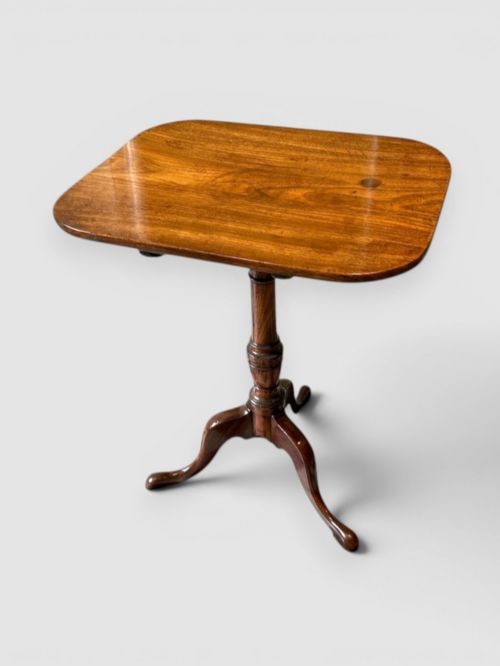
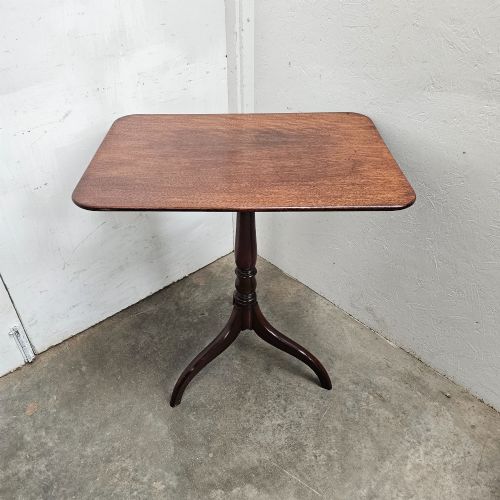
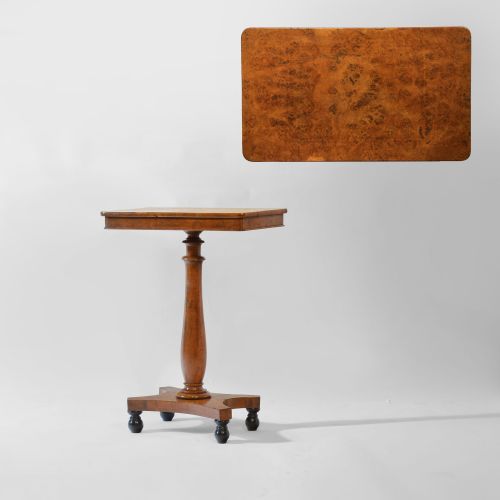
These rectangular tripod table examples offer compact surfaces raised on three-legged pedestals, serving practical needs with refined proportions.
Rectangular Tripod Table
A rectangular tripod table combines a four-sided top with a central pillar supported by three feet. Buyers seeking this form encounter variations designated as wine tables, lamp tables, or occasional tables across Georgian, Regency, and Victorian periods.
The format ranges from small pivoting wine tables to larger breakfast or centre tables fitted with multiple tiers or drop leaves. Most examples found here originate from the eighteenth and nineteenth centuries, constructed predominantly in mahogany and oak.
Makers often incorporated tilting mechanisms, allowing the top to pivot upright when not in use. This clever design saved floor space in domestic interiors while keeping the surface ready for service.
How they were made
Cabinetmakers constructed these tables using solid hardwoods such as mahogany, oak, and yew, occasionally employing pollard oak or kingwood for decorative cross-banding and inlay. Timber selection dictated the structural integrity of the central pillar and the stability of the three splayed legs.
Joinery involved turning the central column on a lathe and fitting it securely into the tripod base using dovetail or dowel joints. Tops were frequently mounted on bird-cage mechanisms or tilting blocks fixed with brass catches and hinges.
Some tilt-tops spent centuries doubling as impromptu fire screens when tipped upright near a hearth.
What varies in quality
The refinement of the timber grain and the precision of the turning on the central pillar distinguish finer examples from simpler workshops. Rich flame grain in mahogany or thoughtful contrast in inlaid wood elevate the visual presence of the piece.
Stability relies on the snugness of the joints where the legs meet the shaft and the smoothness of the tilting mechanism. Superior specimens retain their original brass fittings and move without wobble or excessive play.
Regency Gillows
The Rectangular Tripod Table Glossary
- Tilt-top
- A hinged tabletop that pivots from a horizontal surface to a vertical position against the pedestal. This mechanism allows the table to stand flat against a wall when not in use.
- Bird-cage
- A wooden frame beneath the tabletop that permits the surface to both tilt and rotate independently of the central column. It adds height and structural complexity to the upper support.
- Tripod base
- A support structure consisting of three radiating legs connected to a central vertical pillar. This design ensures stability on uneven floors by maintaining three points of contact.
- Cross-banding
- A decorative border of veneer laid around the perimeter of a tabletop with the grain running perpendicular to the centre. It frames the main panel and demonstrates skilled woodworking.
- Pollard oak
- Timber harvested from trees that were cut back to promote a dense network of branches, producing a heavily figured and mottled grain pattern. It was prized for decorative occasional furniture.
Rectangular Tripod Table: Frequently Asked Questions
What is a rectangular tripod table used for?
These tables served primarily as portable stands for holding wine glasses, lamps, or books beside seating areas in period drawing rooms.
Their compact footprints and tilting tops made them adaptable for multiple domestic uses throughout the day.
How do you operate a tilt-top mechanism?
A wooden catch or brass pin beneath the top releases the surface, allowing it to pivot upright on its pivot block.
When returning the top to the horizontal position, the latch engages automatically to secure the surface for use.
Are these tables sturdy on three legs?
Three-legged bases maintain firm contact on uneven floorboards far better than four-legged designs because three points define a plane.
Well-proportioned splayed legs distribute weight evenly outward from the central pillar to prevent tipping.
How do I distinguish Georgian from Victorian examples?
Georgian versions generally display restrained classical turning and simpler moulded edges, often executed in rich mahogany or oak.
Victorian pieces frequently introduce heavier ornamentation, such as barley twist columns or more dramatic flame grain veneers.
What is a bird-cage support?
A bird-cage is an open wooden assembly fitted beneath the table top that enables the surface to rotate as well as tilt.
This sophisticated device permits the user to turn the table top to any angle without moving the heavy base.