





Queen Anne Revival Seating
Queen Anne revival seating brings structured elegance and graceful cabriole supports into traditional rooms through enduring walnut and mahogany designs.
Queen Anne Revival Seating
Queen Anne revival seating encompasses chairs, stools, and benches produced from the late nineteenth century through the early twentieth century. These pieces draw heavily on eighteenth-century aesthetics, reinterpreting historical forms for later domestic interiors.
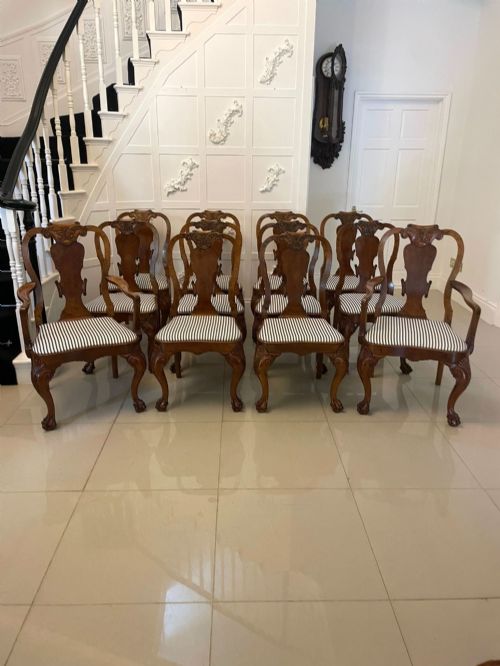
The version most commonly met on this page is the dining chair or armchair executed in walnut or oak. Examples range from individual library chairs to substantial sets of dining chairs featuring characteristic splat backs and scroll terminals.
How they were made
Makers utilised solid hardwoods such as walnut, mahogany, and oak to construct sturdy frames capable of supporting elaborate carved details. Cabriole legs were shaped directly from the timber, often flowing seamlessly into pad or claw-and-ball feet.
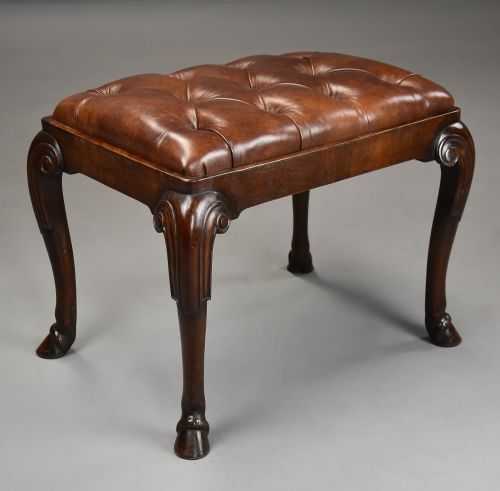
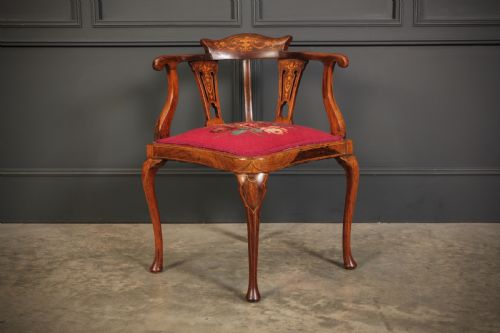
Upholstered elements relied on durable textiles, including leather, velvet, and patterned fabrics, secured over padded foundations. Decorative flourishes like marquetry inlay and painted finishes appeared on select panels and splat backs.
Even a child's chair deserves a proper cabriole leg.
What varies in quality
The standard of carving distinguishes superior examples from simpler production, particularly in the crispness of shell motifs and scrollwork on the knees and crest rails. Timber selection also dictates grade, with figured burr walnut commanding greater visual depth than plain stock.
Frame integrity depends upon the joinery employed at stress points such as leg junctions and backrest uprights. Pieces retaining original textiles and undisturbed wooden surfaces demonstrate higher preservation value.
The Queen Anne Revival Seating Glossary
- Cabriole leg
- A furniture leg featuring a double curve, typically curving outward at the knee and inward at the ankle to end in a pad or foot. This form derives from classical traditions and defines much of the seating seen here.
- Splat
- The central vertical strip of wood in the back of a chair. In these pieces, the splat often takes a solid vase or fiddle shape.
- Marquetry
- Decorative inlay work where pieces of wood veneer are fitted into a background panel to form geometric or floral patterns. It adds surface ornamentation to select framework elements.
- Wing armchair
- An upholstered seat featuring protective side panels attached to the backrest to deflect drafts. These deep-seated forms frequently incorporate scroll arms and cabriole supports.
Queen Anne Revival Seating: Frequently Asked Questions
How do I identify queen anne revival seating?
Look for characteristic design markers such as cabriole legs, pad feet, and spooned backrests with vase-shaped splats. These elements mimic authentic eighteenth-century forms while showing the timber patination typical of later nineteenth and twentieth-century production.
Examine the construction methods and wood species used beneath the upholstery. Walnut and mahogany were favoured for finer revival items, whilst oak frames tend to exhibit heavier proportions.
Were these chairs made for dining?
Many examples on this page are dining chairs, often found in sets ranging from pairs up to large groupings. They were designed to provide formal seating around substantial timber dining tables.
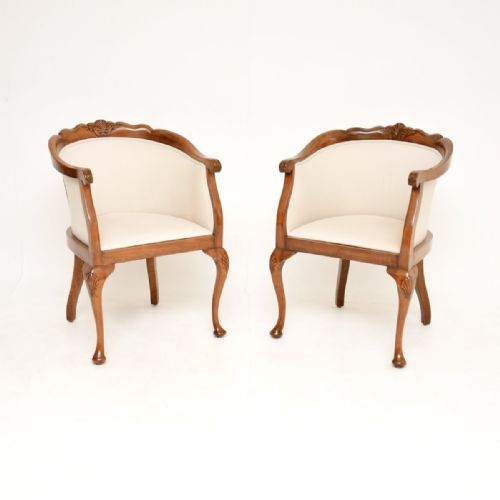
Alongside dining sets, the category includes individual armchairs, library chairs, stools, and window seats intended for parlours and studies.
What woods were used for these chairs?
Makers predominantly worked with walnut and mahogany, though oak and rosewood also appear across the selection. Burr walnut was frequently chosen for high-end dining chairs to create striking figured grain patterns.
Secondary timbers might be found in internal framing, but primary show-woods define the visual character and period style of each piece.
How do I care for antique revival seating?
Maintain wooden surfaces by dusting regularly with a soft cloth and applying appropriate beeswax periodically to nourish the timber. Avoid placing seating in direct sunlight or near heat sources to prevent wood splitting.
Protect upholstered sections by professional cleaning when necessary and handling movable elements with care to preserve original joinery.