
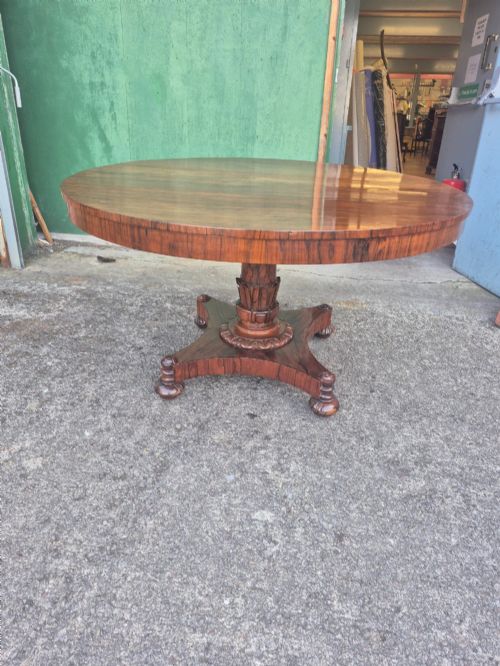
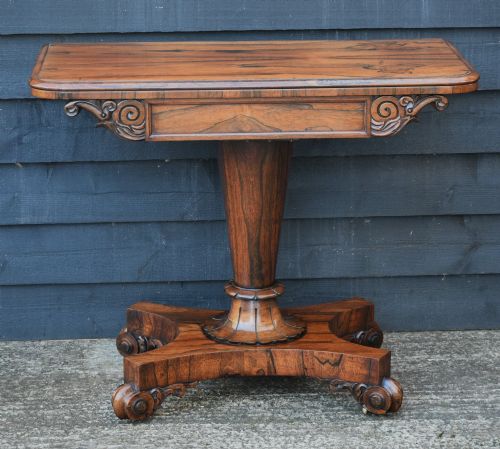
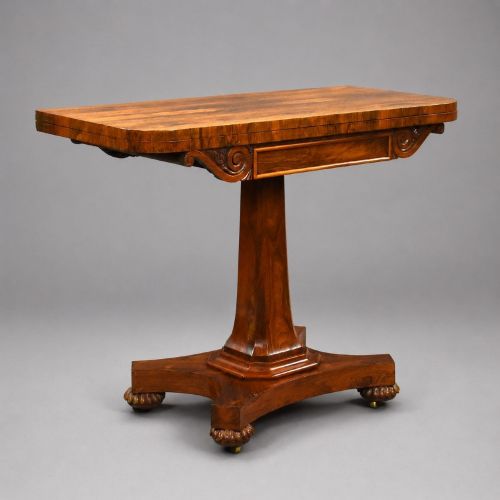
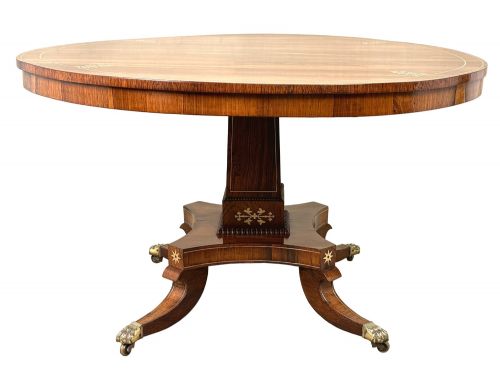
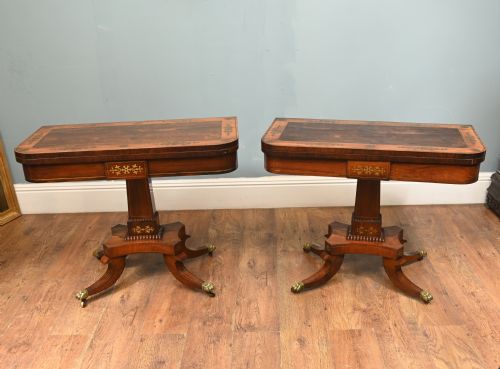

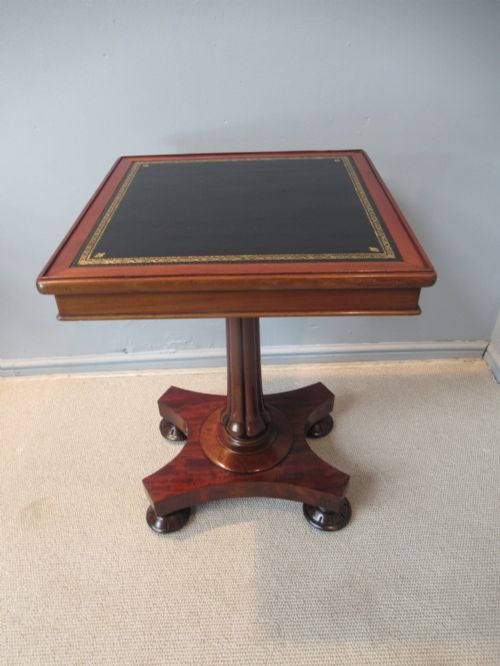
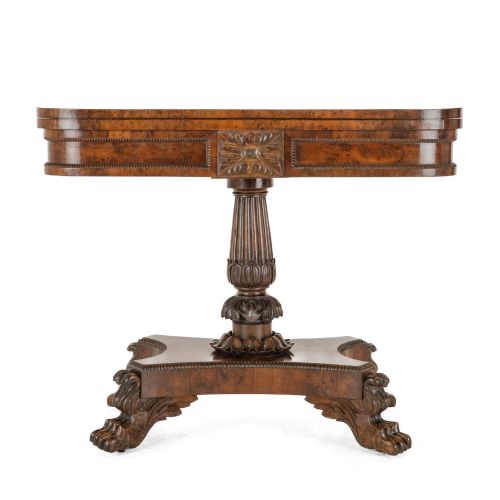
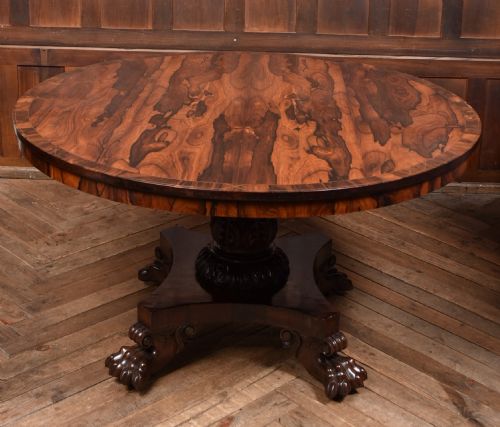


Quadform Base Pedestal Table
These quadform base pedestal table examples bring together nineteenth-century timber work and sturdy central supports, offering a practical centrepiece for any room.
Quadform Base Pedestal Table
The assortment spans diverse forms including card tables, breakfast tables, occasional tables and library tables. Rosewood and mahogany dominate the offerings, often complemented by brass inlay, leather inserts and tilt-top mechanisms suited to domestic interiors.
Materials and construction
Cabinet makers utilised dense hardwoods such as rosewood, mahogany and burr yew, frequently pairing them with oak or secondary timbers for internal structures. Surfaces were finished with detailed woodwork, brass inlay and occasional applications of gold leaf to accentuate the grain.
Many examples incorporate pivoting mechanisms for tilt-top action, snap-top fittings and folding leaves designed for card and tea use. The central pedestals rest upon robust four-way bases, which sometimes feature hidden castors to aid movement across floor surfaces.
Listings for this phrase focus on nineteenth-century examples, spanning Regency, William IV and Victorian periods in rosewood, mahogany and oak.
Defining qualities
The standard of a quadform base pedestal table rests largely on the choice of timber figure, such as finely figured rosewood or burr yew, and the crispness of any brass inlay. Superior examples display thoughtful proportions where the central pillar balances harmoniously with the four-way base and the top.
Execution of mechanical elements, including smooth fold-over hinges, stable tilt-top catches and well-fitted gaming wells, distinguishes finer production. Construction integrity in the pedestal joints ensures the entire piece remains firm and level during daily use.
The Quadform Base Pedestal Table Glossary
- Card table
- A folding table designed specifically for playing cards, featuring a hinged top that opens to reveal a baize or leather playing surface.
- Tilt-top
- A tabletop mounted on a pivot mechanism that allows the surface to be tilted vertical when not in use for convenient storage against a wall.
- Pedestal table
- A table supported by a single central pillar rising from a base rather than traditional corner legs.
- Brass inlay
- Ornamental metalwork embedded flush into the timber surface to create geometric or floral patterns.
- Snap-top
- A spring-loaded mechanism that locks a tilt-top table firmly into its horizontal position during use.
Quadform Base Pedestal Table: Frequently Asked Questions
What is a quadform base pedestal table used for?
These tables served multiple domestic functions depending on their top configuration, acting as breakfast surfaces, reading desks or fold-over card tables for evening entertainment.
Their sturdy central pedestal design allowed chairs to be tucked neatly around the perimeter without hitting corner legs.
How do I identify a Regency pedestal table?
Regency pieces often display classical revival motifs, dark figured rosewood veneers and precise brass inlay work dating from the early nineteenth century.
They typically feature robust central pillars rising from shaped platform bases supported by scrolled feet.
Can I use a antique card table every day?
Most fold-over card and occasional tables remain structurally sound for daily placement in a living room or hallway.
Care should be taken with polished timber surfaces by using coasters and avoiding placement near direct heat sources.
What is the difference between William IV and Victorian tables?
William IV examples generally exhibit bold architectural carving, heavy rosewood or mahogany timbers and classical influences from the 1830s.
Victorian pieces from subsequent decades often introduce varied mechanisms like envelope tops and lighter proportions while retaining central pedestal supports.