



Putti Gilt Clock
These putti gilt clock selections bring together gilded metalwork and figurative sculpture from the nineteenth century, offering both decorative presence and timekeeping.
Putti Gilt Clock
When searching for a putti gilt clock, a buyer encounters figurative horology dominated by nineteenth-century French and English design. These pieces combine mechanical timepieces with sculptural depictions of putti, cherubs, or cupids.
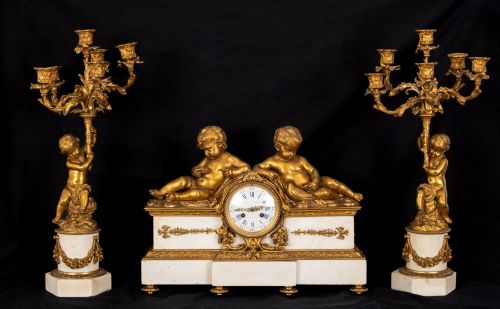
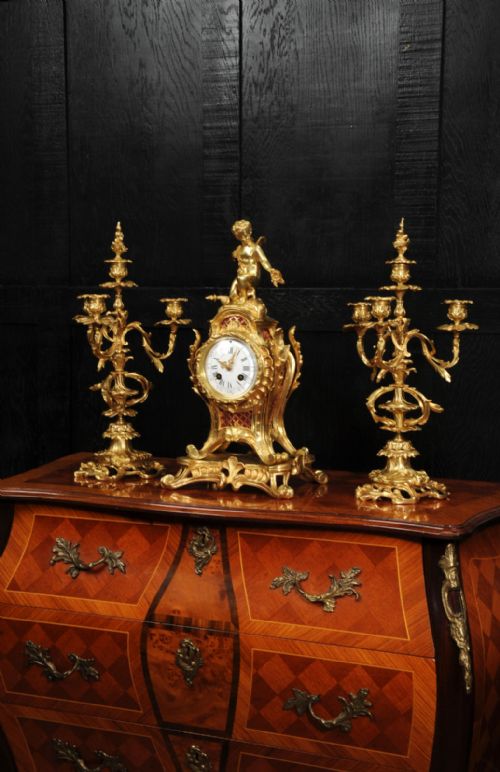
The version most commonly met on this page is the French mantel clock or clock garniture, frequently paired with matching candelabras and executed in ormolu and white marble.
Originating largely from the Victorian era and the later decades of the nineteenth century, these objects range from small table pieces to large garniture sets incorporating bronze and enamel dials.
Materials and construction
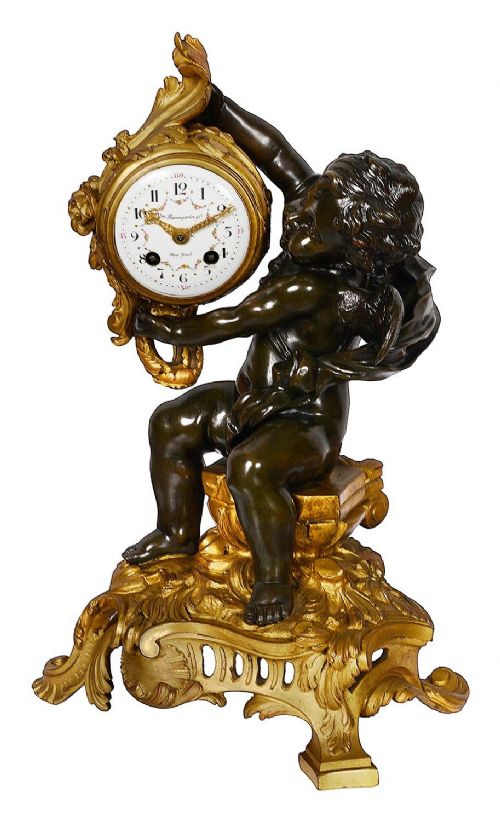
Makers utilised cast bronze and ormolu, applying mercury gilding or electroplating to achieve a bright, uniform golden surface across the decorative mounts and figures. This metalwork was frequently combined with white or red marble bases and bronze plinths.
Clock movements were mechanical, often featuring fusee or pendulum systems housed behind hand-painted dials, enamel chapter rings, and glassbezels. Sculptural elements like putti finials and mounts were cast separately and pinned or screwed to the main chassis.
The documented styles span French Rococo, Louis XVI revival, and classical English designs from the Victorian period.
Distinctions in quality
The upper tier of these pieces displays crisp chasing and hand-finishing on the cast bronze figures, where individual curls, feathers, and facial expressions remain sharp beneath the gilding. Lower quality examples rely on softer castings with smoothed detail and flat, unvaried surface plating.
Integration defines the better pieces, where the marble plinth, clock case, and gilt mounts form a coherent architectural composition rather than an assembled collection of unrelated components.
Le Roy Paris·Leon Message·Jollet et Cie·Phillipe H Mourey·John Bennett
The Putti Gilt Clock Glossary
- Ormolu
- Gilded bronze, produced by applying a mixture of gold and mercury to a bronze base and heating it, or through later electrogilding methods. This technique creates the rich golden lustre characteristic of nineteenth-century French clock cases.
- Putto
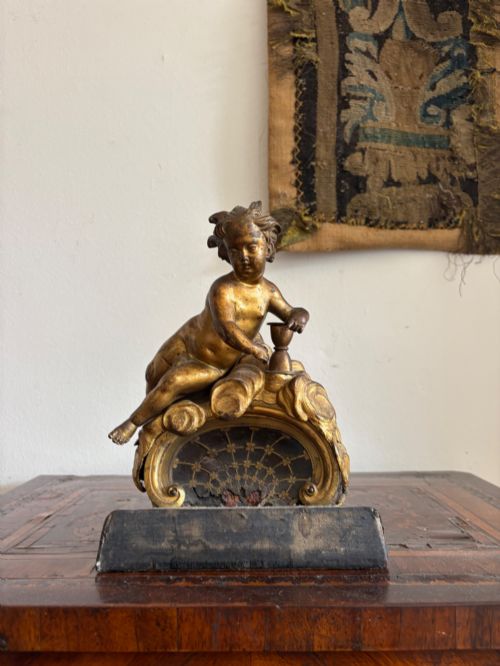
- A plump, naked male child depicted in classical art, often winged and styled as a cupid or cherub. These figures appear widely as finials, mounts, or supporting elements on mantel clocks.
- Garniture
- A set of decorative objects designed to be displayed together, typically comprising a central clock flanked by matching candelabras, urns, or vases. They were made to adorn nineteenth-century mantelpieces.
- Cartel clock
- A wall clock housed in an ornate, scrollwork frame made of metal rather than wood. These pieces often feature rococo revival styling with prominent gilt mounts.
- Fusee
- A conical pulley used in clock movements to maintain an even pull on the gear train as the mainspring unwinds. It ensures more accurate timekeeping throughout the duration of the wind.
Putti Gilt Clock: Frequently Asked Questions
What is a putti gilt clock?
A putti gilt clock is a nineteenth-century timepiece featuring gilded metal mounts and sculptural child figures known as putti or cherubs. These pieces draw heavily on French rococo and classical revival aesthetics.
They serve as both functional timepieces and ornamental centerpieces, often accompanied by matching garniture sets for mantel display.
How do I identify French and English pieces?
French examples from this selection frequently utilise ormolu combined with white or red marble, adhering to Louis XVI or Rococo revival styles. English pieces often employ single fusee movements and simpler gilt bronze cases.
Maker signatures on the dial or movement backplate also help distinguish origin, with Parisian firms favoring elaborate bronze casting and London makers focusing on mechanical precision.
What is a clock garniture?
A clock garniture is a matched set consisting of a central mantel clock and two flanking objects, such as candelabras or vases. They were manufactured as unified decorative schemes for formal rooms.
These sets share identical materials, gilding styles, and sculptural motifs like cherubs and floral mounts across all three pieces.
How should I care for ormolu and marble?
Ormolu surfaces require gentle dusting with a soft, dry brush to prevent accumulation in the recesses of the cast decoration. Moisture and chemical cleaners should be avoided, as they damage the historic gilding.
Marble bases can be wiped with a slightly damp cloth, followed immediately by drying to protect the polished stone from staining.