
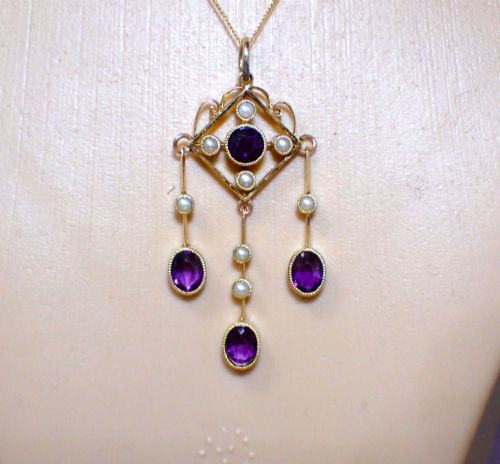


Purple Stone Necklace
A purple stone necklace brings together deep violet hues and precious metals, offering a wearable piece of history for daily wear.
Purple Stone Necklace
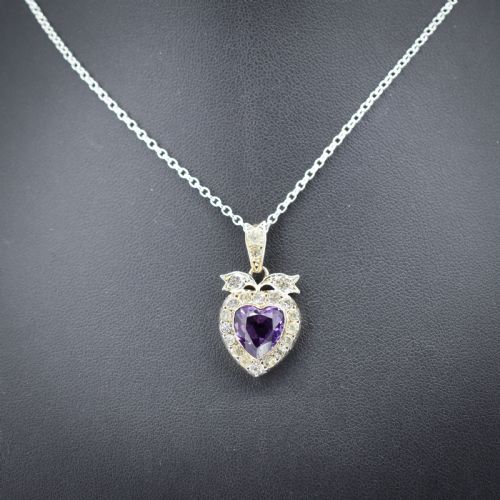
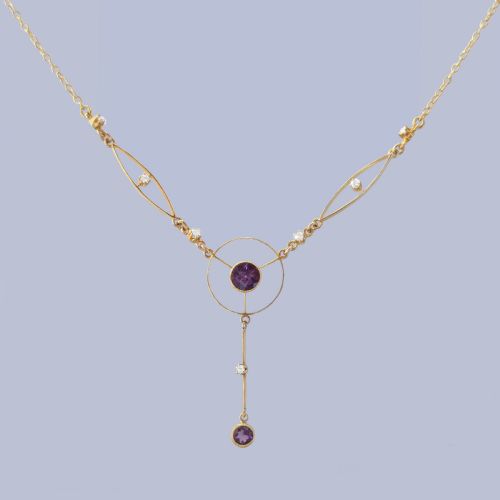
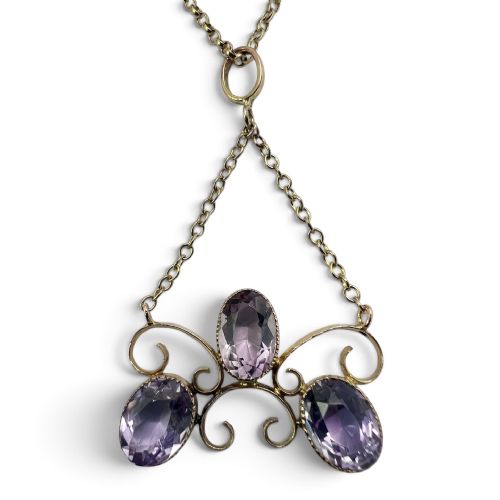
A purple stone necklace centres on violet or purple gems, most frequently amethyst alongside paste, mounted in pendants, lavalier drops, and chains. These pieces span periods from the Victorian and Edwardian eras through to the mid-twentieth century.
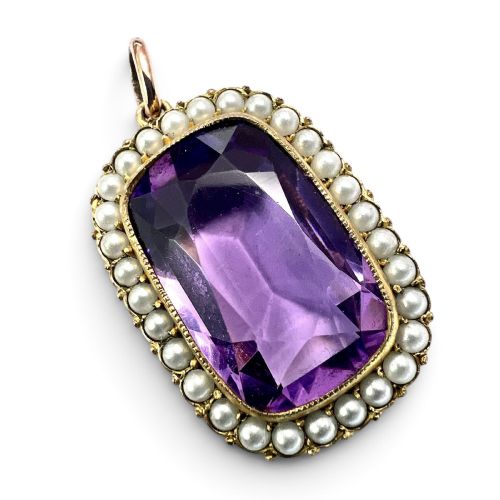
Buyers encounter Victorian clusters, Edwardian lavalier pendants, and later twentieth-century gold and silver designs. The forms range from simple drop pendants to intricate foliate clusters set with seed pearls and diamonds.
Originating across the nineteenth and twentieth centuries, these items reflect changing jewellery fashions from heavy gold lockets to delicate silver Art Nouveau work.
Materials and construction
Gems such as amethyst are combined with precious metals including nine-carat, fifteen-carat, and eighteen-carat gold, as well as silver and white gold. Seed pearls and diamonds often accent the central purple stones.
Craftsmen utilised traditional setting techniques to mount large faceted amethysts within gold claws, yellow gold bezels, or silver collets. Pendant mounts frequently incorporate delicate wirework, foliate motifs, and articulated drops.
Purple Stone Necklace Retail Price Guide 2026
Typical asking prices for purple stone necklace among the pieces listed under this phrase on Sellingantiques today, from the lower quarter to the upper quarter. They describe what is for sale here now, not the wider market.
Listings feature amethysts, diamonds, seed pearls, and paste set in gold and silver across Victorian and Edwardian periods.
Assessing quality
Quality rests in the depth of colour and clarity of the central purple stone, alongside the weight and purity of the gold or silver mount. Heavier gold content and well-matched seed pearls elevate a piece above standard production.
The finesse of the metalwork distinguishes superior examples, particularly in Edwardian lavaliers and Art Nouveau designs where openwork framing and integrated chain links require precise hand assembly.
S. Blanckensee & Son
The Purple Stone Necklace Glossary
- Lavalier
- A pendant necklace featuring a central gemstone with one or more dangling drops suspended below. This style gained immense popularity during the Edwardian period.
- Paste
- Hand-cut glass used as a gemstone substitute in antique jewellery. High-grade paste mimics the brilliance of genuine stones.
- Seed pearl
- Very small, naturally saltwater pearls often drilled and strung or used as accents in cluster and halo settings. They define Victorian and Edwardian pearl work.
- Foliate
- Ornamentation shaped like leaves or foliage. This motif appears frequently in Victorian and Arts and Crafts metalwork.
- Collet
- A band of metal that holds a gemstone in place by its girdle. It forms a secure edge around the stone.
Purple Stone Necklace: Frequently Asked Questions
What periods do these necklaces come from?
The pieces span the Victorian, Edwardian, and Art Nouveau eras, extending into mid-century twentieth-century designs.
Victorian and Edwardian examples predominate, accompanied by later twentieth-century silver and gold pieces.
What metals are used in these mountings?
Mounts utilise various grades of gold, including nine-carat, fourteen-carat, fifteen-carat, and eighteen-carat yellow gold.
Silver and white gold also appear in Edwardian, Arts and Crafts, and mid-century items.
How do I care for a purple stone necklace?
Amethyst and pearls require gentle cleaning with warm soapy water and a soft cloth, avoiding harsh ultrasonic cleaners.
Store the necklace flat in a dedicated box to prevent delicate chains and pendant drops from tangling or scratching.