



Purple Stone Gold Necklace
A purple stone gold necklace brings together rich purple amethyst and warm gold in pieces spanning the Victorian and Edwardian eras up to the mid twentieth century.
Purple Stone Gold Necklace
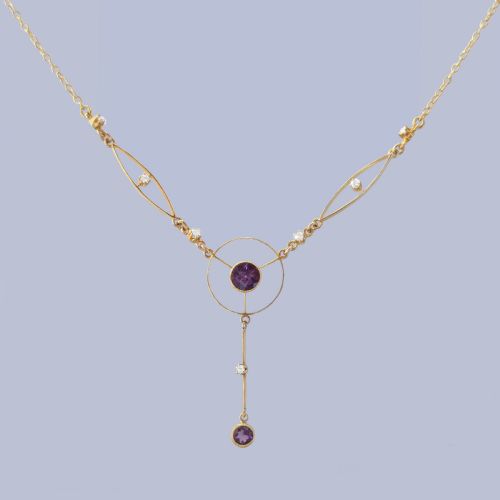
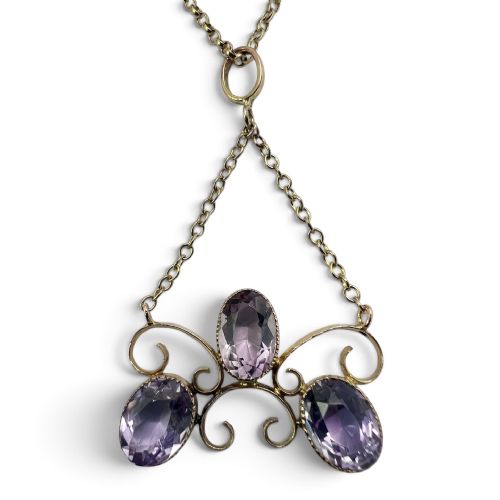
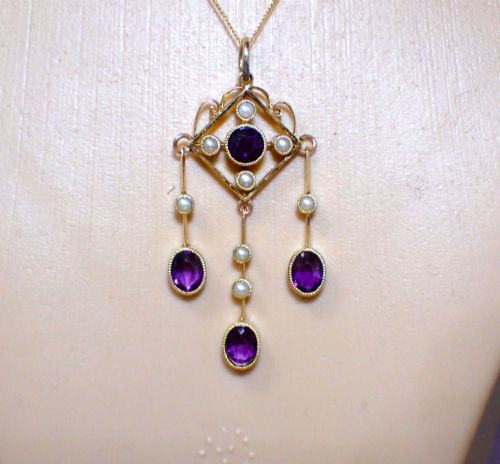
A purple stone gold necklace centres on rich purple quartz set in yellow or white gold, spanning Victorian, Edwardian, and later twentieth century periods. The most frequent versions on this page are Edwardian lavalier pendants and Victorian cluster necklaces incorporating seed pearls or diamonds.
The objects take various forms including drop necklaces, lockets, and pendant necklaces set with stones ranging from modest quartz to large amethysts exceeding twenty carats. Makers such as S. Blanckensee & Son contributed to the variety of pendant designs seen across these eras.
Victorian and Edwardian examples lean into foliate motifs and halo arrangements, while mid-century pieces favour cleaner cluster and drop formations in nine carat or fourteen carat gold. These jewels served as decorative ornaments and keepsakes, often combining amethysts with pearls or old cut diamonds.
Quality factors
Quality rests upon the depth of colour and saturation within the amethyst, alongside the precision of the gold wirework and stone setting. Heavier carat gold mounts and well-matched seed pearls or clean old cut diamonds elevate the finer examples.
Design complexity also distinguishes standard production from superior pieces, particularly in articulated Edwardian lavaliers and detailed Victorian foliate pendants. Maker attribution and the overall integrity of the original gold chain or mount contribute further distinction.
Purple Stone Gold Necklace Retail Price Guide 2026
Typical asking prices for purple stone gold necklace among the pieces listed under this phrase on Sellingantiques today, from the lower quarter to the upper quarter. They describe what is for sale here now, not the wider market.
Listings include amethysts paired with nine, fifteen, and eighteen carat yellow and white gold across Victorian, Edwardian, and mid-century periods.
S. Blanckensee & Son
The Purple Stone Gold Necklace Glossary
- Lavalier
- A pendant necklace featuring a suspended central drop, popular during the Edwardian period. This design often incorporates swinging stone elements connected by fine gold links.
- Seed pearl
- A very small, naturally formed pearl used extensively in Victorian and Edwardian cluster and halo mountings. These tiny pearls accent the purple stone through delicate border work.
- Old cut diamond
- A hand-faceted diamond shape common in nineteenth and early twentieth century jewellery. These stones display smaller tables and wider culets than modern brilliant cuts.
- Cluster
- A stone arrangement where a central gem is surrounded by a ring of smaller stones. This format highlights the main purple quartz using contrasting pearls or diamonds.
- Foliate
- A decorative style inspired by leaves and plant forms, seen frequently in Victorian and Art Nouveau metalwork. This organic ornamentation frames the central amethyst.
Purple Stone Gold Necklace: Frequently Asked Questions
How do I date a gold necklace?
Dating relies on stylistic clues like Victorian foliate framing or Edwardian lavalier drops, alongside the gold purity standards marked on the piece. Hallmarks and fastener types also offer chronological markers.
Later twentieth century pieces introduce different chain construction and cleaner cluster designs distinct from earlier handmade settings.
What gold purities are used?
Listings feature nine carat, fourteen carat, fifteen carat, and eighteen carat yellow and white gold. Higher purities like fifteen and eighteen carat appear more frequently in older Victorian and Edwardian items.
Nine carat gold becomes more common in later twentieth century productions and specific Edwardian chain necklaces.
Are the purple stones natural amethysts?
The purple stones are primarily natural amethysts, though paste alternatives appear in specific twentieth century retro pieces. Gemstone weights vary significantly from modest sizes to substantial multi-carat centre stones.
Inclusions and colour zoning often help identify natural quartz within these antique settings.
How should I care for my necklace?
Amethyst requires gentle cleaning with warm soapy water and a soft cloth, avoiding harsh ultrasonic cleaners or sudden temperature changes. Gold settings benefit from periodic professional checks to ensure stone claws remain secure.
Storing the necklace flat in a lined box prevents the delicate gold chains from tangling or kinking.