



Gold Openwork Lavalier
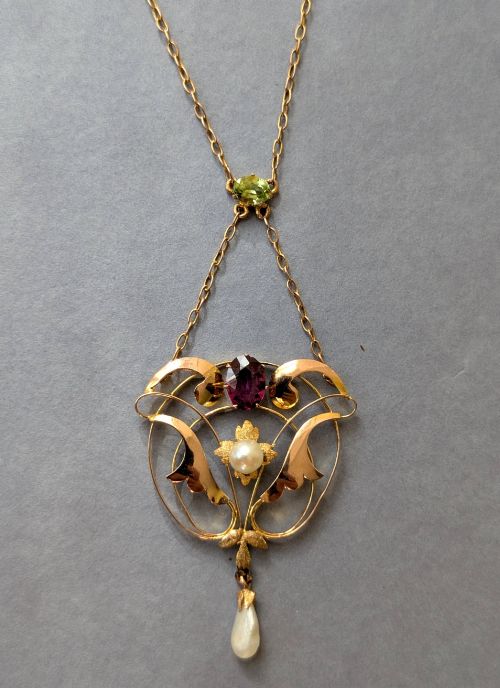
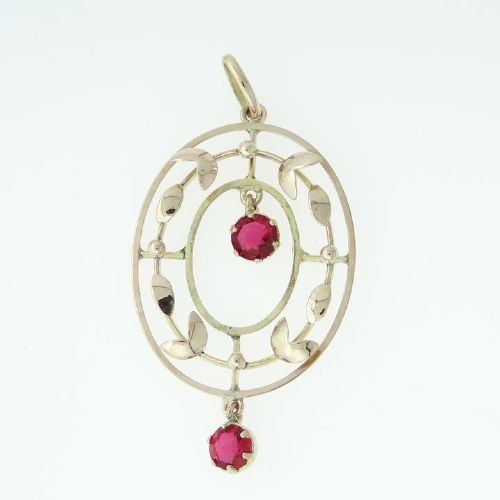
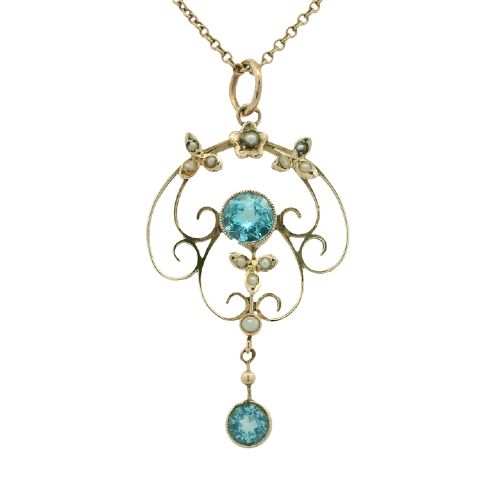
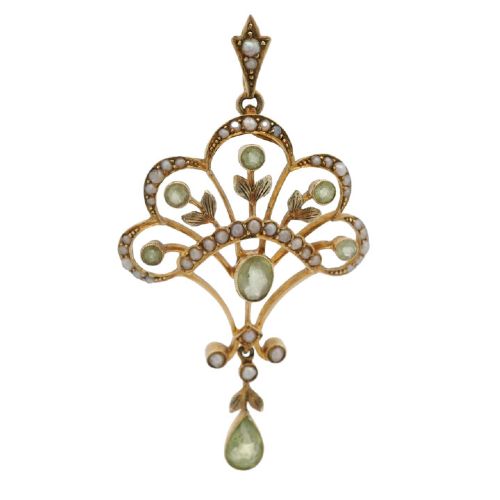
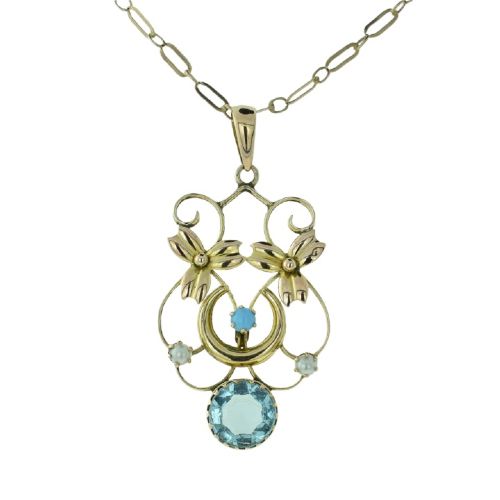
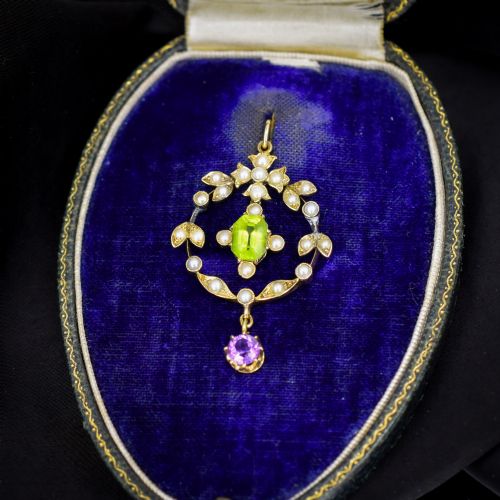
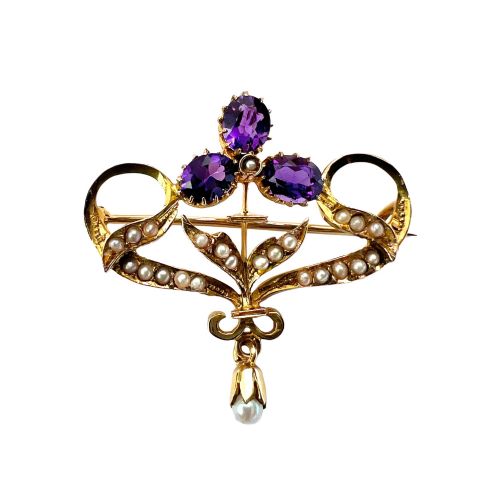
A gold openwork lavalier hangs as a delicate pendant, offering the intricate wirework and suspended gemstones that define early twentieth-century jewellery.
Gold Openwork Lavalier
A gold openwork lavalier is a pendant defined by its delicate, pierced metal framework and dangling gemstone drops, originating predominantly from the Edwardian and Victorian eras. These pieces often incorporate foliate motifs and asymmetrical lines typical of the Art Nouveau movement alongside structured Edwardian designs.
The versions most commonly met on this page span from the late nineteenth century to the early decades of the twentieth century, rendered in both nine-carat and fifteen-carat gold. They frequently suspend central coloured stones such as amethyst, peridot, aquamarine, or blue topaz, accompanied by seed pearls.
Materials and construction
Goldsmiths constructed these pendants using nine-carat and fifteen-carat yellow, rose, and white gold, shaping the metal into intricate wirework frames. Piercing and soldering techniques allowed artisans to create lightweight openwork designs that maximised the play of light through the metal.
Gemstones such as peridot, amethyst, aquamarine, and turquoise were bezel or claw set into the framework, often accented by small seed pearls secured on tiny posts or wired in place.
Gold Openwork Lavalier Retail Price Guide 2026
Typical asking prices for gold openwork lavalier among the pieces listed under this phrase on Sellingantiques today, from the lower quarter to the upper quarter. They describe what is for sale here now, not the wider market.
Distinctions in quality
Quality in a gold openwork lavalier rests on the precision of the piercing and the delicacy of the wirework. Finer examples show crisp symmetry, secure stone settings without excess solder, and balanced proportions between the main frame and the suspended drops.
The choice of gold purity also marks a distinction, with fifteen-carat pieces typically offering a richer metal presence alongside carefully matched, high-clarity gemstones and finely graded seed pearls.
S. Blanckensee & Son
The Gold Openwork Lavalier Glossary
- Lavalier
- A pendant featuring one or more suspended drops that hang below the main body. This style gained immense popularity during the late nineteenth and early twentieth centuries.
- Openwork
- Metalwork that has been pierced or cut through to create a patterned, lace-like background. It reduces the weight of the piece while increasing visual complexity.
- Seed pearl
- A very small, naturally formed or early cultured pearl, often half-drilled and glued or pegged onto a tiny metal post. These are frequently used in clusters or borders on Edwardian jewellery.
- Foliate
- Ornamentation that incorporates leaf motifs and plant-based curves. This style is common in pieces from the Art Nouveau and late Victorian periods.
Gold Openwork Lavalier: Frequently Asked Questions
How do I wear a lavalier?
These pendants suspend gracefully from fine gold chains, resting near the collarbone or slightly lower depending on the original chain length.
Because of their delicate openwork frames and dangling drops, they pair well with simpler necklines that allow the intricate metalwork and gemstones to remain the focal point.
Are these pendants fragile?
The fine wirework and delicate drop components require gentle handling during wear and storage. Removing the pendant before sleeping or strenuous activity protects the small seed pearls and thin gold links.
Storing each piece in an individual compartment prevents the openwork from catching on other items in a jewellery box.
How do I date a lavalier?
Dating relies on stylistic clues such as the flowing asymmetry of Art Nouveau lines or the balanced geometry typical of Edwardian design. Hallmarks stamped on the reverse or the jump ring provide further confirmation of the gold purity and assay office.
The choice of gemstones, such as peridots and amethysts paired with seed pearls, also points directly towards the late Victorian and Edwardian eras.
Can these be worn as brooches?
Some examples are constructed with a pin mechanism alongside the pendant bail, allowing them to function as both brooches and necklaces. This versatility was common in the Edwardian period when multi-functional jewellery was highly prized.
Checking the reverse reveals whether a secure pin and catch accompany the suspension loop.