
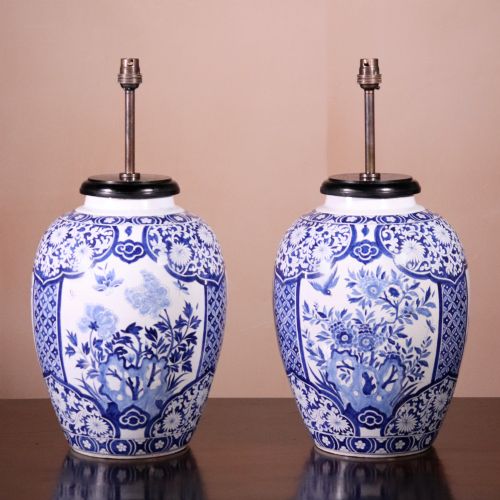


Porcelain Ginger Jar Lamp
Porcelain ginger jar lamps are converted vessels brought into domestic lighting through periods spanning the eighteenth to the twentieth centuries.
Porcelain Ginger Jar Lamp
A porcelain ginger jar lamp takes a traditional ceramic vessel, originating mostly from Chinese, Japanese, or European workshops, and adapts it for modern table illumination. Buyers search for these pieces to introduce classical ceramic forms and hand-painted decoration into interiors.
The versions most commonly met on this page date from the nineteenth century, though eighteenth-century examples and twentieth-century interpretations also appear. These lamps typically combine blue and white, Famille Rose, Famille Verte, or powder blue colour palettes with fitted electrical components.
Many items begin life as lidded vases or ginger jars before conversion, retaining their substantial body proportions while supporting fabric shades. They exist as single pieces or balanced pairs, often paired with wooden, brass, or ormolu bases.
How they were made
Makers shaped these bodies from hard-paste porcelain or tin-glazed earthenware, applying mineral pigments by hand before high-temperature kiln firing. Artisans frequently utilised cobalt blue underglazes or polychrome enamels in Famille Rose and Famille Verte styles.
Metalworkers added structural stability and decorative enrichment through brass, tin, and ormolu mounts, attaching them securely to the ceramic base. Silk, fabric, and gold leaf elements appear in the wider assembly of the finished lighting fixtures.
Porcelain Ginger Jar Lamp Retail Price Guide 2026
Typical asking prices for porcelain ginger jar lamp among the pieces listed under this phrase on Sellingantiques today, from the lower quarter to the upper quarter. They describe what is for sale here now, not the wider market.
Listings feature porcelain, brass, silk, and ormolu materials across pieces dated from the eighteenth to the twentieth centuries.
What varies in quality
Quality rests upon the crispness of the hand-painted ceramic decoration and the depth of the glaze, whether in crackleware, powder blue, or intricate Chinoiserie scenes. Superior pieces display precise brushwork and balanced potting that command attention.
The integration of metal mounts, such as cast ormolu or turned brass, distinguishes finer examples from simpler conversions. The harmony between the ceramic vessel and its auxiliary fittings determines the overall visual success of the lamp.
The Porcelain Ginger Jar Lamp Glossary
- Famille Rose
- A palette of opaque enamel colours dominated by pink, introduced during the Qing dynasty. This palette allows for delicate shading on floral and figurative motifs.
- Famille Verte
- A translucent green enamel overarching ceramic decoration, prominent in nineteenth-century Chinese export wares. It often combines with iron red, yellow, and blue pigments.
- Ormolu
- Gilded bronze used for decorative mounts and bases. It provides a bright golden contrast to the porcelain body.
- Crackleglaze
- A deliberate network of fine fractures in the ceramic glaze. This surface texture adds visual depth to blue and white vases.
- Chinoiserie
- European artistic interpretations of Chinese and East Asian decorative styles. This aesthetic shaped much of the porcelain production seen in Georgian and later periods.
Porcelain Ginger Jar Lamp: Frequently Asked Questions
How do I choose the right lamp size?
Consider the height and proportion of the porcelain body in relation to your table space. Taller jars require sturdy bases and appropriately scaled shades.
Matching pairs provide symmetry for sideboards, whilst single vessels suit smaller reading tables.
Are these lamps converted from old vases?
Many examples began as traditional lidded ginger jars or decorative vases before receiving electrical fittings. The original ceramic bodies retain their historical character.
Conversion methods vary according to the period and the workshop that handled the adaptation.
How should I clean porcelain lamp bodies?
Dust the ceramic surface gently with a soft, dry cloth to protect the painted enamels and glazes. Avoid abrasive cleaners that might damage the surface.
Metal mounts require separate care suited to brass, tin, or ormolu finishes.
What periods do these lamps represent?
The selection spans from the eighteenth century through the nineteenth century and into the twentieth century. Styles include Qing dynasty aesthetics, Japanese Meiji pieces, and European interpretations.
Each era brings distinct glazing techniques and decorative motifs to the ceramic forms.