





Porcelain Couple Statuette
These porcelain couple statuettes bring nineteenth-century cabinet elegance to a room, offering finely modelled pairs in traditional glazed and biscuit finishes.
Porcelain Couple Statuette
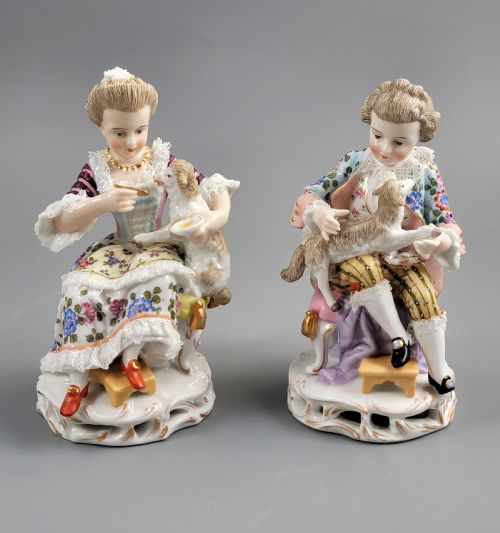
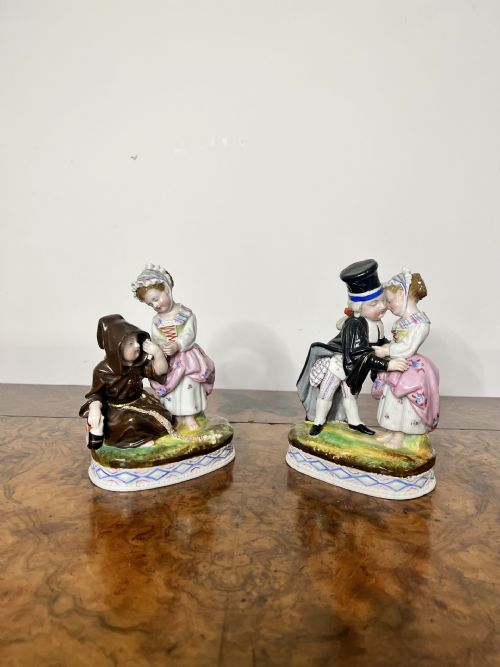
A porcelain couple statuette represents a paired grouping of figures, commonly appearing in nineteenth-century continental and English workshops. These decorative pieces take the form of shepherds, musicians, children, and gardeners, modelled closely after earlier eighteenth-century prototypes.
The versions most commonly met on this page belong to the Victorian era and the broader nineteenth century, originating from German factories such as Sitzendorf, Volkstedt, and Dresden, alongside French and English makers. They typically arrive as matched pairs designed to sit together on a mantelpiece or cabinet top.
Makers utilised various decorative themes, ranging from rustic idylls to formal musical scenes, reflecting the prevailing revival styles of the period. The figures capture detailed period costumes enhanced with delicate hand-painting and applied elements.
How they were made
Painters applied enamel colours and gold leaf by hand over or under the glaze, depending on whether the factory aimed for a bright, reflective surface or the matte texture characteristic of biscuit porcelain. A subsequent low-temperature firing fixed the colours and gilding permanently to the body.
Porcelain Couple Statuette Retail Price Guide 2026
Typical asking prices for porcelain couple statuette among the pieces listed under this phrase on Sellingantiques today, from the lower quarter to the upper quarter. They describe what is for sale here now, not the wider market.
Miniature lambs and pet dogs frequently join the human musicians and gardeners in these fragile ceramic scenes.
What varies in quality
Colour application and gilding execution also separate standard workshop output from exceptional studio work. Precise enamel brushwork and carefully applied gold leaf elevate the decorative impact, whereas heavy or hasty painting obscures the underlying porcelain form.
Volkstedt Porcelain·Chantilly·Sitzendorf Porcelain·Samson Porcelain·Royal Capodimonte Factory·Minton·Carl Thieme·Triebner Ens And Co
The Porcelain Couple Statuette Glossary
- Biscuit porcelain
- Unglazed fired ceramic that presents a matte, marble-like surface texture. This finish highlights fine sculptural details without the distraction of surface shine.
- Hard-paste porcelain
- A dense, vitrified ceramic composition fired at high temperatures. It resists scratching and provides a durable base for delicate figurines.
- Enamel
- Coloured vitreous glass powder fused to the porcelain surface during a second firing. It delivers the vibrant hues seen on period costumes and floral details.
- Gold leaf
- Extremely thin sheets of beaten gold applied to the porcelain for decorative highlights. It brings warmth and contrast to the painted scenes.
- Slip
- Liquid clay suspension poured into moulds to form hollow ceramic shapes. It allows complex figurine designs to be replicated consistently.
Porcelain Couple Statuette: Frequently Asked Questions
What are porcelain couple statuettes?
These pieces are decorative nineteenth-century ceramic figures depicting pairs of people, such as musicians, gardeners, or shepherds. They were produced primarily in European factories to ornament bourgeois interiors.
Cabinet makers and collectors prized them for their intricate hand-painted details and delicate sculptural forms, often arranged symmetrically as matched pairs.
How were these figures used originally?
Victorian households placed these statuettes on mantelpieces, side tables, and enclosed glass cabinets as conversation pieces. They served a purely decorative function, reflecting the owner's taste for historical revival styles.
Owners frequently displayed them in matched pairs to balance mantel displays or anchor the corners of a formal room.
How should I clean porcelain statuettes?
Dust these delicate pieces gently using a soft, dry artist's brush to remove particles from crevices and applied floral elements. Avoid using water, harsh detergents, or immersion, which can damage delicate enamel paints and nineteenth-century gilding.
Keep them away from direct sunlight and areas prone to heavy vibrations to protect their fragile extremities from accidental damage.
How do I identify the period of a figurine?
Examine the base for factory marks, impressed numbers, and the character of the paste, which helps separate nineteenth-century productions from later copies. Stylistic cues like Rococo Revival moulding and hand-painted enamel palettes also point towards the Victorian era.
Comparing the modelling sharpness and the type of glaze used against documented factory examples provides further confirmation of origin and date.