
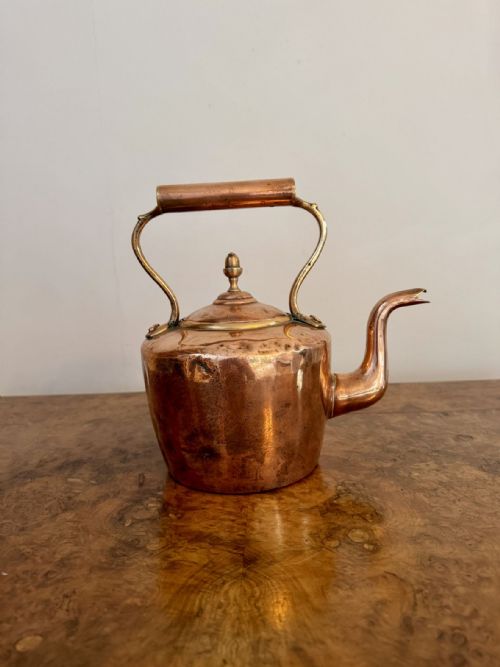


Polished Copper Tea Pot
A polished copper tea pot brings a warm, reflective surface and honest metalwork to the hearth, offering functional history for everyday use.

Polished Copper Tea Pot
When searching for a polished copper tea pot, a buyer seeks hearth vessels designed for heating water, encompassing small kettles and large oval shapes. The material delivers a bright, metallic lustre that reflects room light and warms the kitchen or living space.
The versions most likely to be met on this page belong to the Georgian and Victorian eras, specifically around eighteen hundred. These pieces demonstrate traditional forms fashioned for daily service over an open fire or stove.
Construction and materials
These vessels rely primarily on heavy gauge copper hammered and joined to withstand intense heat. Brass components often appear as contrasting handles or mounts, adding structural rigidity and visual variety.
Wood is utilised in handles or insulators to protect the hand from heat. Smiths shaped the bodies into compact or oval profiles using hand-beaten techniques typical of the period.
Current listings span the Georgian and Victorian periods, featuring copper bodies combined with brass and wood elements.
Judging quality
Quality rests in the weight of the metal and the crispness of the form, separating utilitarian vessels from finer examples. Superior specimens display careful shaping of the oval body and balanced proportions between handle and spout.
The integration of brass and wood fittings also dictates the grade of the piece. Well-preserved surfaces that maintain their reflective polish without excessive thinning of the copper wall denote a higher standard of survival.
The Polished Copper Tea Pot Glossary
- George III
- A stylistic and regnal period spanning the late eighteenth and early nineteenth centuries. Pieces from this era often feature traditional hand-beaten construction.
- Oval shaped
- A descriptor for body profiles that deviate from simple circles. This form provides a broader base for heat absorption.
- Copper
- A ductile metallic element valued for its thermal conductivity and reddish-brown hue. It forms the primary body of these heating vessels.
- Brass
- An alloy of copper and zinc utilised for contrasting mounts and fittings. Its golden tone complements the reddish copper body.
Polished Copper Tea Pot: Frequently Asked Questions
Are these kettles safe for boiling water?
These historical vessels were originally designed for hearth use and boiling water over heat sources. Modern users often assess internal linings before practical application.
Many collectors prefer to maintain them purely as decorative objects to preserve their historical surface finish and polished appearance.
How do I date a copper kettle?
Dating relies on examining the manufacturing marks, construction techniques, and handle materials. George III and Victorian examples show distinct shifts in body shaping.
Comparing the profile, such as compact versus large oval shapes, helps place the vessel within the nineteenth century.
What is the difference between George III and Victorian styles?
George III examples typically date from around eighteen hundred and display hand-wrought proportions. They often feature simple, sturdy lines suited to open hearths.
Victorian pieces reflect later nineteenth-century manufacturing methods, sometimes introducing heavier mounts and different handle configurations.
How should I clean polished copper?
Maintaining the reflective finish requires specialised metal cleaners formulated for copper. Gentle application preserves the bright surface without wearing away the metal.
Avoid abrasive scouring pads that can scratch the polished sheen and diminish the historical character of the vessel.