




Platinum Gold Brooch
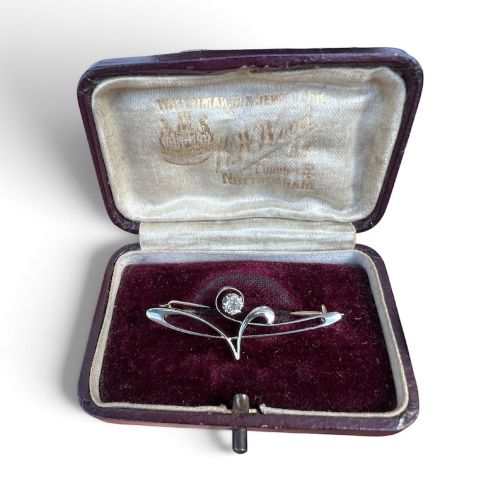
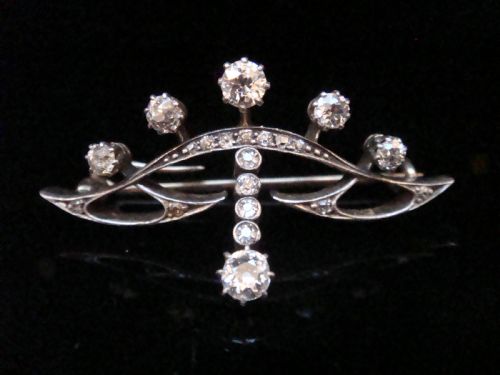
A platinum gold brooch brings together durable precious metals and old cut diamonds, spanning periods from Victorian to Art Deco.
Platinum Gold Brooch
A platinum gold brooch unites the strength of platinum with the warmth of yellow or white gold, serving as a versatile fastening or pendant.
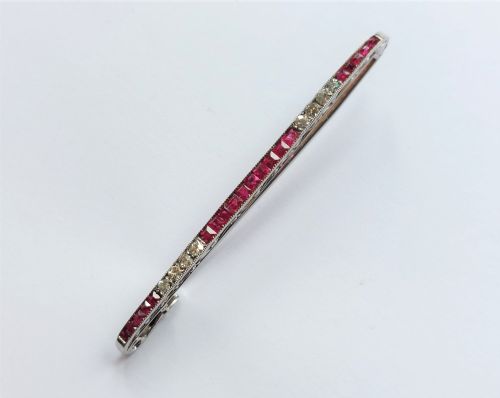
Most examples found here date from the Edwardian era, the 1920s Art Deco period, and the late Victorian years, taking shapes like bars, crescents, and bows.
Makers often shaped these pieces into natural motifs such as birds, flowers, and ribbons alongside geometric bar layouts.
Materials and construction
Goldsmiths combined platinum settings with 9ct, 14ct, 15ct, or 18ct gold to mount diamonds, rubies, sapphires, emeralds, and pearls.
Platinum allowed artisans to form delicate, strong claws and millegrain edges that held small stones securely without heavy metal surrounds.
Look closely for the flying duck and sheaf of wheat motifs hidden amongst the geometric bar brooches.
Assessing craftsmanship and materials
The standard of a piece rests on the precision of the stone setting, the symmetry of the metalwork, and the clarity or cut of the diamonds and coloured gems.
Gems with uniform colour, intact pearls, and crisp millwork distinguish the finer examples from simpler production.
Paillette
The Platinum Gold Brooch Glossary
- Millegrain
- A decorative technique featuring a row of tiny raised metal beads along the edge of a setting. It gives a soft texture to platinum borders.
- Old Cut
- A diamond cut style predating modern round brilliants, characterised by a smaller table and larger facets. These stones catch candlelight effectively.
- Bar Brooch
- A horizontal pin form popular across Victorian and Edwardian periods. It often centres on a single stone or a cluster.
- Pendant Brooch
- A dual-purpose jewel fitted with both a pin and a loop. This allows the wearer to pin it to clothing or hang it from a chain.
Platinum Gold Brooch: Frequently Asked Questions
How do I wear a platinum gold brooch?
These pieces pin securely to lapels, scarves, and heavy fabrics using traditional pin and c-clasp or safety mechanisms.
Several designs also feature hidden loops that transform the pin into a necklace pendant.
What periods do these brooches come from?
The selection spans the Victorian, Edwardian, and Art Deco eras, extending into mid-century designs.
Edwardian and 1920s pieces make up the largest share of the available inventory.
What stones are set in these pieces?
Diamonds predominate, often accompanied by rubies, sapphires, emeralds, pearls, onyx, and opals.
Combinations of pearls and diamonds appear frequently in Edwardian bar brooches.
How do I care for my brooch?
Clean platinum and gold settings gently with warm soapy water and a soft brush, avoiding harsh chemical dips.
Store pearls and softer gemstones separately to prevent scratching the metal or softer stones.