
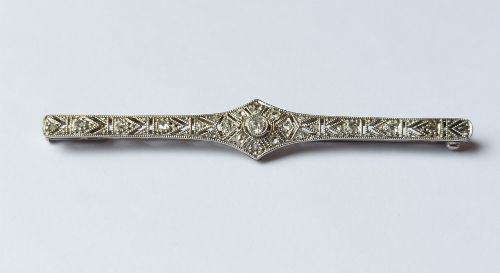
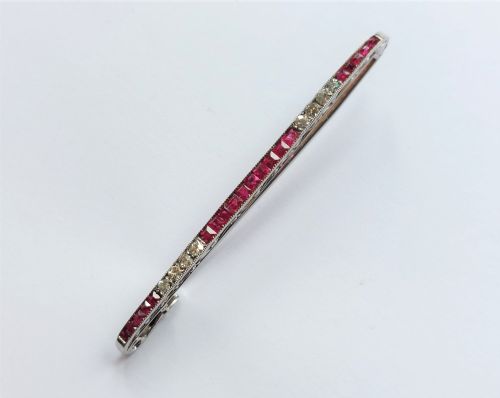


Platinum Art Deco Brooch
A platinum art deco brooch brings together crisp geometry and exceptional metalwork, offering a wearable piece of twentieth-century design history.
Platinum Art Deco Brooch
A platinum art deco brooch is defined by its striking geometric lines, architectural forms, and strong association with the 1920s and 1930s. When searching for a platinum art deco brooch, buyers encounter bar brooches, flexible double clip pendants, and intricate bow or arrow motifs.
The material palette of a platinum art deco brooch relies heavily on the bright, enduring strength of platinum often paired with 18ct gold, while incorporating contrasting gemstones like onyx, rubies, sapphires, and emeralds. Many examples focus on substantial diamond carat weights, ranging from delicate accent stones to prominent central gems.
Originating predominantly from the early twentieth century, these pieces reflect the stylistic shifts away from Edwardian filigree toward bolder modernist shapes. Collectors frequently find convertible pieces that transition from a brooch to a pendant or form part of a necklace.
Assessing Quality
The quality of a platinum art deco brooch rests upon the architectural precision of its metalwork and the uniformity of its gemstone grouping. Superior examples display seamless symmetry in their geometric layouts, where every individual diamond or coloured stone matches in cut, colour, and brilliance.
Distinction also lies in the complexity of the design, such as convertible double-clip mechanisms that detach to form separate dress clips or pendants. Maker attribution and the clarity of platinum hallmarks further elevate an item, showing the hand of skilled workshops from Paris, London, or Sweden.
The listings show platinum combined predominantly with diamonds, onyx, rubies, sapphires, and pearls across the 1920s and 1930s.
Cartier Paris·Paillette·Liberty London
The Platinum Art Deco Brooch Glossary
- Platinum
- A dense, durable white metal prized in jewellery for its strength, allowing for ultra-fine wirework and secure gemstone settings without tarnishing.
- Old Cut Diamond
- A vintage diamond cutting style characterised by a small table, high crown, and large culet, designed to catch candlelight and early electric illumination.
- Bar Brooch
- A long, slender horizontal pin format popular in the early twentieth century, frequently set with a central cluster of diamonds or coloured gemstones.
- Double Clip Brooch
- A versatile jewel comprising two symmetrical clips that lock together on a shared frame to form a single large brooch or detach for wear on lapels.
- Millgrain
- A decorative border of tiny raised metal beads rolled along the edge of a platinum setting to give a soft, textured finish.
Platinum Art Deco Brooch: Frequently Asked Questions
How do I wear a platinum art deco brooch today?
These pieces pin securely onto heavy winter coats, velvet blazers, or silk scarves, adding an immediate focal point to modern tailoring.
Many heavier or convertible versions double as pendants when suspended from a simple chain, offering versatile styling options for evening wear.
Are these brooches suitable for daily wear?
Platinum is exceptionally durable and resists daily wear well, making the metal framework robust enough for regular rotation if handled carefully.
However, because many pieces feature delicate old-cut stones in open-backed settings, it is sensible to store them in a dedicated box and avoid wearing them during vigorous physical tasks.
How can I tell the difference between Edwardian and Art Deco pieces?
Edwardian designs tend to feature soft garland motifs, flowing platinum lace, and light white-on-white diamond arrangements that echo nineteenth-century romanticism.
In contrast, art deco pieces introduce rigid symmetry, sharp angles, and bold contrasts created by dark onyx or bright rubies and sapphires.
What is a convertible brooch pendant?
A convertible brooch pendant is a clever piece of engineering that allows the main decorative section to detach from its pin mechanism and slide onto a necklace chain.
This dual functionality was particularly popular during the 1920s and 1930s, allowing women to transition day wear into evening attire seamlessly.