


Pink Sevres Style Clock
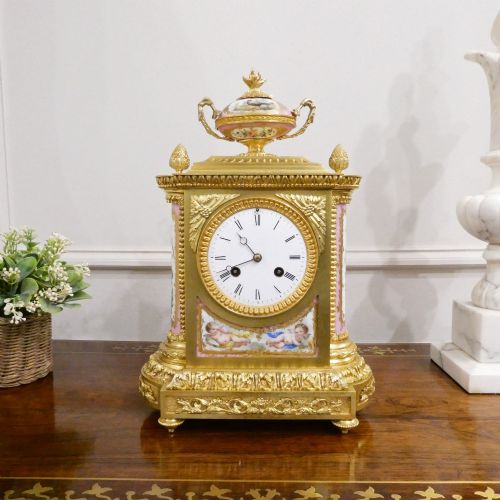
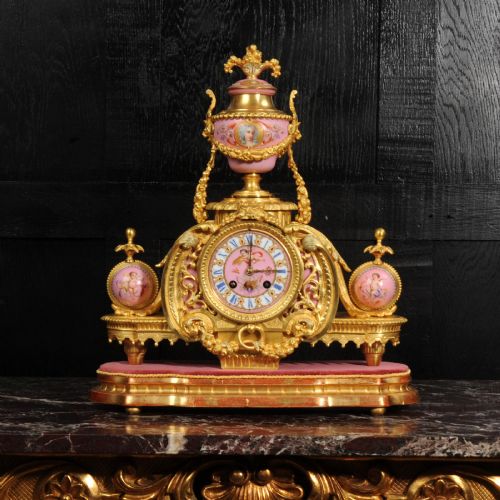
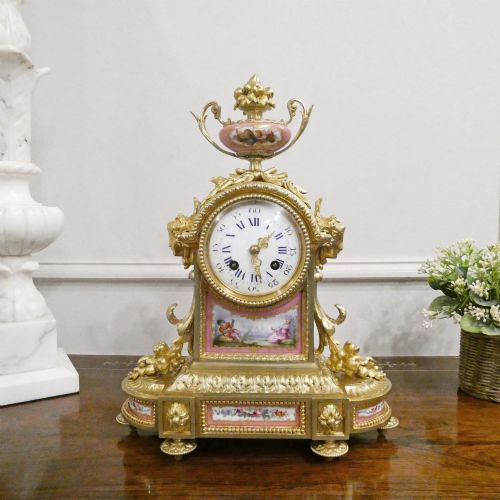
These pink sevres style clock examples bring ornate French charm to a mantelpiece through porcelain panels and rich metallic mounts.
Pink Sevres Style Clock
A pink sevres style clock combines vibrant pink porcelain components with decorative metal mounts in revival styles. These objects take the form of mantel clocks designed to sit prominently in a nineteenth century interior.
Most examples found here date from the Victorian era and the decades between eighteen sixty and eighteen eighty. The aesthetic draws heavily upon Louis XVI and French Rococo revival movements.
Makers housed these movements in cases constructed from gilt bronze, ormolu, and gilt metal, frequently incorporating enamel dials and glass elements. The resulting pieces reflect nineteenth century French manufacturing traditions.
Materials and construction methods
Makers constructed the primary case structures using cast ormolu, gilt bronze, and gilt metal to provide a bright metallic finish. These metal components were often chased and finished by hand to create elaborate surface details.
Porcelain panels, painted in distinctive pink tones, were set directly into the metal framework of the clock cases. Enamel was utilised for the clock face dials, carrying numerals that required careful kiln firing.
Materials recorded across the inventory include porcelain, ormolu, gilt bronze, velvet, and glass.
Distinctions in quality
Superior examples display crisp chasing on the ormolu and gilt bronze mounts, showing sharp relief and deliberate lines. Lesser pieces exhibit softer surface casting with blurred details in the metalwork.
The precision of the porcelain painting and the integration of the dial components separate standard production from finer workshop output. Mechanical execution by established makers also influences the standing of an individual clock.
Jean-Baptiste Delettrez·Achille Brocot·Japy Freres
The Pink Sevres Style Clock Glossary
- Ormolu
- Gilded bronze produced through a mercury amalgamation technique, common on nineteenth century French clock cases.
- Sèvres
- A French porcelain production style imitated across the nineteenth century, known for coloured ground panels and gilt decoration.
- Crystal Regulator
- A clock style featuring glass panels on multiple sides that reveal the internal movement and pendulum.
- Mantel Clock
- A decorative clock designed to stand upon a fireplace mantel or shelf.
Pink Sevres Style Clock: Frequently Asked Questions
What periods do these clocks date from?
The listings span the nineteenth century, with particular concentrations from eighteen sixty through to eighteen eighty.
Victorian era production and earlier centuries such as eighteen hundred are also represented in the recorded periods.
How were these clocks used originally?
These pieces served as functional timekeepers and decorative centrepieces within nineteenth century reception rooms and parlours.
Their ornate gilt and porcelain presentation made them status objects for prominent display on mantelpieces.
How do I care for a porcelain clock?
Keep the clock away from direct sunlight and sudden temperature changes to protect the porcelain glaze and painted panels.
Dust the gilt surfaces gently with a soft dry brush without applying chemical cleaning agents.
What styles influence these clock designs?
The aesthetic draws heavily from Louis XVI revival and French Rococo revival movements of the nineteenth century.
These historicist styles emphasise symmetry, classical foliage, and elaborate metal mounts.