
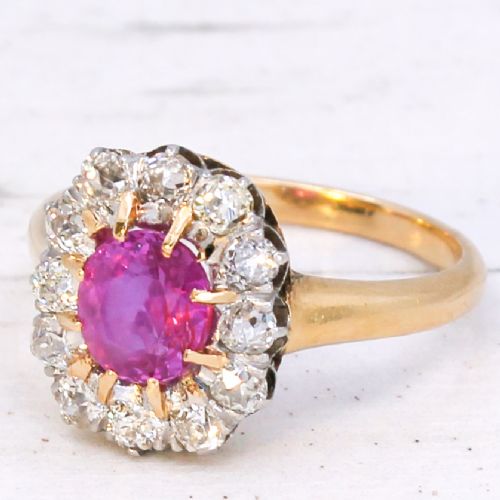

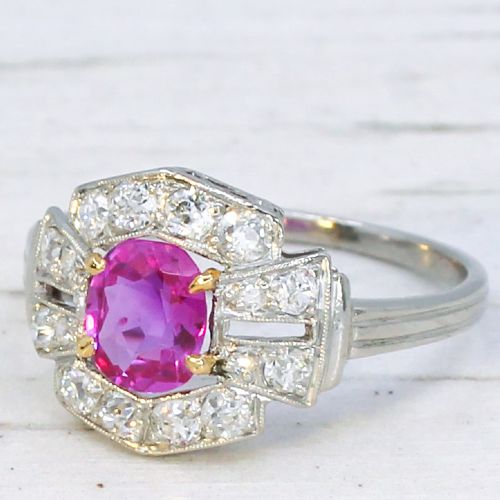


Pink Sapphire Engagement Ring
A pink sapphire engagement ring brings colour and character to the hand through surviving examples from the Edwardian, Art Deco, and Mid-Century periods.
Pink Sapphire Engagement Ring
A pink sapphire engagement ring sits among surviving jewellery forms originating from the early to mid-twentieth century. The selection spans the Edwardian era, the Art Deco period, and the Mid-Century decades, offering distinct design languages from each era.
Most pieces encountered here follow established configurations such as three-stone settings, cluster arrangements, or singular solitaires. Platinum and yellow gold serve as the primary precious metals shaping these mounts.
The central pink sapphires appear in various carat weights, often accompanied by accent diamonds in baguette or traditional cuts. Each piece reflects the aesthetic priorities of its specific decade, from Edwardian delicacy to the geometric lines of the 1920s and 1930s.
How they were made
Goldsmiths and jewellers utilised platinum and yellow gold to construct durable mounts capable of securing central pink sapphires and accent diamonds. Platinum gained particular favour during the Art Deco period for its strength and crisp appearance.
Gemstones received precise shaping, including baguette cuts for diamonds alongside traditional facets for sapphires. Stones were then set securely within metal bezels, prong arrangements, or clustered designs characteristic of the period.
Pink Sapphire Engagement Ring Retail Price Guide 2026
Typical asking prices for pink sapphire engagement ring among the pieces listed under this phrase on Sellingantiques today, from the lower quarter to the upper quarter. They describe what is for sale here now, not the wider market.
Every ring manages to hold a pink sapphire securely while keeping an Edwardian or Art Deco secret tucked away in its metalwork.
What varies in quality
The visual impact of a pink sapphire engagement ring depends upon the saturation and natural qualities of the central stone, alongside the precision of the surrounding diamond work. Unheated stones and larger carat weights distinguish particular pieces within the range.
The finesse of the metalwork, whether platinum or yellow gold, dictates the overall refinement of the setting. Period-specific craftsmanship, particularly the geometric precision seen in Art Deco examples, influences the character of each ring.
The Pink Sapphire Engagement Ring Glossary
- Platinum
- A dense, durable white metal widely utilised in twentieth-century fine jewellery for its strength and ability to hold intricate settings.
- Baguette cut
- A step-cut style for diamonds resulting in a narrow, rectangular shape with straight facets.
- Solitaire
- A ring featuring a single central gemstone mounted on a metal band without accompanying side stones.
- Cluster ring
- A jewellery design featuring a central stone surrounded by a grouping of smaller accent gems.
- Unheated
- A term indicating that a gemstone has undergone no thermal enhancement to alter its natural colour or clarity.
Pink Sapphire Engagement Ring: Frequently Asked Questions
What periods do these rings come from?
The available pieces originate from the Edwardian era, the Art Deco period, and the Mid-Century decades.
These periods span from the early years of the twentieth century through the nineteen-fifties and sixties.
What metals are used in the settings?
Goldsmiths utilised platinum and yellow gold for the construction of these mounts.
Platinum appears frequently in Art Deco pieces due to its strength and bright finish.
What gemstone combinations appear in the designs?
Pink sapphires form the centrepieces, often paired with accent diamonds in various cuts.
Configurations include three-stone arrangements, clusters, and single stone solitaires.
How do Art Deco rings differ from Mid-Century pieces?
Art Deco examples feature geometric lines and platinum mounts with baguette cut diamonds.
Mid-Century rings often showcase different stone proportions and solitaire or multi-stone layouts from the nineteen-fifties and sixties.