
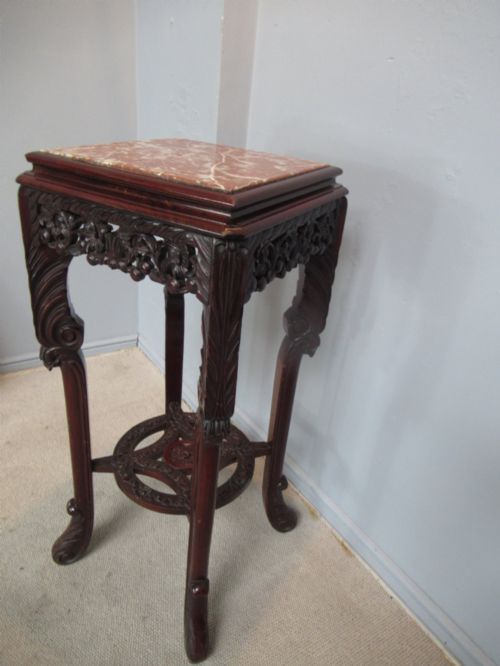
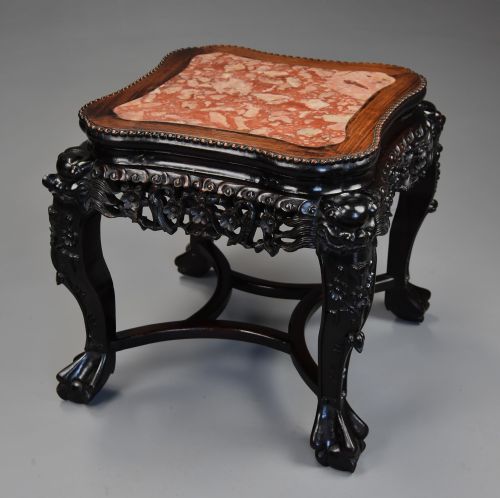
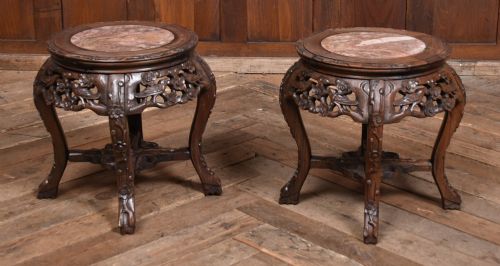
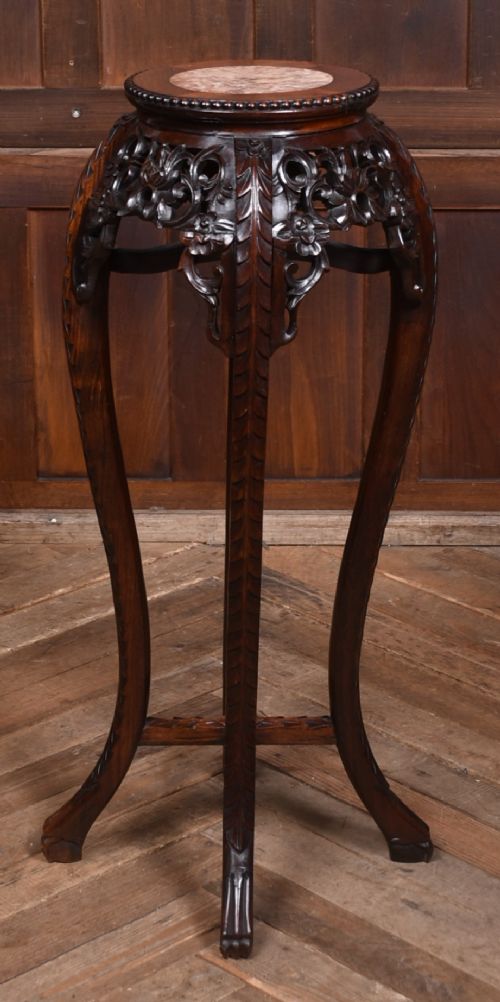


Pink Marble Display Stand
These pink marble display stand pieces bring stone-topped elegance to interiors, offering a stable surface for plants and treasured objects.
Pink Marble Display Stand
When you search for a pink marble display stand, you encounter low tables and plant stands designed to elevate vessels and ornaments. These pieces span the nineteenth century and the early twentieth century, originating primarily from Chinese export workshops alongside Japanese Meiji production.
The most common formats on this page are carved hardwood stands fitted with inset marble panels. These take the form of jardiniere tables, urn stands, and occasional side tables intended for domestic display.
How they were made
Maker-joiners utilised dense timbers such as rosewood and various oriental hardwoods to construct the supportive frames. These woods were carved with intricate foliage and geometric motifs, then joined to house the stone tops securely.
The inset surfaces consist of pink and rouge marble, alongside black marble variants. These stone inserts were cut and polished to fit flush within the wooden framework of each stand.
Listings feature items spanning the nineteenth century, nineteen hundred, and nineteen thirty, utilising rosewood, hard woods, and rouge marble.
What varies in quality
The distinction between tiers rests upon the depth and crispness of the wood carving. Heavy, detailed relief work on the apron and legs indicates superior craftsmanship.
Another measure of quality is the figure and polish of the marble insert itself. Even colouring and a smooth, unblemished surface separate standard examples from finer pieces.
The Pink Marble Display Stand Glossary
- Jardiniere stand
- A tall or low table specifically built to support a ceramic plant holder or flower pot. These often feature inset stone tops to protect the wood from moisture.
- Rouge marble
- A rich red or pink decorative stone with dark veining. It provides a striking contrast against dark hardwoods in nineteenth-century furnishings.
- Meiji period
- The era in Japanese history spanning from eighteen sixty-eight to nineteen twelve. Pieces from this time often display refined woodworking techniques.
- Qing dynasty
- The final imperial dynasty of China, lasting from sixteen forty-four to nineteen twelve. Many carved stands on this page date from the later decades of this period.
- Hardwood
- Slow-growing dense timber such as rosewood used for structural stability. It allows artisans to execute deep, durable relief carvings.
Pink Marble Display Stand: Frequently Asked Questions
What is a pink marble display stand used for?
These pieces served historically as elevated surfaces for heavy porcelain urns, bronze vases, and potted plants. Their solid construction protected domestic interiors while showcasing decorative objects.
Today, they function well as side tables, bedside surfaces, or dedicated plant stands within living spaces.
How do I care for the marble top?
Clean the stone surface with a soft, damp cloth and dry it immediately to prevent water spots. Avoid acidic cleaners that can etch the polished finish.
Apply occasional neutral wax to the wooden base to maintain the lustre of the carved hardwood.
How do I identify a nineteenth-century stand?
Look at the construction methods, such as traditional joinery and hand-carved details in the hardwood frame. Nineteenth-century examples often exhibit natural wear patinas on the timber surfaces.
The specific combination of dense oriental hardwoods and inset rouge marble points directly to this historical era.
Are these stands suitable for heavy items?
The dense hardwoods used in these pieces provide high structural integrity and stability. They were originally engineered to carry heavy ceramic planters and bronze urns.
You can safely place substantial lamps, vases, or sculptures on the marble surface.