


Pierced Fretwork Side Table
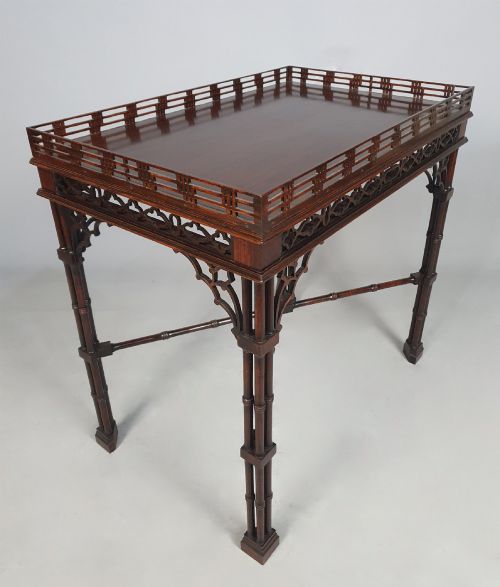
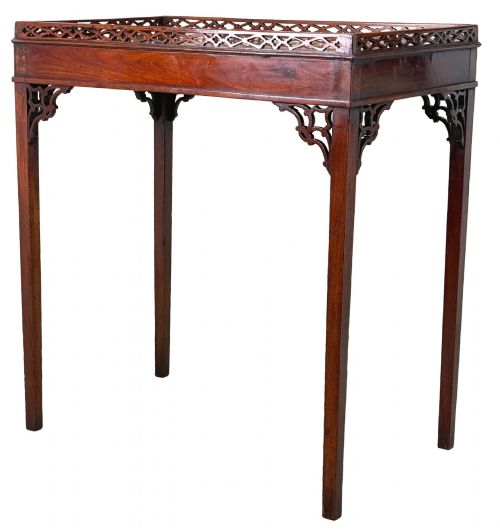
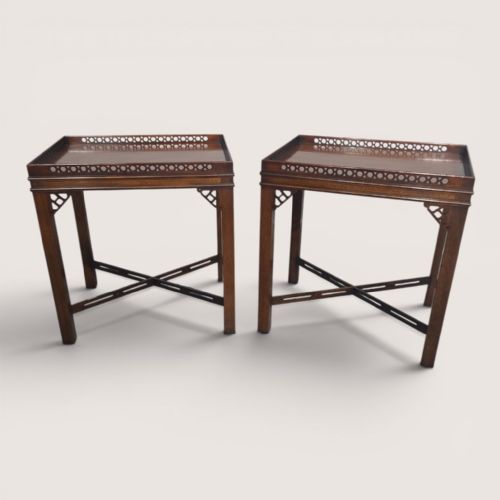
A pierced fretwork side table brings intricate open-carved detail and compact utility to a room.
Pierced Fretwork Side Table
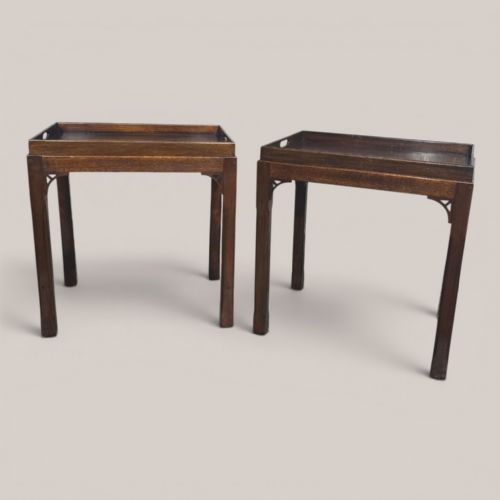
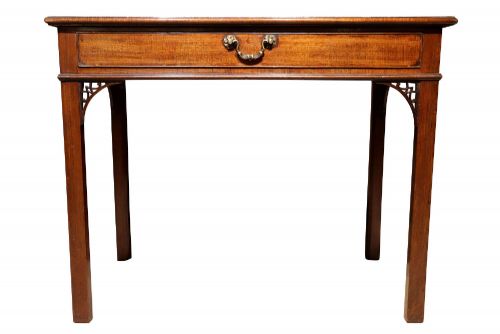
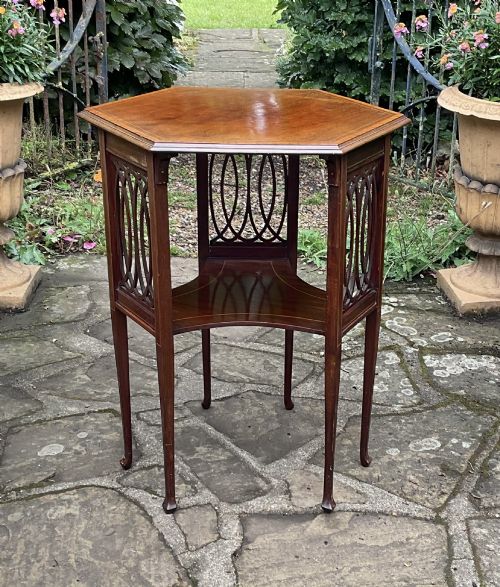
A pierced fretwork side table gathers examples ranging from Georgian origins through Victorian revivals and Edwardian interpretations. These tables function primarily as occasional, lamp, or silver tables, offering small surfaces supported by detailed open woodwork.
The selections span distinct stylistic influences including Chippendale revival designs with Gothic pierced brackets alongside Anglo-Indian and Burmese carved pieces. Mahogany dominates the forms, accompanied by rosewood, walnut, padauk, and teak.
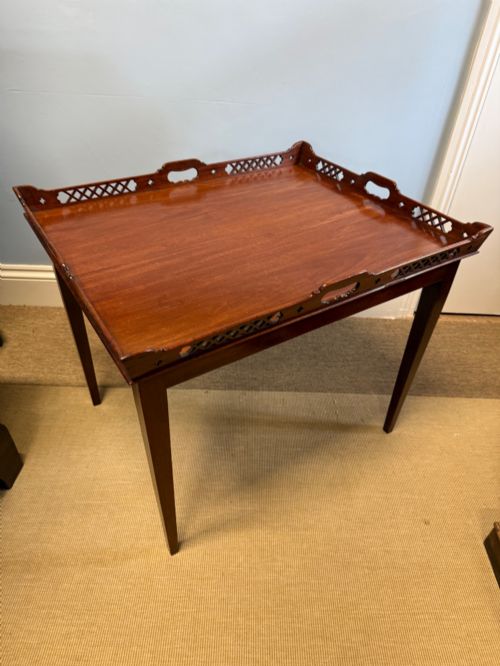
Makers adapted the fretwork technique across various formats such as console tables, tray tables, and writing tables. Buyers encounter both British revival pieces and imported colonial furniture sharing this characteristic pierced ornamentation.
How they were made
Cabinetmakers utilised dense timbers such as mahogany, padauk, and rosewood to support intricate fret-cut patterns without structural failure. Pierced brackets and aprons required precise hand-sawing and chiselling to achieve open geometric or botanical motifs.
Secondary construction involved traditional joinery such as mortise and tenon frames, alongside turned and carved supports. Inlaid details and pietra dura work appear on select surfaces, combining marquetry with structural timber frames.
Listings span the 18th, 19th, and early 20th centuries, featuring mahogany, burr walnut, rosewood, and padauk across various occasional and lamp table formats.
What varies in quality
Quality rests upon the crispness of the pierced fretwork and the depth of the hand-carved relief. Sharp internal corners and clean edges in the timber separate superior execution from softer, more rounded mechanical cutting.
The choice of primary timber and figuring, particularly in burr walnut and striped mahogany panels, dictates the visual weight of the piece. Superior examples maintain structural integrity in the delicate pierced brackets while preserving rich natural grain patterns.
The Pierced Fretwork Side Table Glossary
- Fretwork
- Ornamental perforated wood carving arranged in repeating geometric or organic patterns. This technique defines the aprons and brackets of these tables.
- Chippendale
- An 18th-century English furniture style revived extensively during the Victorian and Edwardian periods. It frequently incorporates pierced fretwork and Gothic arches.
- Padauk
- A dense tropical hardwood with a reddish hue utilised in certain 19th-century tables. It accepts fine carving and fret-cutting.
- Canterbury
- A low stand featuring partitioned vertical sections designed for sheet music or books. Several variations incorporate occasional table tops.
- Pietra Dura
- An inlay technique utilising precision-cut polished coloured stones to create pictorial designs on tabletops. This technique appears on select 19th-century occasional pieces.
Pierced Fretwork Side Table: Frequently Asked Questions
What is a pierced fretwork side table?
A pierced fretwork side table is a small support surface featuring openwork carved wooden panels, brackets, or aprons. These tables emerged during the 18th century and saw widespread revivals throughout the Victorian and Edwardian eras.
They serve as decorative and functional accent furniture designed to hold lamps, silver, or small objects. The pierced decoration provides visual lightness to dense hardwood frames.
How do I date a fretwork table?
Dating relies on identifying the timber species, secondary wood construction, and the specific style revival. Georgian pieces display period-appropriate joinery and timber oxidation, whereas Edwardian and Victorian examples often utilise machine assistance or different secondary woods.
Looking at the sharpness of the fret-cut patterns and the style of the legs helps distinguish 18th-century originals from 19th-century Chippendale revival pieces.
Where should I place an occasional table?
Occasional tables fit beside seating areas, in hallways, or as lamp stands in drawing rooms. Their compact proportions allow them to occupy tight spaces without overwhelming a room.
Tables with detailed fretwork benefit from placement where lighting casts shadows through the open carvings.
What woods were used for these tables?
Mahogany forms the primary material for the majority of British revival pieces. Cabinetmakers also utilised rosewood, burr walnut, teak, and padauk.
Imported Anglo-Indian and Burmese pieces frequently employ dense regional hardwoods suited for deep carving and intricate piercing.