
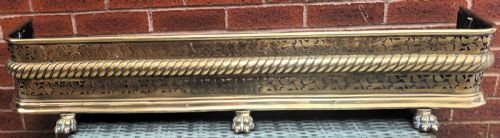
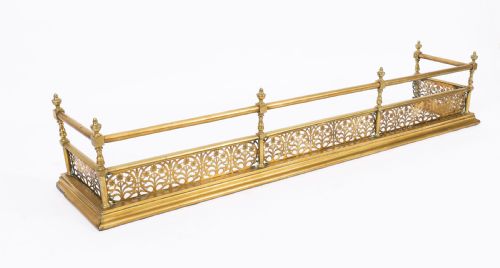

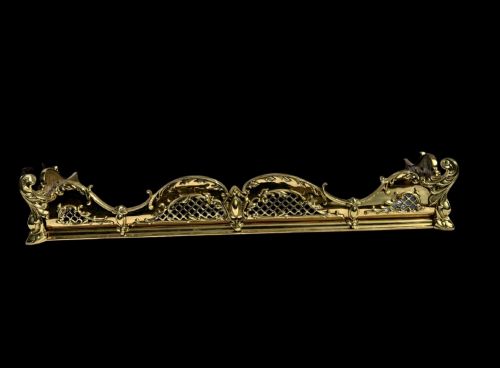


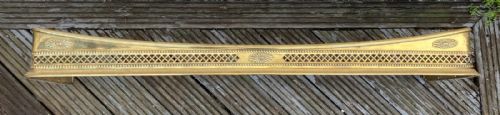
Pierced Brass Hearth Curb
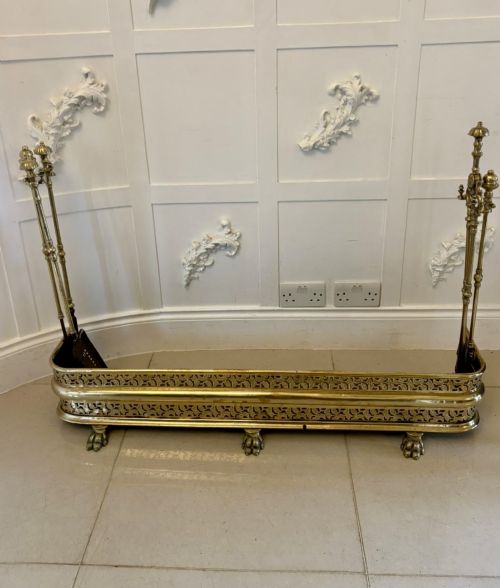
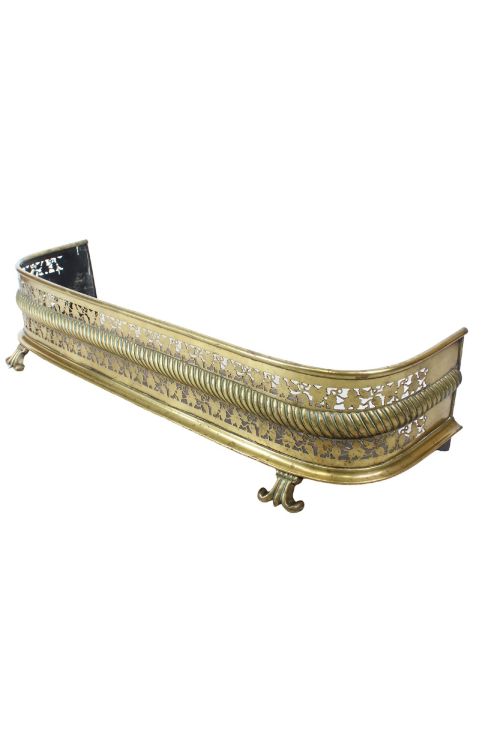
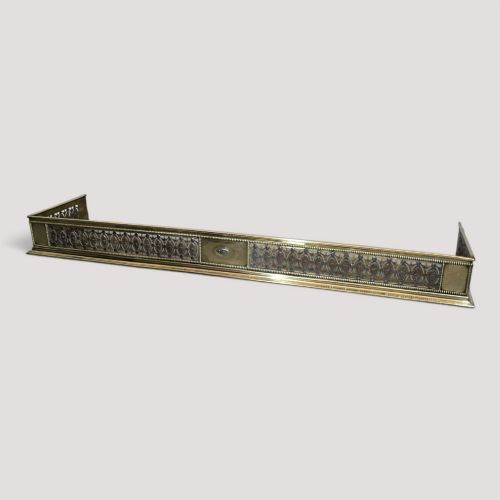
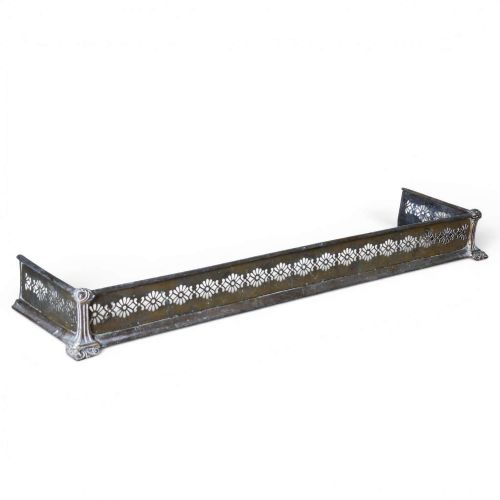
A pierced brass hearth curb frames the fireplace, keeping embers off the floor while bringing bright metalwork to the hearth.
Pierced Brass Hearth Curb
When you search for a pierced brass hearth curb, you are looking at functional metal guards designed to sit on the floor around an open hearth. These pieces are most commonly encountered from the Victorian and Georgian eras, spanning the nineteenth century in various designs.
The standard form runs along the front and sides of the fireplace opening, often combining sheet brass with iron or steel components. Examples range from simple domestic versions to grand Regency and William IV shapes with curved corners.
Makers produced these guards in styles that shifted from formal Georgian proportions to elaborate Victorian decoration and flowing Art Nouveau lines. The pierced pattern work allows heat to circulate while catching stray sparks from the fire.
How they were made
Blacksmiths and metalworkers built these curbs using sheet brass, cast brass, and polished steel. The decorative pierced motifs were punched or cut directly into the metal plate by hand.
Iron and steel parts provided internal structural strength to support the softer brass exterior. Many pieces paired bright polished brass with dark cast iron or cut steel mounts.
Listings feature items from the Georgian, Regency, and Victorian periods, with materials spanning brass, cast iron, and cut steel.
What varies in quality
The thickness of the brass sheet and the crispness of the pierced pattern dictate the grade of the piece. Heavy gauge metal and deeply stamped or hand-sawn details separate substantial examples from lighter domestic items.
The integration of steel components and the survival of original fire tools or matching fire irons indicate higher workshop standards. Better pieces display careful jointing at the corners rather than simple folded plates.
The Pierced Brass Hearth Curb Glossary
- Pierced brass
- Sheet metal decorated by cutting or punching holes through it in geometric or floral patterns. This technique reduced weight while letting firelight reflect through the design.
- Curb fender
- A low metal barrier placed on the hearth in front of a fireplace. It serves to contain hot coals and protect the floor covering.
- Cut steel
- Small faceted steel studs riveted to a metal backing to catch the light. It appears on finer Georgian and Victorian hearth furnishings.
- William IV
- A British design period spanning the 1830s characterised by robust classical proportions. Pieces from this era often feature curved corners and restrained ornamentation.
Pierced Brass Hearth Curb: Frequently Asked Questions
What is a pierced brass hearth curb?
A pierced brass hearth curb is a low metal guard placed in front of an open fireplace to stop rolling embers from reaching the room.
The perforated metal design allows warmth to circulate while serving as a decorative boundary for the hearth.
How do I date a brass fender?
Dating relies on stylistic clues, such as the flowing organic lines of Art Nouveau or the stricter symmetry of Georgian and Regency pieces.
Material combinations also help, as nineteenth-century examples frequently pair bright brass with cast iron or cut steel.
Were these curbs used with fire irons?
Many hearth arrangements included matching pokers, tongs, and shovels that sat alongside the main guard.
Some surviving sets retain their original tools, while others were made solely as protective barriers for the fire opening.
How do I clean an antique brass fender?
Maintenance generally involves gentle dusting and occasional cleaning with a mild metal polish suitable for historic brass.
Harsh abrasives should be avoided to preserve the patinated surface built up over generations of use.