

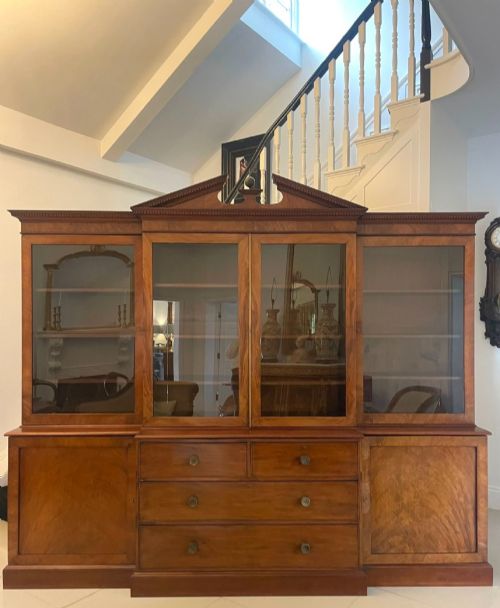
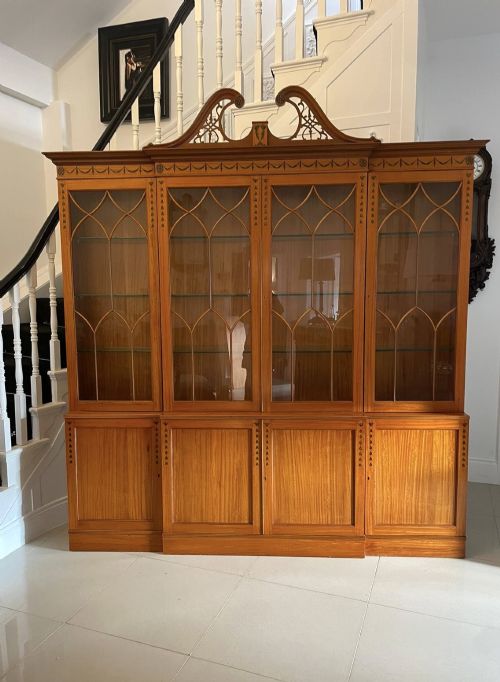
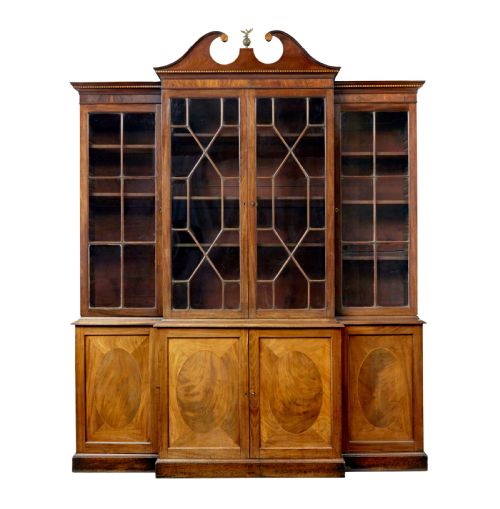


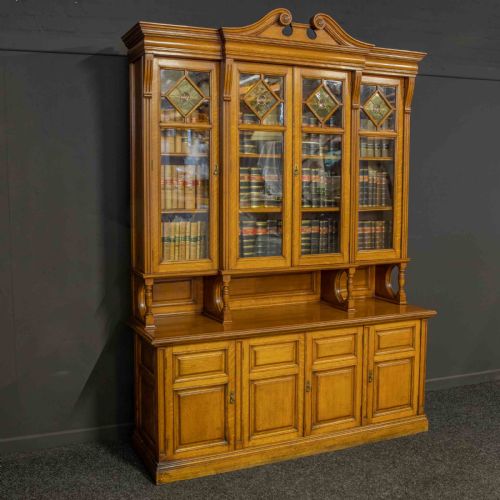
Pediment Breakfront Bookcase
A pediment breakfront bookcase commands a room with its architectural presence, offering disciplined proportions and generous shelving for serious collections.
Pediment Breakfront Bookcase
A pediment breakfront bookcase presents a tripartite facade where the central section projects forward from the flanking wings, crowned by a distinct architectural pediment. This configuration establishes a commanding visual rhythm across the library wall, dividing large collections into orderly bays.
The versions most frequently encountered on this page span the Georgian, Victorian, and Edwardian eras, executed predominantly in mahogany, satinwood, and walnut. These pieces combine glazed upper doors for display with enclosed lower cupboards, balancing transparency with substantial storage.
Makers adapted classical architectural forms to domestic interiors, incorporating astragal glazing bars and fine timber inlays to soften the monumental scale. Buyers encounter both original period pieces and later revival interpretations spanning the nineteenth and early twentieth centuries.
How they were made
Cabinetmakers constructed these large carcasses from dense timbers such as mahogany and rosewood, often applying finely figured veneers of satinwood or burr walnut to the primary surfaces. Crossbanding and marquetry details frame the drawer fronts and door panels, introducing subtle geometric contrast to the dark grains.
Glazing relies on intricate wooden astragal bars arranged in Gothic, diamond, or intersecting arch patterns to hold individual panes of glass securely within the door frames. Carved pediments and dental mouldings finish the upper cornice, requiring precise carpentry to align the projecting central breakfront.
Pediment Breakfront Bookcase Retail Price Guide 2026
Typical asking prices for pediment breakfront bookcase among the pieces listed under this phrase on Sellingantiques today, from the lower quarter to the upper quarter. They describe what is for sale here now, not the wider market.
Some nineteenth-century makers hid secret drawers behind decorative dentil mouldings, rewarding anyone tall enough to inspect the top cornice.
What varies in quality
Quality rests on the architectural ambition of the pediment and the crispness of the carving, distinguishing bespoke cabinet work from standard workshop production. Timber selection dictates visual depth, with carefully matched flame mahogany or figured satinwood elevating the piece above plain domestic joinery.
Proportion and the integrity of the original glass panes and brass hardware define the upper tier of survivals. Refined craftsmanship shows in the seamless movement of deep drawers and the precision of the astragal glazing bars across the projecting central section.
Edwards and Roberts·Gillows
The Pediment Breakfront Bookcase Glossary
- Breakfront
- An architectural cabinet design where the central section projects forward from the flanking side sections. This arrangement creates depth and shadows that break up the flat expanse of a large bookcase wall.
- Astragal
- A narrow moulding used to divide glass panes within a cabinet door. These wooden bars form geometric patterns that secure the individual panes while adding decorative detail.
- Pediment
- The triangular or arched architectural ornament crowning the top of the bookcase. It draws the eye upward and references classical building facades.
- Marquetry
- The art of applying decorative pieces of veneer to a structure to form intricate designs. Cabinetmakers utilise contrasting timbers like satinwood and mahogany to create pictorial or geometric motifs.
- Crossbanding
- A strip of veneer laid around the border of a panel with the grain running perpendicular to the centre. This technique frames the primary wood and provides a clean visual edge.
Pediment Breakfront Bookcase: Frequently Asked Questions
How do I fit a large breakfront bookcase into a modern room?
A pediment breakfront bookcase requires a dedicated wall with sufficient ceiling clearance to accommodate its architectural cornice and commanding height. Because these pieces project significantly into the room, measure the floor space carefully to ensure clearance for opening lower cupboard doors.
Balance the visual weight of dark timbers like mahogany or rosewood by placing the bookcase against a neutral wall with ample ambient light. Fill the upper shelves with books or curated displays to let the astragal glazing bars frame the contents effectively.
What is the difference between Georgian and revival breakfront bookcases?
Georgian breakfront bookcases originate from the eighteenth century, showcasing native timber selection and construction methods tied to classic cabinetmaking traditions. They display authentic patination accumulated over centuries of use.
Revival pieces, produced during the Victorian and Edwardian periods or later in the twentieth century, often employ earlier styles such as Chippendale or Sheraton Revival. These later interpretations utilise period techniques but typically exhibit cleaner, less worn timber surfaces and standardised interior fittings.
How do I care for antique mahogany and satinwood finishes?
Maintain timber surfaces by applying a traditional beeswax polish sparingly and buffing with a soft cloth to nourish the grain. Avoid placing the bookcase near direct heat sources or strong sunlight, which can dry out the wood and fade delicate satinwood inlays.
Dust the intricate carved pediments and astragal glazing bars regularly with a soft brush to prevent particle buildup in recessed mouldings. Check the stability of the room humidity to protect the joinery and prevent veneer lifting.
Can the upper and lower sections be separated for transport?
Most large breakfront bookcases are constructed in multiple modular sections, typically dividing the upper glazed cabinet from the lower pedestal base. This sectional design facilitates easier manoeuvring through doorways and up staircases during relocation.
Examine the cornice and plinth connections to understand how the sections lock together before attempting any movement. Professional removal is recommended due to the sheer weight of dense hardwoods like mahogany and rosewood.