



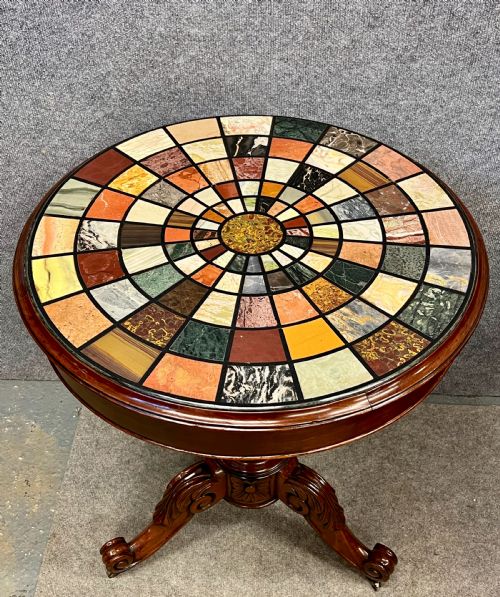

Pedestal Specimen Marble Table
These pedestal specimen marble table pieces combine intricate stone tops with rich timber supports, offering a striking centrepiece for any room.
Pedestal Specimen Marble Table
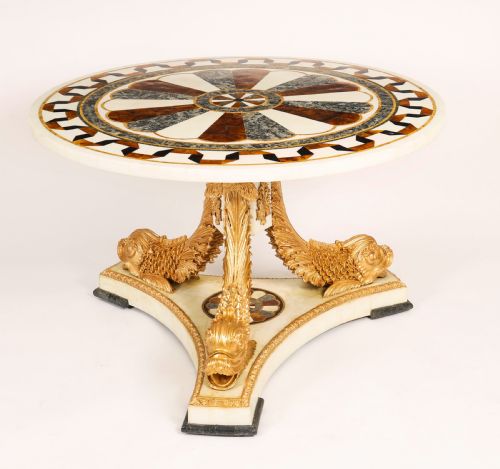
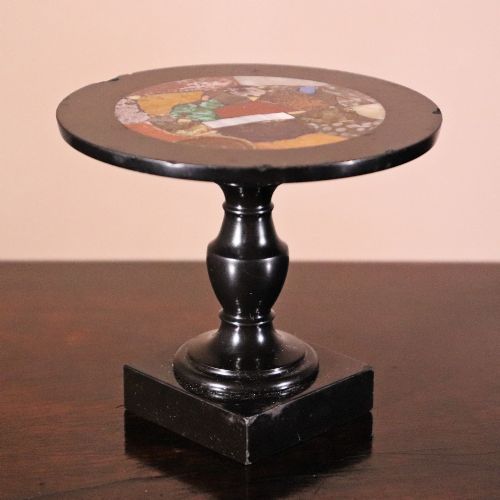
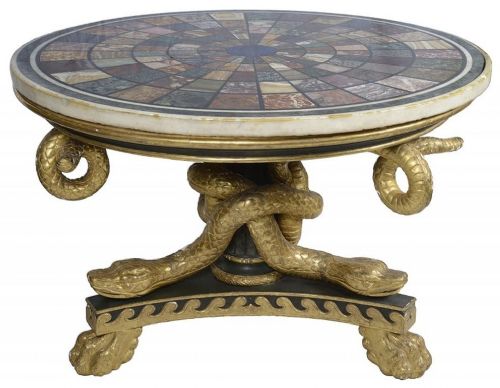
When you search for a pedestal specimen marble table, you are looking for an elevated surface featuring a detailed top composed of various coloured stones. The pieces found here predominantly span the nineteenth century, including Regency and Victorian periods, alongside later twentieth-century interpretations.
The forms vary across centre tables, occasional tables, side tables, and games tables, often standing on substantial timber pedestals. Many examples reflect Neoclassical Revival, Grand Tour, or Florentine Renaissance Revival influences, bringing classical Italian and British design traditions into domestic interiors.
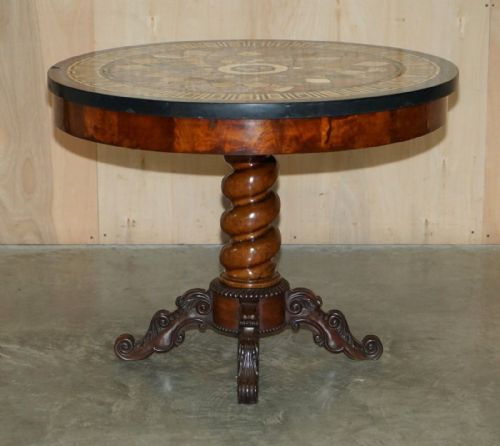
You will encounter regional variations such as Maltese, English, and Florentine works, showcasing different local tastes in stone inlay and timber selection. Mahogany, rosewood, walnut, and satin birch commonly form the structural bases that support these heavy marble surfaces.
Materials and construction
The construction relies on combining dense natural stones with sturdy hardwoods such as mahogany, rosewood, and walnut, sometimes accented with brass or giltwood details. Tabletops often utilise pietra dura or meticulous geometric specimen layouts, embedding numerous marble varieties into a single cohesive surface.
Masons cut and fitted individual stone fragments with immense precision, securing them to a slate or timber backing before mounting the finished top onto a central pedestal. Cabinetmakers then shaped the supporting timber columns and bases to handle the considerable weight of the stone above.
Materials span natural stone varieties paired with mahogany, rosewood, walnut, slate, and satin birch.
Distinctions in quality
Quality rests upon the complexity and tightness of the stone inlay, where narrower joints and rarer mineral specimens demonstrate superior lapidary skill. Simpler geometric arrangements or simulated marble surfaces sit at the accessible end of the range, contrasting with intricate pictorial pietre dure panels.
The architectural ambition of the timber pedestal also determines the tier of the piece, with richly carved mahogany, walnut, or rosewood framing matching the high status of the stone top. Maker attribution, such as documented English workshops, further elevates the standing of specific examples.
Woodley family
The Pedestal Specimen Marble Table Glossary
- Specimen Marble
- A tabletop composed of many different types of marble and hardstones assembled in geometric or pictorial patterns. This lapidary technique became particularly popular during the nineteenth-century Grand Tour.
- Pietra Dura
- An artistic technique of inlaying cut and fitted polished coloured stones to create pictures or ornaments. Craftsmen use this method extensively on Florentine and Italian tables.
- Grand Tour
- A cultural journey of Europe undertaken by wealthy young Englishmen in the eighteenth and nineteenth centuries. Travellers frequently returned home with portable decorative arts and specimen marble tops.
- Centre Table
- A freestanding table designed to be viewed from all sides, placed in the middle of a room rather than against a wall. These often feature robust central pedestals to support heavy stone tops.
- Regency
- A British architectural and decorative style spanning the early nineteenth century. Pieces from this era typically draw heavily on classical Greek and Roman motifs.
Pedestal Specimen Marble Table: Frequently Asked Questions
How were these tables used historically?
Historically, centre tables served as prominent display surfaces in the middle of principal reception rooms. They held decorative objects, books, or lamps while demonstrating the owner's refined taste and wealth.
Some specialised versions functioned as games tables, featuring inlaid chessboards within the stone surface for leisurely pursuits.
How do I care for a marble top?
Marble is a relatively soft and porous stone that requires gentle cleaning with a soft cloth and mild, pH-neutral soap. Avoid acidic liquids like wine or citrus juice, which can etch the polished surface upon contact.
Using coasters and protective pads helps preserve the historical finish without resorting to harsh modern chemical polishes.
How do I distinguish Regency from Victorian examples?
Regency examples typically exhibit refined Neoclassical restraint, utilising dark timbers like rosewood and precise, restrained brass or carved details. Victorian pieces often display bolder, heavier proportions and greater variety in walnut or mahogany framing.
Stylistic cues such as Florentine Renaissance Revival influences also point towards the later Victorian decades of the nineteenth century.