
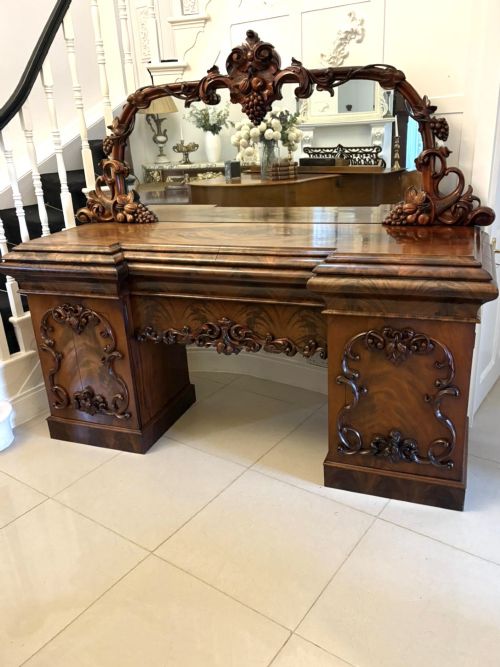


Pedestal Mirror Sideboard
These pedestal mirror sideboard pieces bring grandeur to a dining room, offering substantial timber presence paired with a large fitted glass.
Pedestal Mirror Sideboard
A pedestal mirror sideboard combines a heavy base cabinet with a substantial upright glass, designed principally for the Victorian dining room. These pieces serve as both storage units and display surfaces, often featuring flanking pedestals and carved wooden frames around the mirror glass.
The versions most commonly met here belong to the Victorian period, spanning mahogany, oak, and flame mahogany veneer examples. Makers of the nineteenth century built these cabinets with grand proportions, occasionally incorporating Gothic Revival or Renaissance Revival stylistic details into the woodwork.
While primarily associated with Victorian dining spaces, related forms include Edwardian mahogany variations and occasional dressing tables or chiffonier sideboard hybrids. The defining characteristic across these examples remains the combination of a pedestal base and an integrated mirror back.
How They Were Made
Cabinet makers utilised solid mahogany, oak, and pollard oak for the structural framing and pedestals, frequently applying flame mahogany veneer to the main body panels to create distinct grain patterns. Brass hardware and fittings appeared on doors and drawers, complementing the heavy timber construction.
The upper sections integrate heavy mirror glass within carved wooden frames, requiring robust joinery to support the weight of the glass above the sideboard base. Workshops employed deep relief carving, geometric woodwork, and specimen wood inlay, particularly evident in pieces influenced by the Gothic Revival style.
Listings span Victorian, Edwardian, and nineteenth-century periods, utilising mahogany, oak, brass, and mirror glass.
What Varies in Quality
The depth and execution of the carved ornamentation separate standard production from superior examples, with hand-chiseled foliage and geometric details showing distinct artisan skill. Selection of timber also dictates the visual impact, particularly where highly figured flame mahogany veneer or pollard oak is matched across large surfaces.
Proportion and structural integrity define the higher tier of these pieces, ensuring the heavy mirror back integrates harmoniously with the pedestal base without architectural awkwardness. The quality of the original mirror glass and the precision of inlaid specimen woods further distinguish finer nineteenth-century workshops.
The Pedestal Mirror Sideboard Glossary
- Pedestal sideboard
- A large dining room cabinet featuring two structural pedestals flanking a central section, providing extensive interior storage. These pieces form the substantial lower foundation for an added mirror superstructure.
- Mirror back
- An upright wooden frame containing a large mirror plate attached to the rear of a sideboard. This element reflects light and room interiors, characteristic of nineteenth-century dining furniture.
- Flame mahogany veneer
- A thin slice of mahogany timber cut from the fork of the tree where branches join the trunk, producing a flickering, highly figured grain pattern. Cabinet makers applied this to prominent surfaces for visual depth.
- Gothic Revival
- An architectural and decorative style popular during the Victorian era, drawing inspiration from medieval design. It manifests in pointed arches, heavy tracery, and solemn carved oak woodwork.
- Pollard oak
- Timber taken from oak trees that have been pollarded, resulting in gnarled wood with dense, clustered grain knots. This material was selected for high-status cabinet work.
Pedestal Mirror Sideboard: Frequently Asked Questions
What rooms suit a pedestal mirror sideboard?
These large pieces traditionally anchor a formal dining room, providing a commanding focal point against a substantial wall.
Because of their grand proportions, they require adequate floor space and ceiling height to sit comfortably without overwhelming the room.
How do I care for antique mahogany and oak?
Regular dusting with a soft, dry cloth preserves the polished surface of the timber without building up unnecessary wax layers.
Keep these heavy wooden cabinets away from direct sunlight and strong heat sources to prevent the veneers from drying and cracking.
Are these sideboards modular for moving?
Most nineteenth-century examples separate into distinct sections, typically detaching the mirror superstructure from the heavy pedestal base for transport.
Even when disassembled, the individual timber components remain exceptionally heavy and require professional handling.
How do I identify a Gothic Revival piece?
Gothic Revival examples display architectural motifs such as pointed arches, quatrefoils, and deep chamfering carved directly into the solid oak.
These pieces often feature darker finishes and heavier geometric detailing than standard Victorian mahogany furniture.