

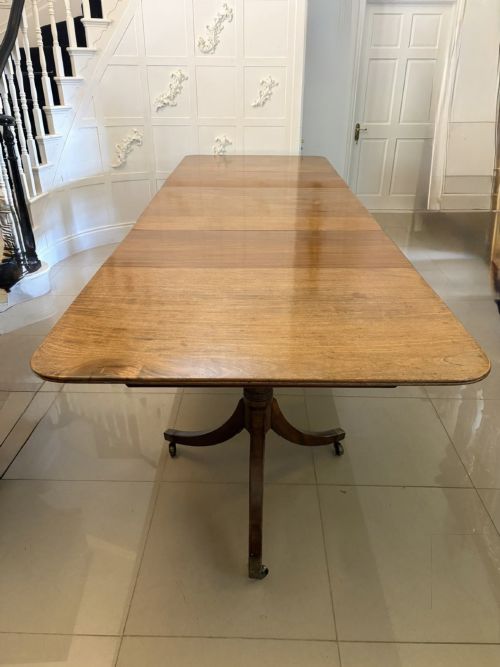
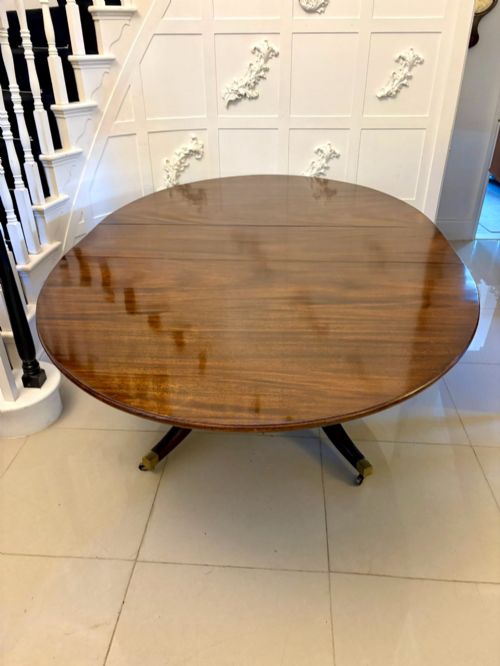
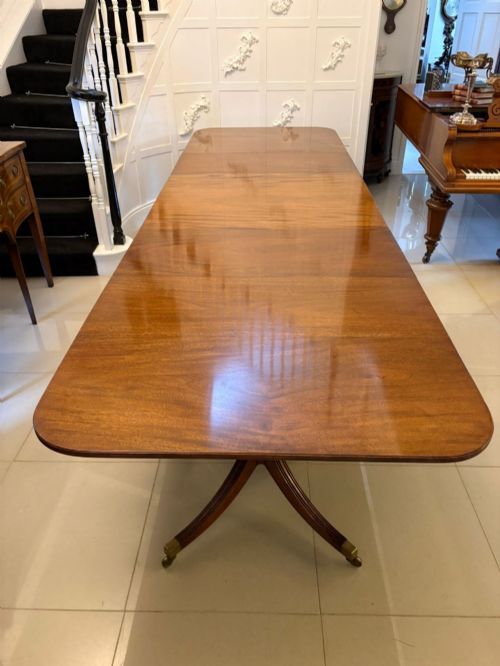
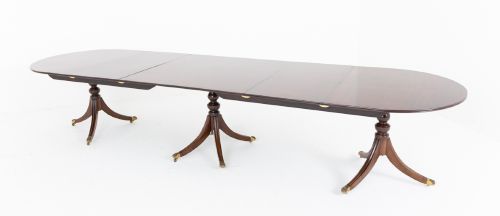
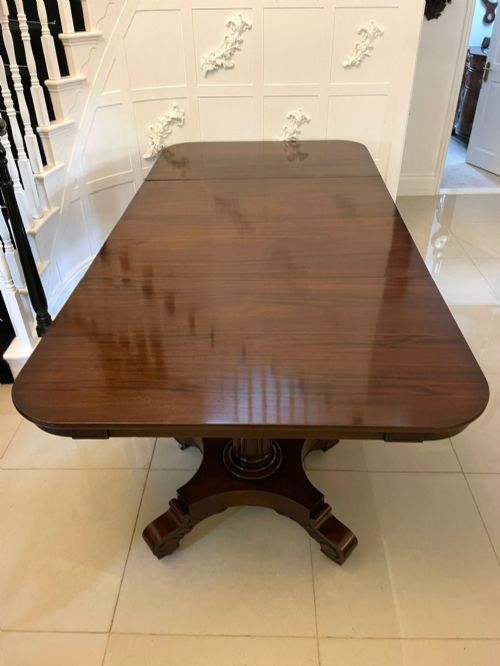
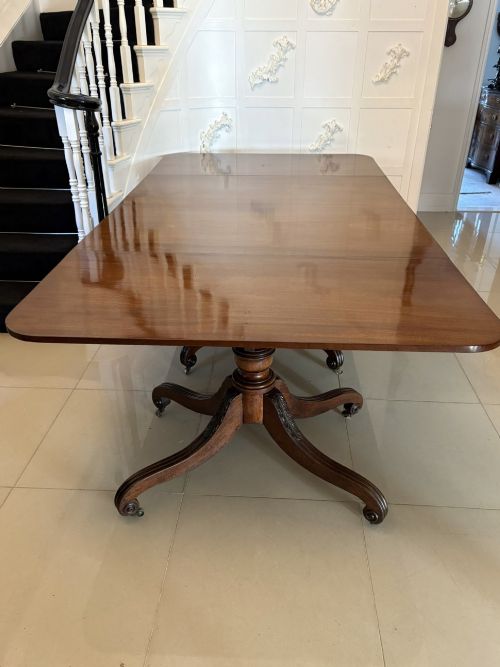
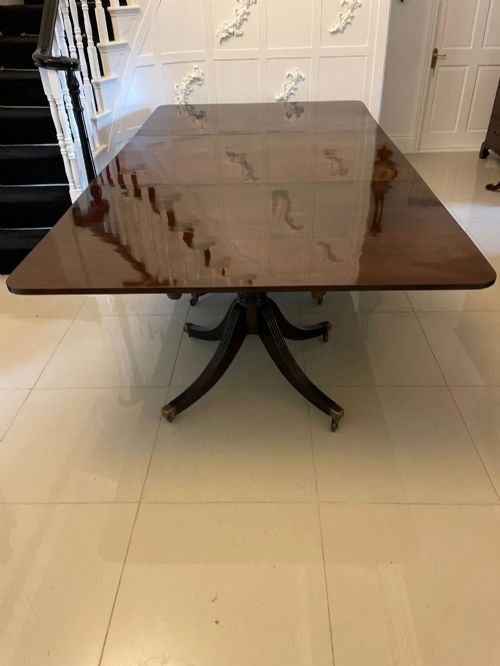
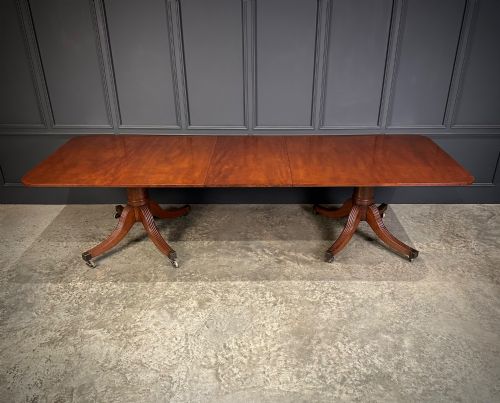

Pedestal Banqueting Table
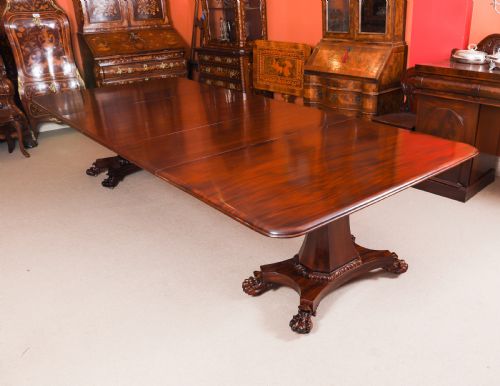
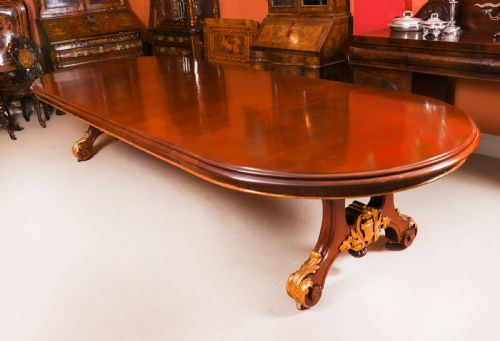
These substantial pedestal banqueting table examples offer modular extension and timber gravitas for seating large gatherings in formal dining rooms.
Pedestal Banqueting Table
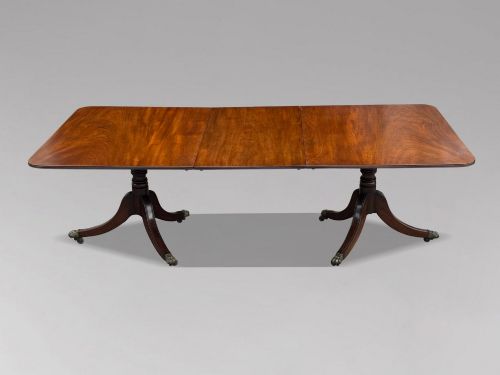
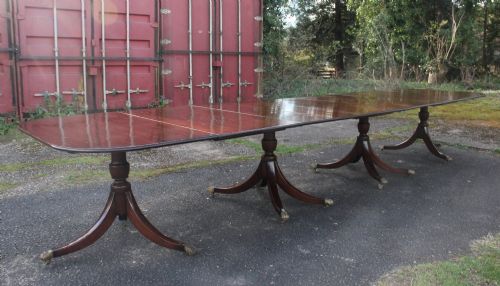
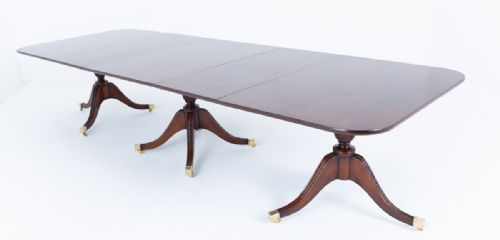
When you search for a pedestal banqueting table, you encounter large-scale dining furniture designed to extend across multiple pillar supports. The pieces listed here span the Georgian, Regency, Victorian, and Edwardian periods, stretching from twin-pillar layouts up to monumental four-pillar formats.
Most examples rely on modular leaves and central column pedestals to accommodate seating capacities ranging from ten to upwards of twenty-eight guests. Mahogany dominates the selection, appearing alongside rosewood and walnut variations influenced by Regency and Georgian design principles.
Materials and construction methods
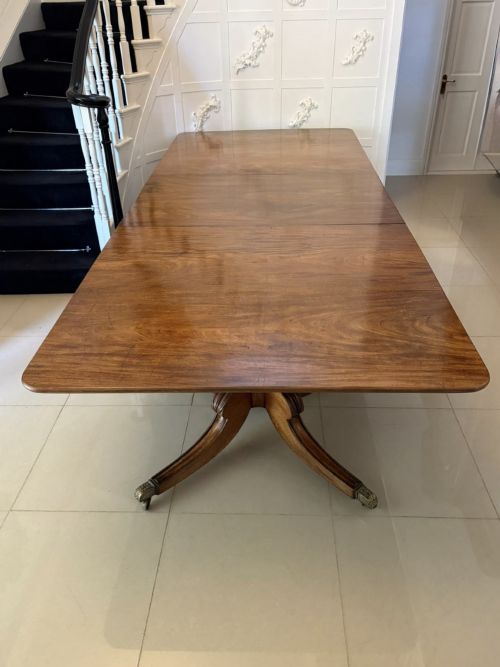
Cabinet makers built these tables primarily using solid and figured mahogany, supported by secondary timbers like oak and accented with brass fittings or inlaid details. The central pedestals frequently stand on reeded or splayed legs terminating in brass castors to allow smooth movement across the floor.
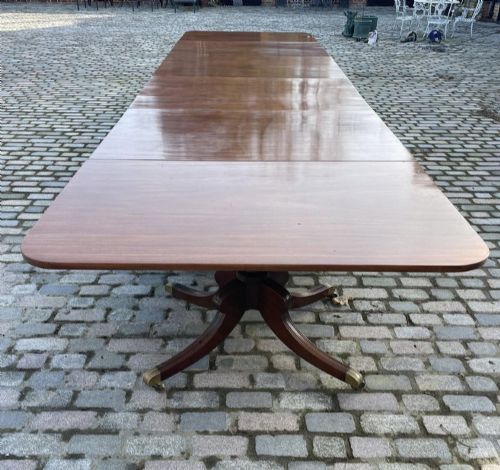
Extension systems utilise drop-in leaves secured by brass clips or wooden pins, paired with wind-out mechanisms in later Victorian examples to expand the central frame evenly. Timber selection focused on rich grain patterns, particularly figured mahogany and burr walnut surfaces finished with polish to highlight the natural figure.
Pedestal Banqueting Table Retail Price Guide 2026
Typical asking prices for pedestal banqueting table among the pieces listed under this phrase on Sellingantiques today, from the lower quarter to the upper quarter. They describe what is for sale here now, not the wider market.
Several tables require an army of twenty-eight guests just to test out their newly extended legroom.
Assessing craftsmanship and proportion
Quality rests in the harmony of the proportion between the heavy pedestal bases and the expansive topboards, ensuring the table remains stable when fully extended with multiple leaves. Finer pieces demonstrate precise joinery in the leaf alignment and seamless grain matching across the separate sections.
The sophistication of the pedestal turnings, the weight and detail of the brass castors, and the depth of the timber figuring distinguish standard production from exceptional workshop output. Tables retaining their original matching leaves and unmodified pillar structures hold greater architectural integrity.
Wylie & Lochead·Whytock & Reid
The Pedestal Banqueting Table Glossary
- Pedestal
- A central column support resting on splayed legs, usually numbering two, three, or four beneath longer dining tables.
- Leaf
- A removable section of timber inserted into the centre of an extending table to increase its overall length.
- Wind-out mechanism
- A mechanical screw system operated by a crank handle that opens the frame of an extending dining table.
- Reeded
- A decorative moulding consisting of parallel convex rows carved directly into the timber legs or pillar columns.
- Castor
- A small wheel mounted in a swivel housing attached to the base of each leg to assist with moving heavy furniture.
Pedestal Banqueting Table: Frequently Asked Questions
How many people can these tables seat?
Seating capacity depends directly on the number of pedestals and inserted leaves, ranging from modest twin-pillar formats seating ten people up to four-pillar models accommodating over twenty-eight guests.
Larger banqueting tables utilise up to five leaves to extend the timber surface across significant lengths while maintaining stable weight distribution.
How do I identify a Regency style table?
Regency and Regency style examples typically feature heavy pillar columns, brass toe castors, and rich mahogany timbers reflecting early nineteenth-century design aesthetics.
Later revivals from the twentieth century often replicate these architectural proportions and classical details closely.
Can the table length be adjusted easily?
Adjustment relies on pulling the pedestal sections apart and inserting or removing the designated wooden leaves according to dining requirements.
Some mid-nineteenth century variants incorporate mechanical wind-out systems to separate the frame smoothly.
What woods were used in construction?
Mahogany remains the predominant timber across the selection, appearing alongside figured variations, rosewood, burr walnut, and oak.
Individual pieces may also incorporate brass hardware, gold leaf accents, and inlaid borders.