


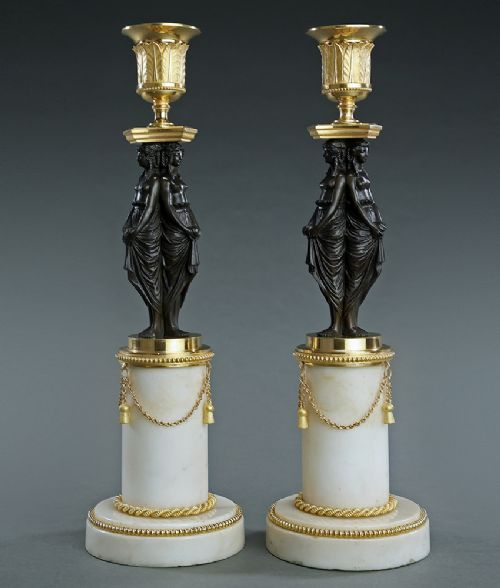


Patinated Bronze Candleholder
These patinated bronze candleholder pieces bring tactile weight and classical design to a room, offering both sculptural presence and functional illumination.
Patinated Bronze Candleholder
A patinated bronze candleholder unites deep, dark metal tones with functional illumination, taking the form of single candlesticks or multi-branch candelabra. When searching for a patinated bronze candleholder, buyers encounter numerous French examples spanning the nineteenth century, often combining dark bronze surfaces with gilt bronze or ormolu highlights.
The objects frequently incorporate figural and architectural motifs, ranging from cherubs and caryatids to mermen, dolphins, and Chinese figures. Pairs dominate the selection, designed symmetrically for mantelpieces, side tables, or wall mounting.
Makers drew on various historical revivals, producing pieces styled after the French Empire, Louis XVI, and Renaissance periods, alongside occasional Dutch Amsterdam School and Japanese designs.
How they were made
Foundries produced these pieces using traditional casting methods in bronze, alongside alternative base metals such as brass, patinated metal, and spelter. Artisans combined dark patination with fire-gilded elements in ormolu and gilt bronze to create strong visual contrast across the surface of the metal.
Many designs incorporate carved marble bases or multi-component assemblies secured with threaded pins and screws. The patination process involved chemical treatments applied to the bronze to age the surface and achieve deep brown, black, or greenish tones.
Flamingos, mermen, and Chinese figures occasionally replace classical caryatids on nineteenth-century French stems.
What varies in quality
The harmony between patinated surfaces and fire-gilded ormolu highlights also determines the visual success of an object. Heavier gauge metal, integrated marble components, and signed or attributed works represent the upper tier of the range.
Rabiat·Galle
The Patinated Bronze Candleholder Glossary
- Patinated bronze
- Bronze that has been treated with chemical solutions to produce a darkened or coloured surface finish. This protective and decorative layer defines the characteristic dark tones of the metal.
- Ormolu
- A technique of applying finely ground high-carat gold to an object of bronze through a mercury amalgamation process. It provides bright golden highlights against dark patinated surfaces.
- Candelabra
- A branched candlestick designed to hold multiple candles simultaneously. These fixtures often feature removable branches to convert them into single candlesticks.
- Caryatid
- A sculpted female figure serving as an architectural support element replacing a column or pilaster. They frequently appear supporting the stems of classical candlesticks.
- Pricket candlestick
- A candleholder featuring a sharp central spike rather than a socket to secure the candle. This medieval form persists in later revival designs.
Patinated Bronze Candleholder: Frequently Asked Questions
How do I clean patinated bronze?
Dust the surface gently with a soft, dry cloth to remove everyday accumulation. Avoid abrasive cleaners, polishes, or chemical dips that can strip the original patination.
For stubborn grime, use a slightly damp cloth with mild soap, then dry thoroughly. Preserving the existing surface oxidation maintains the historical character of the piece.
How do I tell Empire style from Louis XVI?
Louis XVI style pieces lean towards restrained classical symmetry, featuring straight lines, urns, ribbons, and refined neoclassical motifs. They often feel lighter and more delicate in their proportions.
Empire style adopts heavier military and imperial symbolism, inspired by ancient Rome and Egypt. Expect bolder forms, sphinxes, caryatids, and strong contrasts between dark patinated bronze and bright gilt highlights.
Why are so many offered in pairs?
Mantelpiece decoration and formal dining table arrangements traditionally required symmetrical pairings of ornamental lighting. Makers cast and finished these objects in matched sets to balance interior spaces.
Displaying them as a matched pair preserves their original decorative function and visual symmetry. Splitting pairs often diminishes their collective presence in a room.