

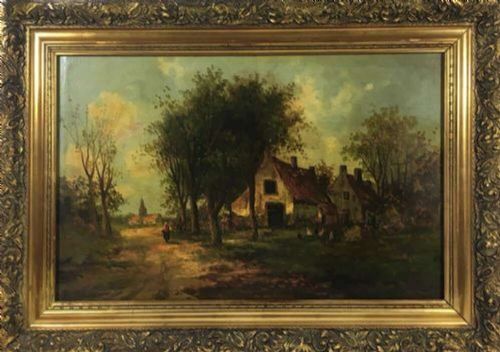
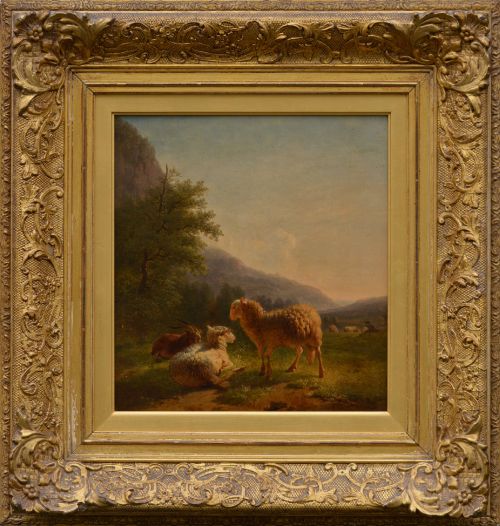



Pastoral Scene Portrait
These pastoral scene portrait works capture rural life, featuring shepherds, livestock, and maids in idyllic countryside settings.
Pastoral Scene Portrait
A pastoral scene portrait depicts rural or agricultural life, often centring on figures like shepherds, milkmaids, and agricultural labourers alongside livestock such as sheep, cattle, and horses. These works draw heavily upon 18th century and 19th century traditions, reflecting an idealised or romanticised view of the countryside.
The versions most commonly met on this page include oil on canvas paintings and smaller works on paper or canvas, frequently housed in giltwood frames with gesso ornamentation. They span periods from the Georgian era through the Victorian period, encompassing French Rococo influences and the Barbizon School.
Buyers also encounter miniature paintings and framed artwork depicting woodland gatherings, farmyards, and coastal cliff tops. These pieces offer a glimpse into historical artistic interpretations of agrarian existence, ranging from expansive exhibition-sized landscapes to intimate portrait miniatures.
Distinguishing Quality
The distinction between tiers rests upon the confidence of the brushwork and the precision with which figures and animals are rendered. Superior examples demonstrate a careful balance of light and shadow, capturing atmospheric depth in landscapes and expressive detail in animal portraits.
Framing and material preservation contribute substantially to the standing of a piece. Original giltwood and gesso frames that complement the canvas without modern intervention elevate the integrity of the work.
Pastoral Scene Portrait Retail Price Guide 2026
Typical asking prices for pastoral scene portrait among the pieces listed under this phrase on Sellingantiques today, from the lower quarter to the upper quarter. They describe what is for sale here now, not the wider market.
Listings span the 18th century, 19th century, and Victorian periods, utilising canvas, oil paint, paper, wood, glass, gesso, and giltwood.
Eugène Verboeckhoven·Charles Zacharie Landelle·Thomas Sidney Cooper·Augustus Jules Bouvier·Claude Cardon·Daniel Pasmore·John W Morris·Francois Boucher·Charles Jones
The Pastoral Scene Portrait Glossary
- Barbizon School
- A French art movement of the mid-19th century focusing on realism in landscape painting, closely connected to the transition toward painting en plein air.
- Gesso
- A plaster-like mixture applied to wood substrates or frames to create a smooth surface for gilding or painting.
- Giltwood
- Wood that has been coated with gold leaf or gold paint, frequently used for ornate period frames.
- Miniature painting
- A small-scale artwork, often executed with meticulous detail on paper, card, or vellum.
- Oil on canvas
- A medium where pigments are suspended in drying oils and applied to a stretched woven fabric support.
Pastoral Scene Portrait: Frequently Asked Questions
What subjects appear in pastoral portraits?
These works commonly depict shepherds with flocks, cattle near watering troughs, and milkmaids in woodland or farmyard settings. The focus remains on agrarian life and romanticised rural landscapes.
Animals feature prominently alongside human figures, capturing daily interactions within the countryside.
How do I date an antique painting?
Dating relies on stylistic markers, materials such as canvas and gesso, and artist signatures or biographical records. The transition from Georgian formality to 19th century romanticism provides clear chronological indicators.
Frame construction and backing materials also offer valuable clues regarding the period of creation.
Where were these paintings displayed?
Historically, these artworks hung in domestic reception rooms, parlours, and galleries as decorative statements of refined taste. Smaller miniature paintings were often kept as personal items or worn as lockets.
Larger exhibition-sized pieces were designed to dominate wall space in substantial country houses.
How should I care for oil paintings?
Preservation requires stable indoor humidity and avoidance of direct sunlight to protect canvas and oil paint layers. Dusting should be performed gently with a soft, dry brush.
Original giltwood and gesso frames also benefit from minimal handling and stable environmental conditions.