
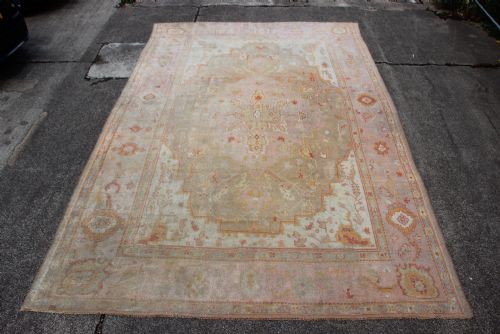


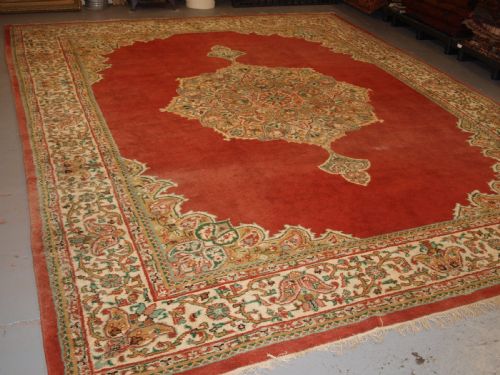
Pastel Floral Rug
A pastel floral rug brings soft colour and intricate historic design into a room, offering durability through wool and cotton construction.
Pastel Floral Rug
A pastel floral rug encompasses large carpets and smaller floor coverings originating from various international traditions, featuring softer palettes and botanical motifs. When exploring a pastel floral rug, buyers encounter antique examples spanning the mid-nineteenth century through to the mid-twentieth century.
The selection includes specific regional styles such as Ottoman Oushak carpets, Persian Tabriz pieces, Bessarabian kilims, Portuguese needlepoint, and French Aubusson weaves. These diverse origins provide distinct medallion designs and floral patterns tailored for residential interiors.
How they were made
Production relies fundamentally on natural textile materials, predominantly wool and cotton, utilised across hand-knotted, flat-woven, and needlepoint techniques. Artisans constructed these carpets using traditional regional methods that defined the structure of Oushak, Tabriz, and Aubusson pieces.
Weavers employed specific dyeing traditions to achieve the characteristic soft pastel tones found across nineteenth- and twentieth-century Turkish, Persian, and European workshops.
What varies in quality
Quality differentiates through the precision of the weave and the complexity of the classic medallion or floral design executed by the maker. Finer knots and superior handling of wool and cotton elevate certain regional carpets above simpler flat-woven kilims or needlepoints.
The integrity of the soft pastel colour palette and the preservation of the original pile or flat structure determine the overall standing of an antique rug.
Benlian Tabriz
The Pastel Floral Rug Glossary
- Oushak
- A traditional Turkish carpet style known for large-scale floral motifs and soft wool construction. These rugs frequently exhibit muted or pastel colour palettes.
- Tabriz
- A Persian carpet weaving tradition originating from the city of Tabriz, noted for intricate medallion designs. Master workshops here produced finely knotted decorative pieces.
- Kilim
- A flat-woven carpet or rug produced without a pile, common in Bessarabian and Eastern traditions. They offer crisp geometric and floral integration.
- Aubusson
- A French tapestry-weave rug style influenced by Rococo and Neoclassical aesthetics. These floor coverings utilise wool and cotton to depict classical floral arrangements.
- Needlepoint
- A hand-stitched textile technique where yarn is worked through a stiff open-weave canvas ground. Portuguese examples often display delicate botanical patterns.
Pastel Floral Rug: Frequently Asked Questions
What periods do these rugs come from?
The available pieces originate from various decades spanning the mid-nineteenth century to the mid-twentieth century.
Production dates in the selection include examples from the eighteen-fifties, eighteen-eighties, eighteen-nineties, and early nineteen-twenties and nineteen-forties.
Which regions produced these rugs?
Origin locations include Turkey, Persia, France, Portugal, and Eastern Europe.
Specific regional traditions represented are Oushak, Tabriz, Sivas, Kula, Isparta, Bessarabian, and Aubusson.
What materials were used?
Construction primarily involves wool and cotton fibres.
These materials appear across hand-knotted pile carpets, flat-woven kilims, and needlepoint textiles.
How do I identify different styles?
Styles are recognised through their distinct regional weaving techniques and motif structures, such as French neoclassical Aubusson weaves or classic medallion Turkish Oushaks.
Examining the handling of floral patterns and pastel colour distribution helps separate Persian Tabriz pieces from European needlepoints.