


Paris Street Scene Art
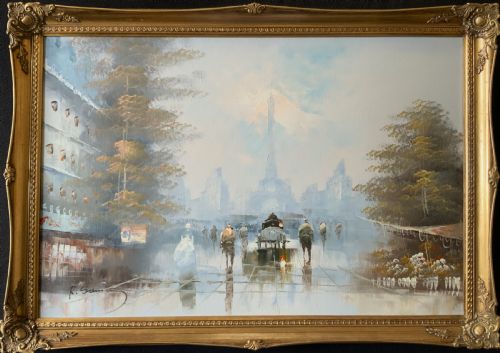
Paris street scene art captures the energy of the French capital through oil paintings and watercolours framed in wood and gilt.
Paris Street Scene Art
Paris street scene art encompasses depictions of the French capital ranging from the nineteenth century to the mid-twentieth century. Buyers encounter works capturing iconic locations such as the Eiffel Tower, the Pont Neuf, Montmartre, and the Latin Quarter. These pieces take the form of oil paintings on canvas or board, watercolours, and pastel drawings.
The selections span distinct movements including Impressionism, Post-Impressionism, Belle Epoque, and French Realism. Mid-century expressionist interpretations and works by salon-exhibiting artists also appear across the selection. Subjects range from bustling city streets and snowy scenes to quiet suburban views with figures.
Materials and Techniques
Artists create these works primarily using oil paint applied to canvas, board, or paper. Watercolours and pastel drawings on paper represent alternative media used to capture urban views. Many pieces feature brushwork characteristic of Impressionist and Post-Impressionist techniques.
Finished works are typically housed in wood frames, often enhanced with gilded wood or gilt finishes. These frames range from period gilt wood surrounds to mid-century mouldings that complement the painting style.
Periods range from eighteen-fifty through the nineteenth century, nineteen-hundred, nineteen-ten, nineteen-twenty, nineteen-thirty, nineteen-forty, nineteen-fifty, to nineteen-sixty.
Judging Quality
Quality rests in the handling of light, atmosphere, and architectural perspective within the urban landscape. Works by recognised salon-exhibiting artists or named painters demonstrate superior draughtsmanship and composition compared to anonymous student pieces.
The integrity and originality of the framing contribute to the overall presentation. Period gilt wood frames that match the age of the canvas elevate the piece above works in later replacement mouldings.
Lilian Colbourn·Albert Ludovici Jnr·Caroline Burnett·Victor Gabriel Gilbert·Merio Ameglio·Eduard Leon Cortes·Louis Dali
The Paris Street Scene Art Glossary
- Impressionism
- A nineteenth-century art movement characterised by relatively small, thin, yet visible brush strokes and an emphasis on accurate depiction of light. It forms a primary style found in Parisian cityscapes.
- Gilt wood
- Wood decorated with gold leaf or gold paint applied to the surface. It is commonly seen on the frames enclosing these paintings.
- Salon
- An official art exhibition in Paris judged by professional artists. Works associated with salon-exhibiting painters carry specific art-historical significance.
- Pastel drawing
- A work of art made with dry pigment sticks bound with gum water. It offers a distinct matte texture compared to oil on canvas.
Paris Street Scene Art: Frequently Asked Questions
What periods do these paintings cover?
The works span from the mid-nineteenth century through the Belle Epoque and into the mid-twentieth century. This includes pieces created around eighteen-fifty, the nineteen-twenties, and nineteen-fifties.
Later mid-century expressionist interpretations sit alongside earlier realist and impressionist depictions of the French capital.
Are all these pieces oil paintings?
While oil on canvas and oil paint on board represent the majority of works, other mediums appear. Watercolours and pastel drawings on paper are also present.
Frames vary from simple wood structures to ornate gilded wood and gilt wood surrounds.
How do I identify a street scene style?
Styles range from French Impressionism and Post-Impressionism to French Realism and Belle Epoque art. Brushwork and lighting choices typically signal the movement.
Utrillo-like views of suburbs and Montmartre often feature muted palettes and distinct architectural arrangements with figures.
Where were these scenes usually set?
Locations focus heavily on Parisian landmarks and neighbourhoods, including the Eiffel Tower, the Pont Neuf, Montmartre, and the Latin Quarter. Churches and local squares also feature prominently.
Artists frequently depicted everyday Parisian life, capturing cab rides, rainy streets, and winter scenes.