
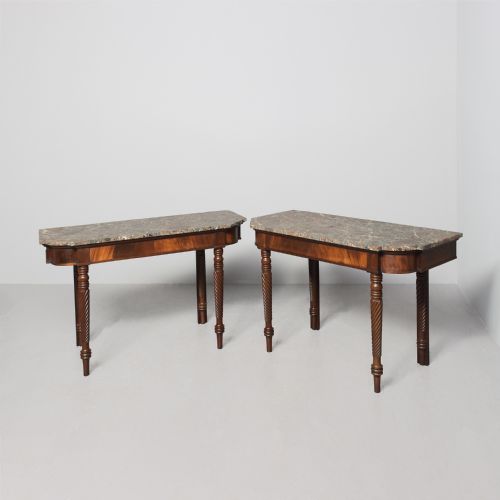

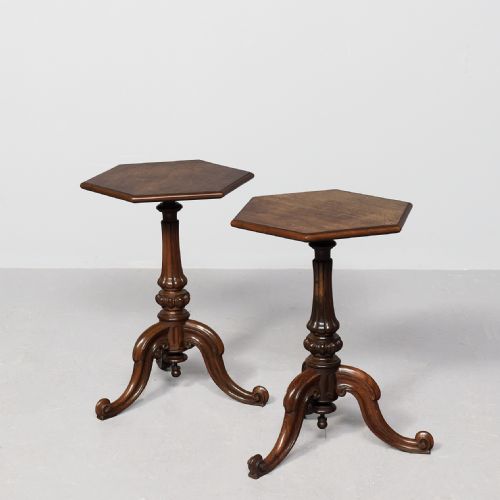
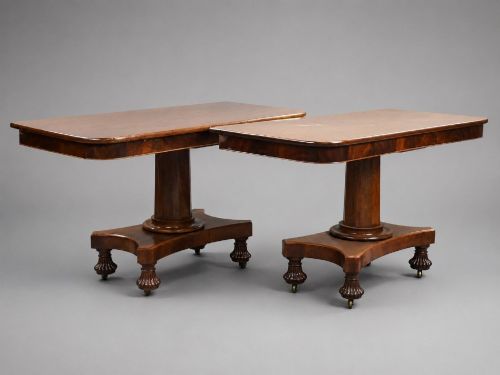
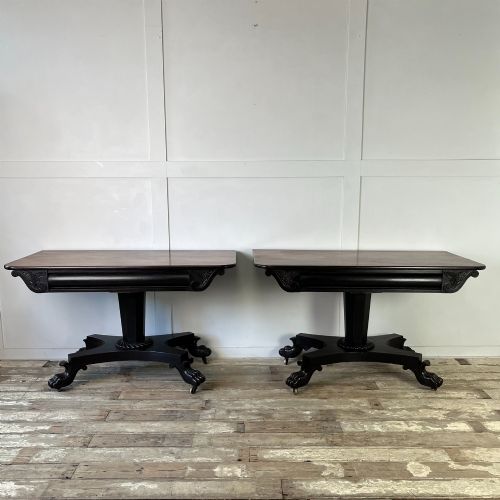


Pair William IV Tables
Pair william iv tables bring matched symmetry and architectural weight to a room, uniting functional surfaces with the bold joinery of the period.
Pair William IV Tables
When you search for pair william iv tables, you encounter matching sets of furniture predominantly built during the nineteenth century under Regency and William IV design influences. The evidence shows that console tables, card tables, and occasional forms dominate the selection, often rendered in rich timbers designed to anchor a formal interior.
Mahogany and rosewood form the backbone of these listings, appearing alongside flame mahogany veneer and occasional marble tops. Buyers frequently find console tables and card tables built with architectural precision, designed to stand symmetrically in a hall, drawing room, or library.
The materials and forms reflect a period of transition from Georgian restraint to heavier Victorian proportions, yet these tables retain a distinct sculptural clarity. Whether you meet a foldover card table or a break-front console, each piece is conceived to function as part of a balanced pair.
Materials and construction
Cabinetmakers utilised solid mahogany and rosewood, frequently applying flame mahogany veneer over secondary timbers to achieve dramatic grain patterns. These dense hardwoods provided the structural integrity required for heavy marble tops and substantial pedestal bases.
Secondary materials such as brass, giltwood, and mirror glass appear in hardware and decorative mounts, adding reflective contrast to the dark timber surfaces. Joinery relies on traditional framing techniques that support the weight of console slabs and the pivoting mechanisms of card tables.
Some card tables hide secret compartments once reserved for storing ivory gaming counters and deck markers.
Judging the standard
Quality in these tables rests upon the selection of timber veneers and the crispness of carved details such as ring-turned supports and reeded legs. Superior examples display continuous grain matching across a pair, ensuring that the two surfaces read as a single unified commission.
The stability of the subframe and the precision of folding or pivoting mechanisms distinguish workshop-standard pieces from master cabinet work. Finer items exhibit restrained proportion and harmonious integration of brass and gilt elements rather than excessive surface ornamentation.
Gillows·Minton
The Pair William IV Tables Glossary
- Console table
- A wall-mounted or freestanding table designed to sit against a flat surface, frequently topped with marble in nineteenth-century interiors.
- Card table
- A folding table with a hinged top that opens to reveal a baize-lined playing surface, popular for evening entertainment.
- Flame mahogany veneer
- A sliced section of timber showing a flickering, flame-like grain pattern, applied to primary surfaces for visual impact.
- Ring-turned support
- A cylindrical leg or pedestal shaft shaped on a lathe with decorative horizontal grooves and ridges.
- Break-front
- A piece of furniture where the central section projects forward from the flanking wings, adding architectural depth.
Pair William IV Tables: Frequently Asked Questions
What rooms suit these tables?
Console and card tables fit naturally into entrance halls, drawing rooms, and studies where symmetrical placement creates a formal balance.
Their compact depths allow them to sit flush against walls without obstructing walkways while offering functional display space.
How do I spot a matched pair?
Look for consistent timber grain, identical dimensions, and matching turning on the legs or pedestals. True pairs share the same workshop hand and seasoning of wood.
Minor variations in colour often arise from sunlight exposure over time rather than original manufacture.
Were these tables used daily?
Card and games tables served for evening recreation, while console and side tables held lamps, porcelain, and decorative objects. Their sturdy construction indicates they were built for active household service.
Foldover mechanisms allowed surfaces to double in size when guests arrived for entertainment.
How do I care for rosewood and mahogany?
Keep timber surfaces away from direct sunlight and excessive heat sources to prevent veneer lifting and timber shrinkage. Regular dusting with a dry, soft cloth preserves the wax finish.
Avoid moisture on unsealed wood and use protective pads beneath items placed on the polished tops.