
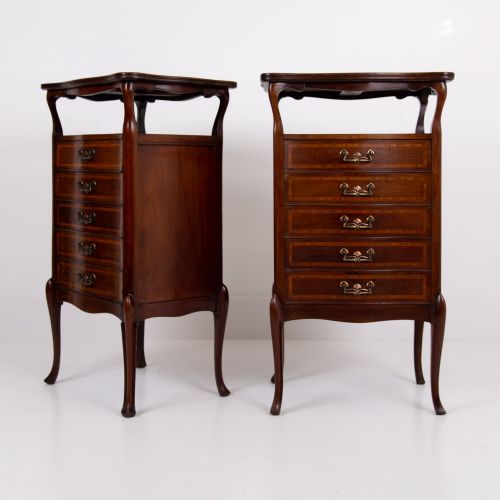

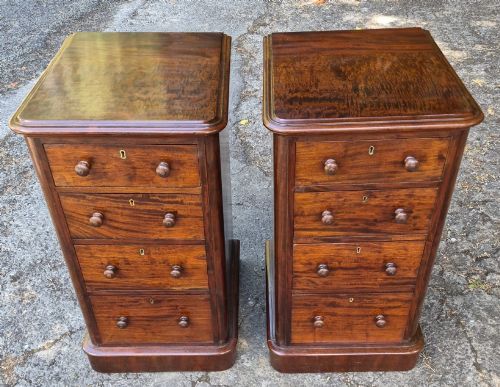
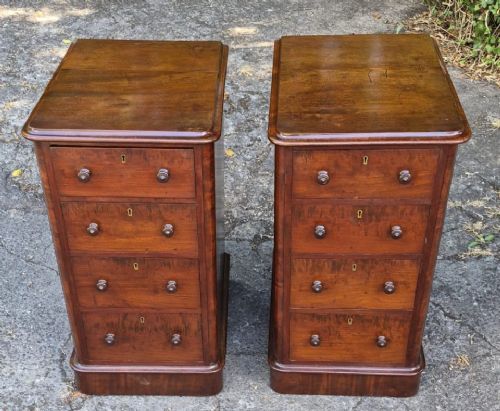
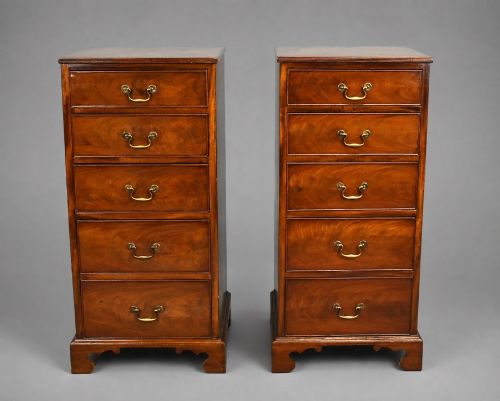

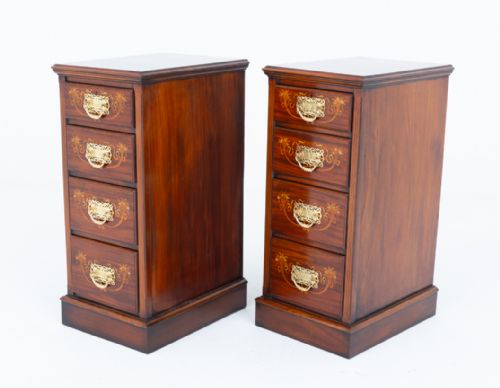
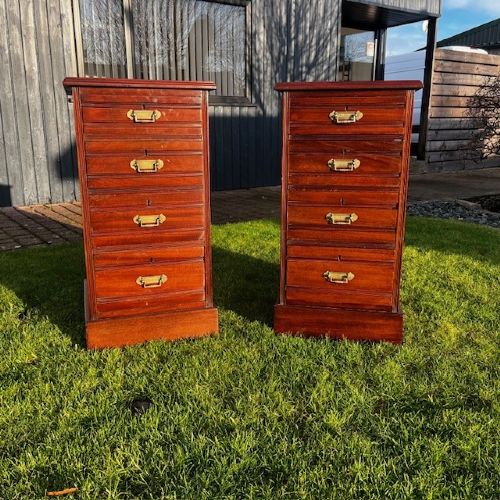


Pair Tallboy Chests
Pair tallboy chests deliver matched vertical storage in scaled-up formats, uniting functional utility with symmetry.
Pair Tallboy Chests
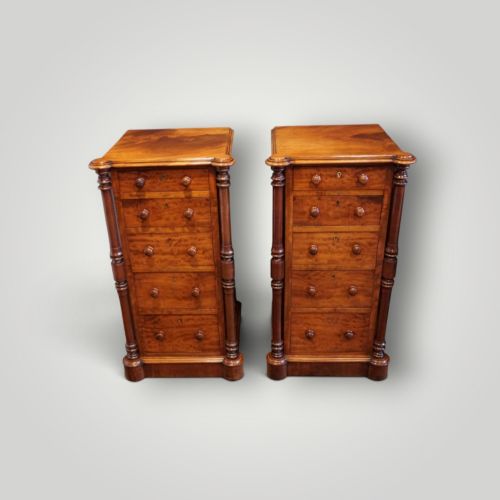
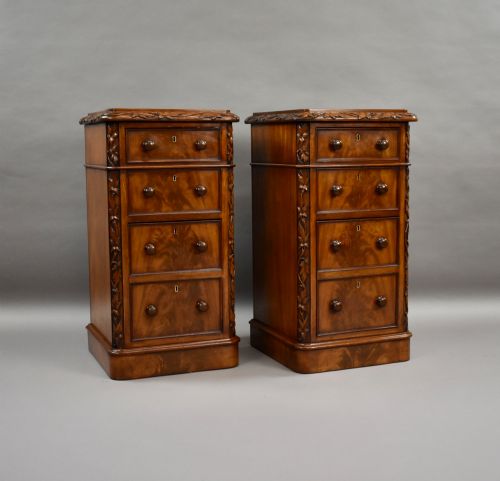
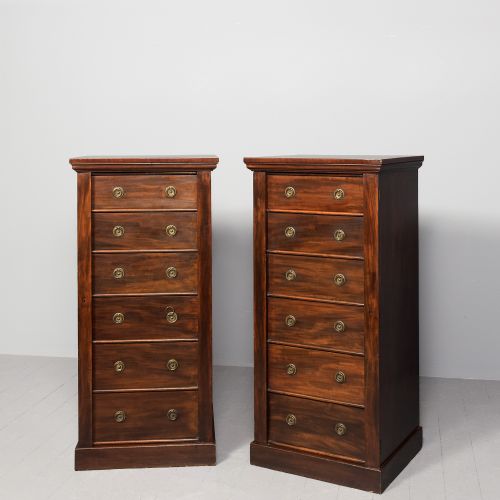
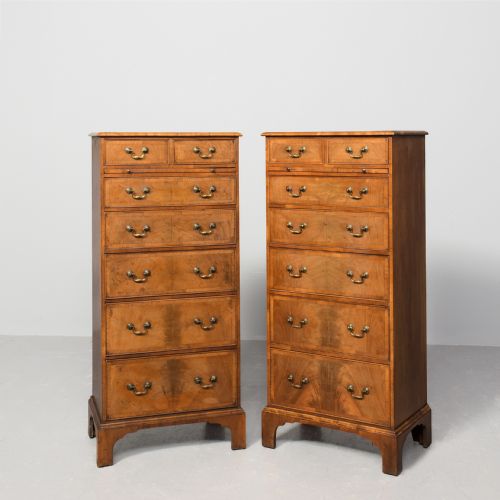
When you search for pair tallboy chests, you encounter vertical storage items spanning Georgian, Victorian, and Edwardian periods. These configurations frequently manifest as matching bedside chests, tall nightstands, Wellington chests, and chests on chests rather than singular traditional tallboys.
The materials range from mahogany and walnut to rosewood, pine, and satinwood, reflecting styles from George III to Louis XV Revival and military aesthetics. Proportions remain narrow and tall, designed to maximise drawer capacity within limited floor footprints.
Materials and construction
Makers utilised solid timbers alongside rich veneers, applying mahogany, walnut, rosewood, and satinwood over secondary woods like pine. Surfaces display decorative techniques including marquetry inlay, parquetry veneer, and painted finishes.
Hardware incorporates brass drawer pulls, drop handles, and locking mechanisms typical of Wellington chests and military-style lockers. Construction relies on traditional dovetailed drawer joints and solid timber framing suited to heavy daily use.
Listings feature mahogany, walnut, rosewood, satinwood, and pine across Victorian, Edwardian, and 18th-century periods.
Assessing quality in execution
Quality rests in the crispness of timber figure, the precision of marquetry or parquetry inlay, and the consistency of the matched pair. Superior examples maintain original brass hardware, stable carcass construction, and clean internal drawer linings without alteration.
Finer pieces demonstrate considered proportions, such as narrow footprints with deep drawer capacities, alongside high-grade secondary woods. The integration of specialised mechanisms, like locking stiles on Wellington chests, separates standard production from superior workshops.
Warings Liverpool
The Pair Tallboy Chests Glossary
- Tallboy
- A tall chest of drawers, often comprising a chest stacked upon another or built as a single elongated vertical unit. They provide substantial storage while occupying minimal floor space.
- Wellington chest
- A tall, narrow chest of seven drawers secured by a hinged locking stile on one side. This mechanism locks all drawers simultaneously with a single key.
- Marquetry
- Decorative veneer work forming pictorial or geometric patterns using various coloured woods. Craftsmen apply thin slices of timber to the primary carcass surface.
- Parquetry
- A geometric mosaic of wood pieces used for decorative floors and cabinet surfaces. It creates repeatable patterns like squares, triangles, or chequers.
- Chest on chest
- Two substantial drawer chests stacked vertically, with the upper section typically narrower than the lower base. This form maximises storage through vertical stacking.
Pair Tallboy Chests: Frequently Asked Questions
What defines a tallboy chest?
A tallboy is a vertical storage unit combining multiple drawers in a stacked formation, designed to maximise capacity within a compact floor area.
They appear in various formats across this selection, including bedside cabinets, Wellington chests, and chests on chests.
How do I use a pair in a bedroom?
Matching pairs function effectively as twin bedside cabinets or flanking storage units framing a bed or architectural feature. Their vertical orientation provides generous drawer space without crowding small rooms.
Position them where the height balances surrounding furniture scales.
Are these pieces made of solid wood?
Construction combines solid primary timbers like mahogany, walnut, and pine with decorative wood veneers applied to carcass surfaces. Finer pieces utilise dense hardwoods for structural integrity and drawer framing.
Secondary woods support internal elements and concealed drawer linings.
How can I tell Victorian pieces apart?
Victorian examples span from mid-century mahogany models to late-period aesthetic movement walnut and marquetry inlaid cabinets. Look for characteristic hardware, timber selection, and construction methods such as hand-cut dovetails.
Stylistic influences range from military lockers to French revivals within the same era.