

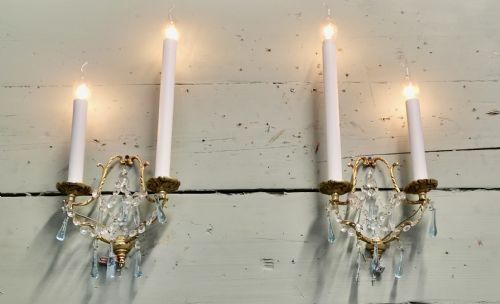

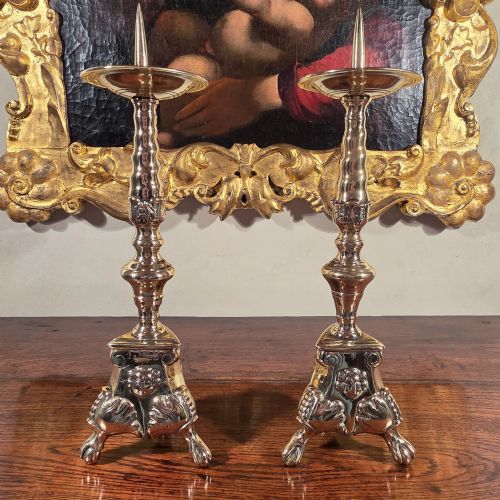


Pair Tall Brass Holders
These pair tall brass holders deliver the height and presence needed for striking interior illumination, spanning ecclesiastical and domestic designs from the nineteenth century onwards.
Pair Tall Brass Holders
When you search for pair tall brass holders, you encounter substantial lighting accessories designed primarily as candlesticks, church altar pieces, and pricket stands. These objects originate predominantly from the Victorian and Edwardian eras, incorporating earlier Georgian forms alongside later Gothic Revival and Arts and Crafts examples.
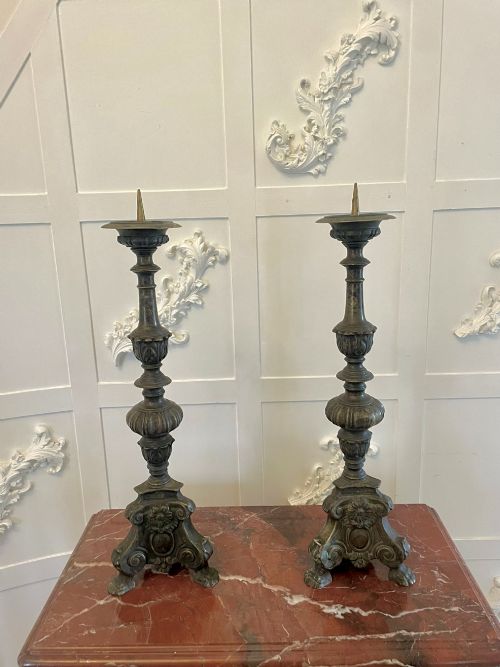
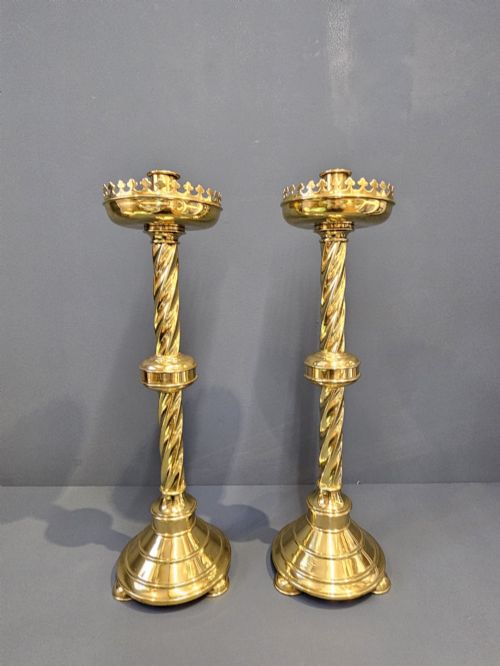
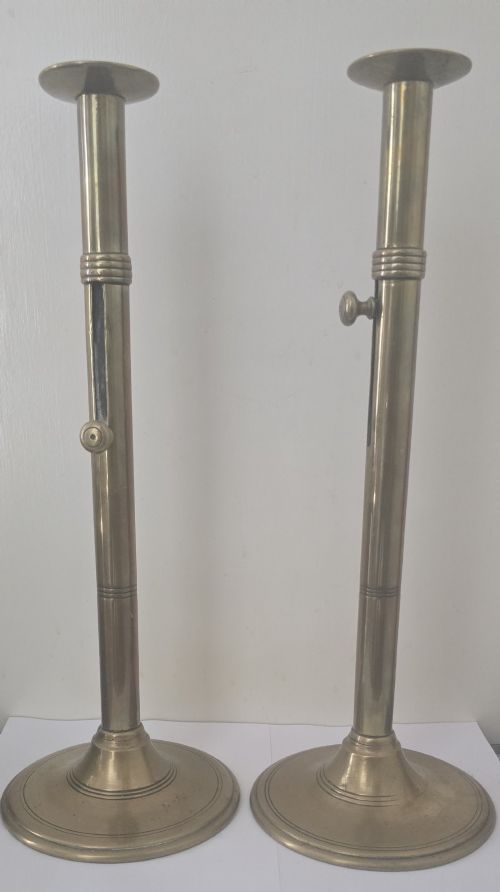
The domestic and ecclesiastical forms appear in column, barley twist, and classical configurations, often standing well above standard table heights. Heavy ecclesiastical brass and bronze dominate the selection, complemented by occasional oak and mahogany turned shafts.
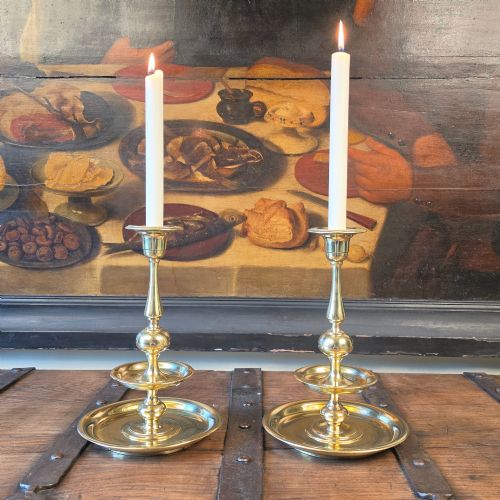
Church candlesticks and pricket sticks form a significant portion of these tall pairs, offering sturdy bases and deep drip pans designed for large wax candles. Domestic column and twist models provide a more refined domestic scale while retaining the vertical emphasis buyers seek.
How they were made
Manufacturers utilised casting techniques to produce heavy brass and bronze components, joining separate sections with threaded rods or pins. Seamed construction appears on mid-nineteenth century examples, where sheet metal is rolled and joined before soldering or brazing to weighted bases.
Lathe turning shapes the cylindrical columns and barley twist shafts seen in both metal and timber designs. Detail work involves hand chasing, surface turning, and the integration of cut glass or wrought iron elements on specific Gothic and Arts and Crafts pieces.
One signed Dutch school pair merges copper and brass with an iron pricket spike, proving that industrial materials found artful purpose.
What varies in quality
Casting thickness and metal weight dictate the structural integrity of tall holders, distinguishing heavy ecclesiastical and columnar pieces from lighter domestic versions. Crispness in chased surface ornamentation and the precision of turned barley twists reveal the skill of the original workshop.
Proportion and base stability determine the visual balance of elevated candlesticks, particularly when supporting heavy prickets or wide sockets. Original components, including matching ejector mechanisms and undisturbed patination, elevate the integrity of a matched pair.
James Clews
The Pair Tall Brass Holders Glossary
- Pricket candlestick
- A candlestick featuring an upward-facing metal spike designed to impale the base of a candle, commonly found on church altars. These sticks hold large wax lights securely during prolonged burning.
- Barley twist
- A carved or cast helical column resembling a twisted rope, popular during the Victorian and Edwardian periods. This technique adds dynamic vertical movement to wooden and brass shafts.
- Ejector
- A mechanical slide or internal push-rod within a candle socket designed to lift out remaining wax stubs. Georgian and Victorian examples frequently integrate this practical mechanism into the nozzle.
- Column candlestick
- A lighting form modelled on classical architectural orders such as Doric, Corinthian, or Ionic. These pieces feature a distinct capital, a straight fluted or plain shaft, and a stepped square base.
- Ecclesiastical
- Pertaining to the Christian church and church architecture, describing items manufactured for liturgical use. Ecclesiastical brassware typically displays Gothic Revival ornamentation and substantial scale.
Pair Tall Brass Holders: Frequently Asked Questions
How tall are these candlesticks usually?
Most pieces categorized under this search measure significantly above standard tabletop lighting, frequently exceeding thirty centimetres in overall height. Church and ecclesiastical variants often stand taller still to command presence on altars.
Proportions vary according to the original function, with domestic column pairs maintaining a slender profile while heavy pricket sticks showcase wider, weighted bases.
Were these made for churches or homes?
The selection includes both ecclesiastical and domestic lighting, reflecting the diverse origins of nineteenth-century metalwork. Heavy pricket sticks and column designs typically originate from chapels and churches.
Domestic variants feature similar height and weight but incorporate standard sockets for taper candles rather than spikes. Both types translate effectively into decorative interior display pieces today.
How do I clean antique brass holders?
Preserving the aged patination is standard practice for antique metalwork, avoiding harsh chemical dips that strip away historical character. Gentle dusting with a soft cloth removes surface grime without disturbing the underlying finish.
If polishing is necessary, use a mild, non-abrasive metal cleaner applied sparingly to maintain the definition of chased details and cast mouldings.
How can I date a pair of brass holders?
Dating relies on examining manufacturing methods, such as identifying seamed construction techniques or cast component seams typical of the mid-nineteenth century. Stylistic indicators like Gothic Revival motifs, Arts and Crafts execution, or Georgian column proportions provide clear chronological markers.
Maker marks, registration stamps, and matching construction irregularities further help narrow the period of origin.