

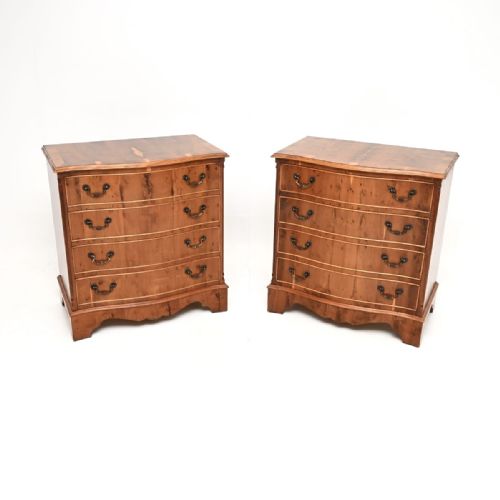
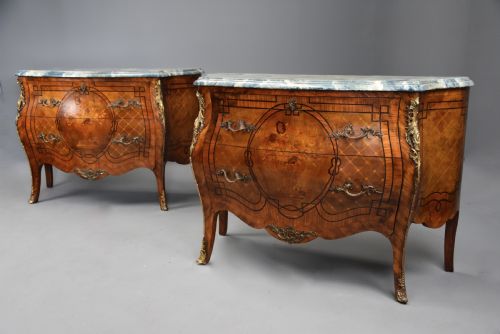
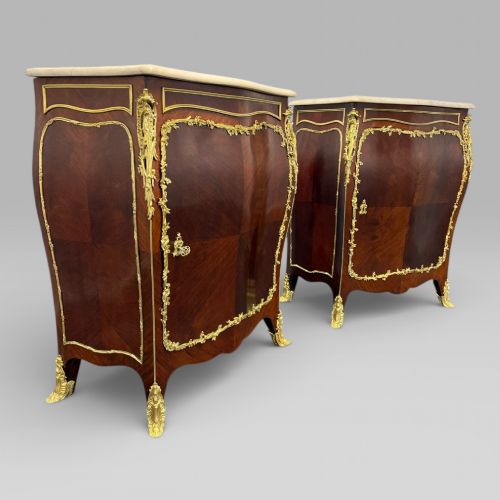
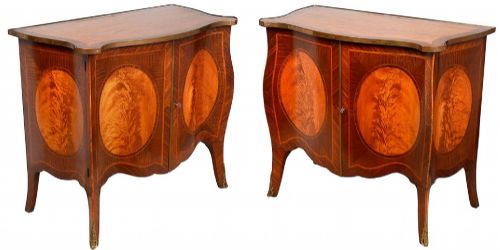
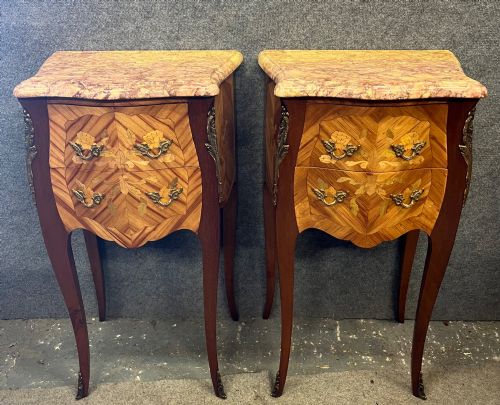
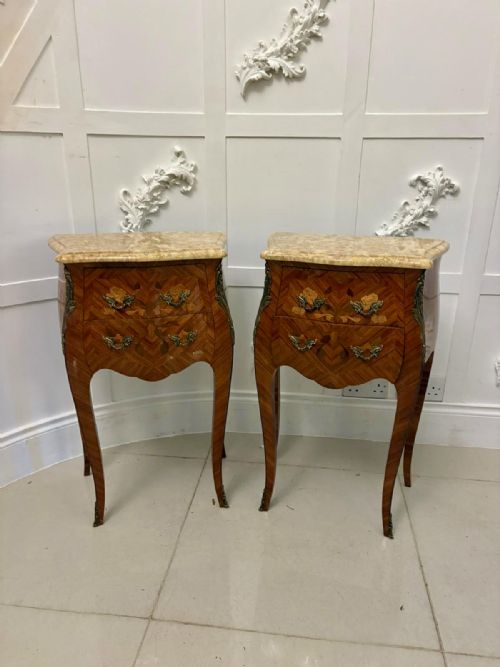
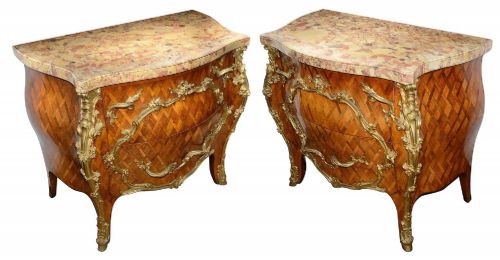


Pair Serpentine Commodes
These pair serpentine commodes bring architectural curve and French or Italian flair to a room, offering matched symmetry and generous storage.
Pair Serpentine Commodes
When you search for pair serpentine commodes, you encounter matched sets of chests of drawers, bedside cabinets, and side cabinets featuring distinctive undulating fronts. These pieces span the eighteenth, nineteenth, and early twentieth centuries, drawing heavily on French Rococo, Louis XV, Louis XVI, and Sheraton revival idioms.
The inventory on this page runs from Italian burr walnut and Venetian walnut pieces through to French kingwood and mahogany examples. You will find both bombé profiles that swell dramatically and refined neoclassical silhouettes topped with marble.
Forms range from compact bedside chests and lamp tables to substantial side cabinets and chest of drawers formats. The unifying element remains the undulating serpentine contour paired with the convenience of a matching pair.
How they were made
Cabinetmakers constructed these frames using timber carcases of walnut, mahogany, or kingwood, often enhanced by intricate marquetry and parquetry veneers. Shaping the serpentine curve required precise joinery and patient hand-carving to ensure the timber followed the desired undulating line.
Surfaces were frequently completed with marble tops, while mounts and handles in ormolu, brass, or gilt bronze provided structural accents. The combination of figured wood veneers and cast metal hardware defined the aesthetic of these refined cabinets.
Pair Serpentine Commodes Retail Price Guide 2026
Typical asking prices for pair serpentine commodes among the pieces listed under this phrase on Sellingantiques today, from the lower quarter to the upper quarter. They describe what is for sale here now, not the wider market.
The selection spans compact bedside chests from the nineteenth century alongside larger eighteenth-century style commodes and side cabinets.
What varies in quality
The distinction between tiers rests upon the precision of the veneer work and the crispness of the serpentine shaping. Superior examples display seamless marquetry patterns that flow naturally across the curved drawer fronts without awkward interruptions.
Hardware weight and the refinement of the ormolu or gilt bronze mounts also separate standard productions from masterworks. Furthermore, the integration of heavy marble tops and the fidelity of the period revival style dictate the standing of a given pair.
E. Kahn
The Pair Serpentine Commodes Glossary
- Serpentine
- A curved furniture front or shelf featuring a concave centre flanked by two convex ends, resembling the gentle undulations of a snake. This profile adds visual movement and sophistication to case furniture.
- Bombé
- A swelling, bulging outward contour typical of continental European case furniture, particularly associated with French and Italian commodes. It requires advanced woodworking skill to veneer successfully.
- Marquetry
- The art of applying decorative pieces of veneer to a structure to form intricate pictorial or geometric patterns. Makers utilised various woods to create tonal contrast.
- Parquetry
- A geometric mosaic of wood pieces used for decorative floors and furniture surfaces. It creates repeating patterns like cubes or chequers across the top or sides of a chest.
- Ormolu
- Gilded bronze used for decorative mounts, handles, and feet on high-end furniture. The technique involves applying a gold amalgam to heated bronze.
Pair Serpentine Commodes: Frequently Asked Questions
Where should I place pair serpentine commodes?
These cabinets work exceptionally well flanking a bed as substantial bedside tables, or placed symmetrically in a formal reception room or hallway. Their curved fronts soften linear architectural spaces.
Ensure there is sufficient clearance around the undulating edges so the profile can be appreciated without obstruction from surrounding furniture.
How do I care for the marble tops?
Marble surfaces require gentle cleaning with a damp cloth and mild, pH-neutral soap to avoid dulling the stone or damaging historic finishes. Avoid placing acidic items directly on the stone.
Using coasters and placemats protects the polished surface from rings and etching over time.
Are these commodes suitable for daily storage?
The drawers provide practical enclosed storage for bedside items, linens, or general household goods depending on the scale of the specific chest. The internal construction generally offers robust space.
Take care not to overload older drawer bottoms and operate the handles gently to preserve the historic joinery.
How can I tell eighteenth century from revival pieces?
Eighteenth-century pieces display period-specific construction methods, hand-cut dovetails, and aged patina native to their original period of manufacture. Revival pieces from the nineteenth and early twentieth centuries reflect later interpretations of those earlier styles.
Examining the secondary timbers, nail types, and backboards usually clarifies the exact age of the cabinet.