


Pair Painted End Tables
These pair painted end tables bring decorative colour and period character to a room, offering matched surfaces for lamps and books.
Pair Painted End Tables
When you search for pair painted end tables, you encounter matched small furniture designed for dual placement beside seating or beds. The selection spans side tables, lamp tables, bedside tables, and occasional tables.
The objects originate from diverse periods including the eighteenth, nineteenth, and early twentieth centuries. Styles range from Chinoiserie and French Chateau to Gustavian, Kashmiri, and English Country.
Forms include D-end console tables, side cabinets, and bookends alongside conventional lamp tables. Most examples feature painted wood surfaces finished with decorative motifs or solid colour schemes.
How they were made
Construction relies primarily on wood and pine as foundational carcase materials. Artisans applied paint, lacquer, and gilt to decorate the exterior surfaces.
Selected pieces incorporate inset marble tops or brass hardware alongside the wooden structure. Decorative finishes include Chinoiserie decoration, Kashmiri painting, and traditional Swedish painted treatments.
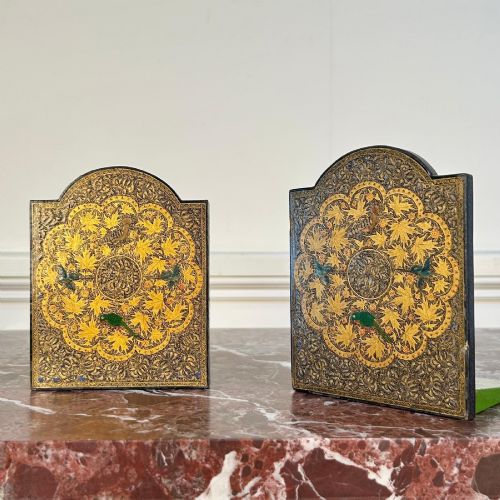
One listed pair of Kashmiri bookends proves that painted wooden pairs extend beyond conventional tables.
What varies in quality
Quality rests in the execution of the painted decoration and the crispness of the underlying woodwork. Pieces with hand-executed Chinoiserie, lacquer, or traditional regional paintwork stand apart from simpler commercial finishes.
Materials also dictate grade, with heavy marble inserts and brass mounts elevating a piece above standard pine construction. The integrity of the painted surface across both matched items determines the overall cohesion of the pair.
The Pair Painted End Tables Glossary
- Chinoiserie
- European decorative style imitating Chinese artistic traditions. It frequently appears on lacquer and painted furniture.
- Gustavian
- Swedish neoclassical style characterised by pale painted finishes and restrained carving. It reflects a lighter interpretation of French court aesthetics.
- D-end
- Table shape featuring a straight edge and a semicircular end. Pairs often join together to form a larger console.
- Lacquer
- Resin finish applied in multiple layers and polished to a hard sheen. It forms a durable surface on Asian and European decorative tables.
- Gilt
- Application of gold leaf or gold paint to surface details. It highlights carved mouldings and painted highlights.
Pair Painted End Tables: Frequently Asked Questions
Where should I place pair painted end tables?
These matched tables sit naturally on either side of a bed, a sofa, or a fireplace. Their painted surfaces add focal points to corners and hallways.
Because they arrive as a pair, they create visual symmetry in a room. Use them to support lamps, books, or decorative objects.
How do I clean painted wooden tables?
Dust the surfaces regularly with a soft, dry cloth to prevent dirt buildup. Avoid abrasive cleaners or excess water which can damage old paint and lacquer.
Protect the painted top from moisture by using coasters under glasses. Wax can be applied sparingly to unpainted wood elements.
What styles are common in painted end tables?
The selection includes regional European designs like Swedish Gustavian and French Chateau. Asian influences appear through Chinese lacquer and Kashmiri painting.
English Country and Chippendale revival styles also feature painted finishes. Each style dictates the specific motifs and colour palettes used by the maker.
How do I match them with existing furniture?
Look at the primary colour and finish of the paintwork to coordinate with your room. Swedish or French painted tables suit neutral interiors, while Chinoiserie adds strong colour.
Matching the period or general aesthetic matters more than exact colour replication. A contrasting painted finish often creates a successful focal point.