
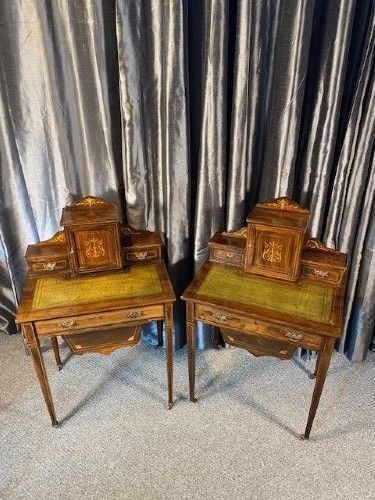


Pair of Writing Tables
These pair of writing tables span the Regency and Victorian periods, offering dual workspaces fashioned from mahogany, rosewood, and walnut.
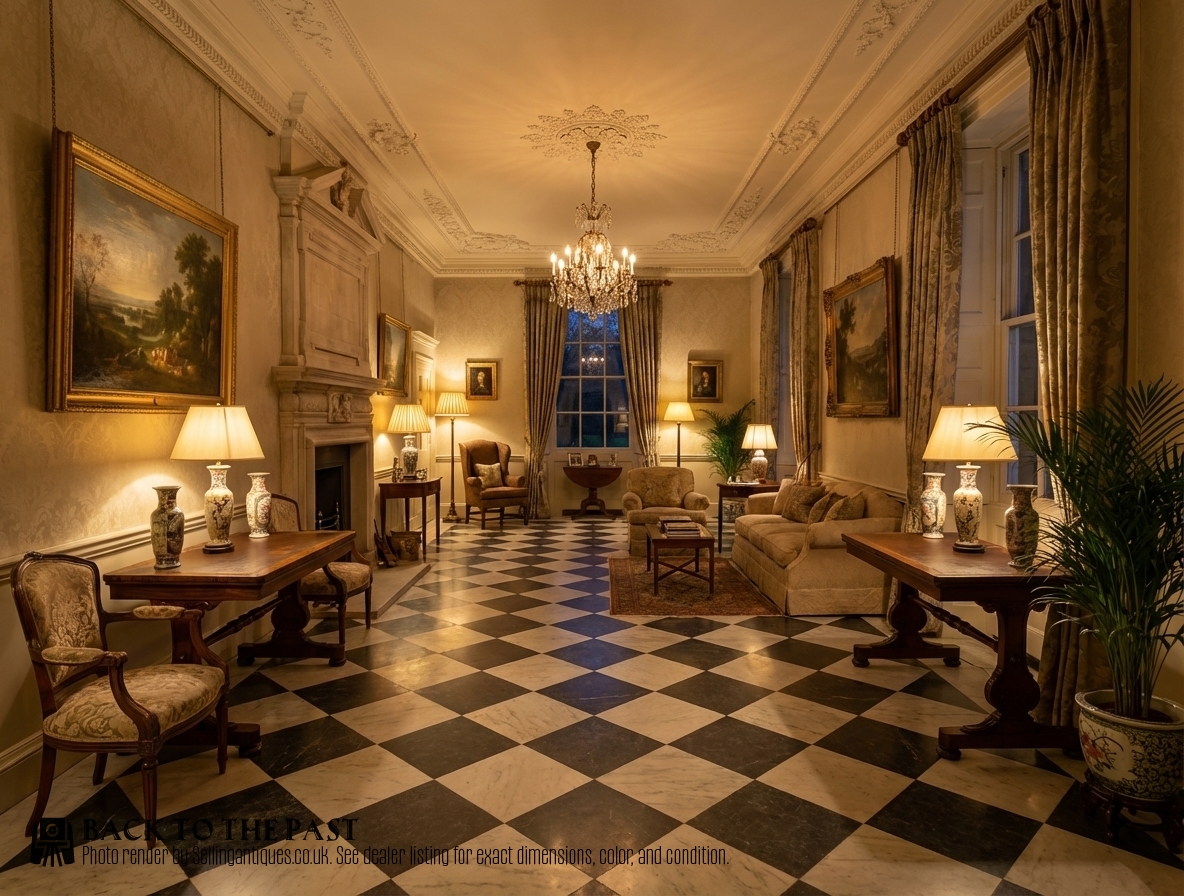
Pair of Writing Tables
A pair of writing tables brings matched workspace into a room, taking forms such as library tables, sofa tables, and bureau plat desks. Buyers seeking a pair of writing tables most frequently encounter nineteenth century mahogany and rosewood examples across this selection.
The objects serve various domestic functions, appearing as bonheur du jours, side work tables, and Carlton house desks. Makers fashioned these pieces during the Regency, Victorian, and Edwardian eras to furnish dual studies or grand reception rooms.
How they were made
Cabinetmakers constructed the carcases from dense timbers including mahogany, rosewood, walnut, and satinwood, frequently applying kingwood and boxwood veneers. These surfaces often incorporate inlaid details and leather writing inserts.
Metal mounts in brass and ormolu provide structural reinforcement and decorative contrast alongside lacquered finishes and pietra dura panels.
Object forms include library tables, sofa tables, Carlton house desks, and bonheur du jours originating in 19th-century and Edwardian workshops.
What varies in quality
The selection of timber grain and the precision of cabinetwork distinguish finer examples from standard production, particularly in figured mahogany and rosewood veneers. Superior execution shows in the integration of brass mounts and inlaid stringing.
Matched proportions between the two pieces determine the success of the pair, alongside the sophistication of secondary details such as leather toolings and ormolu mounts.
John MaClean·Gillows
The Pair of Writing Tables Glossary
- Bonheur du jour
- A light lady's writing desk featuring a small cabinet or superstructure on the top surface. These compact pieces frequently date from the nineteenth century.
- Sofa table
- A rectangular table designed to stand in front of a sofa, equipped with drop leaves at either end. These pieces often incorporate dual drawers and trestle supports.
- Ormolu
- Gilt-bronze ornamentation applied to furniture, common in French and English Regency pieces. The technique involves mercury gilding over a cast bronze base.
- Pietra dura
- Inlaid work using cut and fitted polished coloured stones to create images or geometric patterns. This decorative technique appears on nineteenth century bonheur du jours.
Pair of Writing Tables: Frequently Asked Questions
What is a pair of writing tables?
A pair of writing tables comprises two matching desks designed to provide symmetrical workspaces within a room. These pieces range from grand library tables to compact bonheur du jours.
Craftsmen produced them in matching timbers and styles to furnish unified interiors, particularly during the Regency and Victorian periods.
How were library tables used?
Library tables functioned as central room pieces for reading, correspondence, and storing volumes. Their finished backs allowed them to stand away from walls.
They provided stable writing surfaces with integrated drawers for stationery and documents.
How do I identify Regency pieces?
Regency pieces often feature classical motifs, rosewood or mahogany timbers, and brass inlay or mounts. Proportions tend to be clean and architectural.
Makers working in this style drew inspiration from classical antiquity and contemporary French design.
Where should I place a pair?
A pair of writing tables can flank a fireplace, sit opposite one another in a large library, or furnish matching home offices. Their symmetrical nature suits formal reception spaces.
Ensure adequate clearance around both pieces to allow drawers to open freely.