

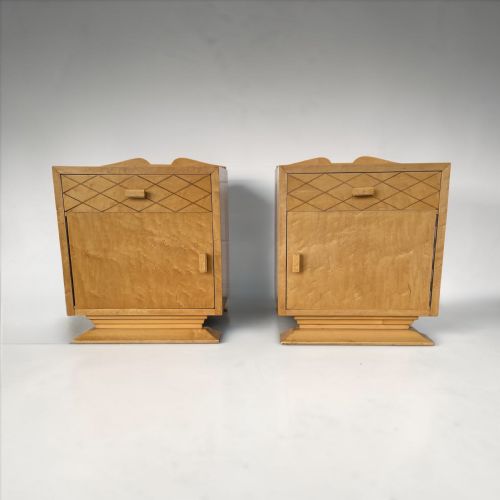


Pair of Swedish Tables
These pair of swedish tables bring classical form and painted timber to the interior, shaped by centuries of Scandinavian design traditions.
Pair of Swedish Tables
A buyer examining a pair of swedish tables encounters forms ranging from 19th Century demi-lune console tables to early 20th Century bedside cabinets. These pieces reflect regional aesthetics spanning Gustavian, Swedish Empire, and Scandinavian Art Deco movements.
The selection on this page centres heavily on side tables, console tables, and occasional tables, alongside related forms such as commodes and chests of drawers. Nineteenth Century painted pine and birch examples appear with great frequency alongside later 1920 and 1930 variations.
Originating primarily from Swedish workshops, these matching items provide balanced symmetry for a room. The structural vocabulary incorporates neoclassical lines alongside simpler country interpretations.
Materials and construction
Carpenters utilised native softwoods and hardwoods including pine, solid birch, and birch veneer, often applying layered paint finishes, ebonisation, or faux marble decoration. Ormolu and gilt bronze mounts appear on more formal Empire period pieces.
Surface treatments define much of the visual character, ranging from traditional hand-painted and ragwork finishes to high-gloss Art Deco treatments. Construction methods follow established cabinetmaking practices appropriate to each period, from 1860 joinery up to 1930 modernism.
The listings here encompass pieces spanning the 1860s through to the 1930s, constructed in pine, birch, and painted wood.
Assessing craftsmanship and finish
The standard of execution depends heavily on the crispness of timber carving, the stability of the structural joinery, and the integrity of the painted or veneered surface. Finer examples retain their original decorative schemes and tactile patination rather than later heavy-handed repainting.
Proportion and decorative restraint separate standard utility items from higher design manifestations like Gustavian or Swedish Empire pieces. The alignment of grain in birch veneer or the precision of hand-applied paint finishes marks the distinction between workshop tiers.
The Pair of Swedish Tables Glossary
- Demi-lune
- A half-moon shape commonly found in console tables designed to sit flush against a wall.
- Gustavian
- A Swedish neoclassical style characterised by restrained symmetry, fluted legs, and pale painted surfaces.
- Ormolu
- Gilt bronze mounts used as decorative enrichment on furniture from the Empire period and later revivals.
- Ragwork
- A decorative painting technique using rags to create a textured, mottled finish on timber surfaces.
- Biedermeier
- A Central European and Scandinavian style emphasising clean lines and utilitarian comfort without excessive ornamentation.
Pair of Swedish Tables: Frequently Asked Questions
Where should I place a pair of swedish tables?
Console and side variations sit naturally in hallways, living rooms, or flanking a fireplace to create balanced symmetry.
Smaller bedside cupboards and occasional tables function effectively in bedrooms as functional display surfaces.
How do I identify a Gustavian piece?
Gustavian items typically display lighter painted finishes, subtle neoclassical carving, and straight tapering legs.
They reflect the Swedish interpretation of French Louis XVI taste.
Are these tables made of solid wood?
Construction materials vary by period and type, utilising solid pine and birch alongside birch veneers on secondary timbers.
Painted finishes frequently conceal the underlying softwood construction.
How do 19th Century and Art Deco models differ?
Nineteenth Century examples lean toward neoclassical proportions, painted pine, and traditional console formats.
Art Deco pieces from the 1930s introduce streamlined geometric forms and polished veneers.