
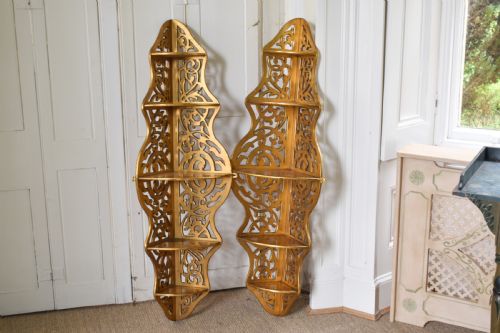
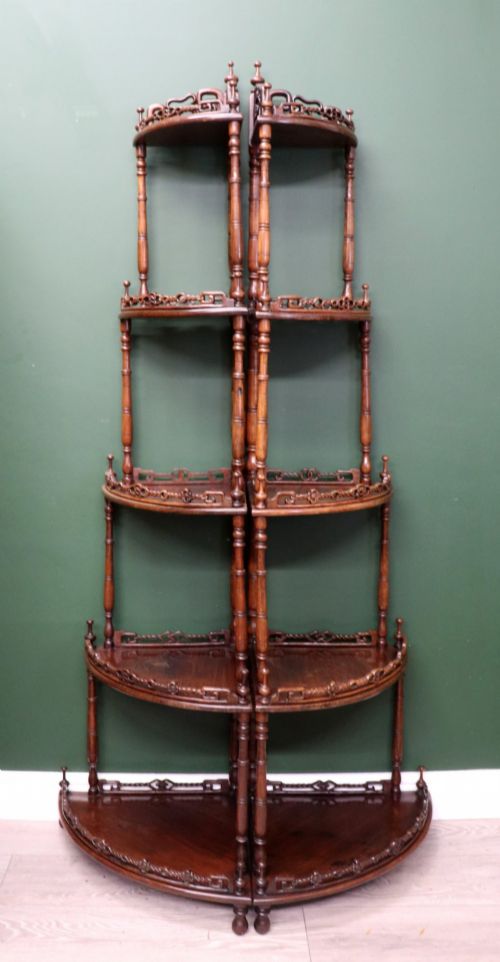
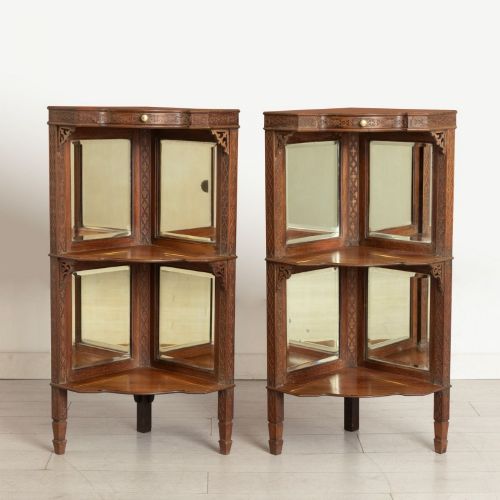


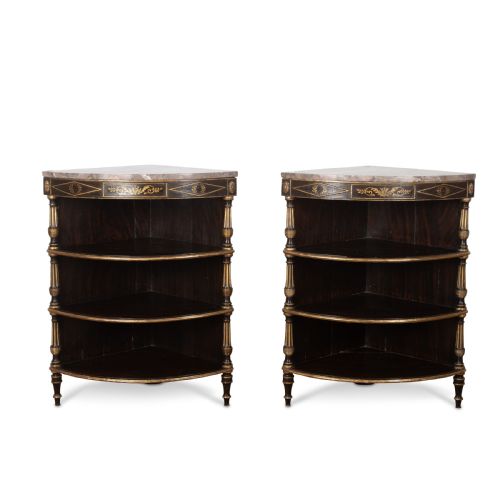


Pair of Corner Shelves
These pair of corner shelves solve the eternal problem of dead wall space by bringing rich timber and gilt detail right into the angle of a room.
Pair of Corner Shelves
A pair of corner shelves turns neglected room angles into display space, appearing in forms ranging from wall-hung brackets to floor-standing corner cupboards and etageres. You will most frequently meet Victorian examples in mahogany or gilt finishes, alongside Regency and twentieth-century interpretations.
Makers such as Edwards & Roberts produced fine display pieces, while other items draw upon Georgian style, Italian Rococo, and Colonial traditions. These wall-mounted or freestanding units utilise timber and giltwood to maximise awkward corners with practical tiers.
Materials and construction
Makers relied heavily on solid hardwoods like mahogany, walnut, and oak to build sturdy tiers that could support heavy china and books. Finer examples incorporate gesso, gold leaf, and paint to decorate surfaces, especially on giltwood and French gesso items.
Construction methods vary from wall brackets screwed directly to masonry to freestanding corner cabinets and multi-tiered whatnots joined with careful joinery. Brass mounts and marble tops occasionally appear on Regency and nineteenth-century pieces to add weight and contrast.
The listings span from the Regency period through the Victorian era and into the twentieth century, constructed primarily in mahogany, walnut, oak, and giltwood.
Judging the standard of a pair of corner shelves
Quality rests primarily on the crispness of the carving, the selection of timber veneers, and the integrity of the original gilt or paint finish. Pieces carrying maker signatures, such as Edwards & Roberts, demonstrate superior cabinet-making compared to anonymous workshops.
The architectural proportion dictates visual success, where well-balanced tiers and secure bracket joints separate utilitarian storage from refined decorative furniture. Original surfaces without crude overpainting command greater respect among collectors.
Edwards & Roberts
The Pair of Corner Shelves Glossary
- Gesso
- A plaster-like mixture applied to wood and smoothed before gilding or painting. It provides a stable base for gold leaf.
- Whatnot
- A piece of furniture consisting of open shelves for books or ornaments. Mid-nineteenth-century examples often use this term interchangeably with corner shelves.
- Padouk
- A heavy tropical hardwood valued for its durability and rich reddish-brown colour. West African varieties appear in certain antique iterations on this page.
Pair of Corner Shelves: Frequently Asked Questions
How do I hang heavy corner shelves securely?
Heavy wooden corner shelves require solid fixings into wall studs or masonry plugs rather than simple plasterboard screws. The mounting brackets must bear both the weight of the timber and the objects placed upon the tiers.
Consult a professional if the structure is uncertain, as antique hardwoods add considerable weight before any display items are added.
Can I use corner shelves in a modern room?
These pieces integrate easily into contemporary interiors by warming up stark corners with traditional timber tones or bright gilt accents. They provide functional display without claiming valuable floor space in smaller rooms.
Mixing nineteenth-century mahogany or painted pine with modern decor creates a deliberate contrast that highlights the age of the furniture.
What is the difference between an etagere and a whatnot?
Both terms describe multi-tiered shelving units designed for display, though etagere often implies a slightly more delicate French influence. A whatnot typically serves as a general Victorian shelving unit for books or ceramics.
In practical terms, makers used these descriptions interchangeably for corner furniture throughout the nineteenth century.