




Pair Marquetry Pier Cabinets
These pair marquetry pier cabinets bring formal elegance to a drawing room, offering matched symmetry and display space for treasured objects.
Pair Marquetry Pier Cabinets
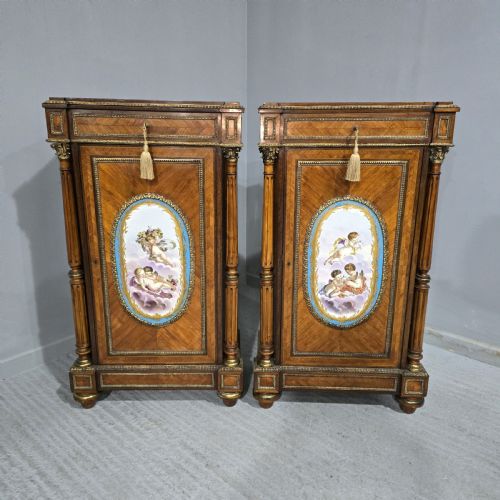
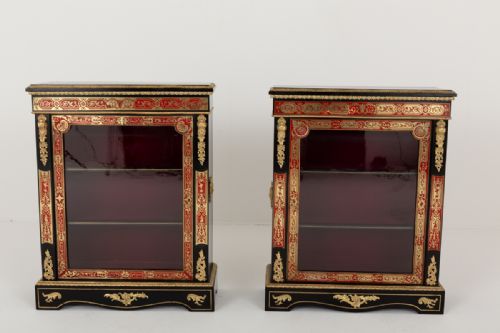
When you search for pair marquetry pier cabinets, you encounter matched furniture designed to fit the narrow wall spaces between windows in nineteenth-century formal rooms. The pieces appearing here span the Victorian era, the eighteenth century, and French Napoleon III and Louis XVI styles.
The dominant forms are pier cabinets, side cabinets, and display cabinets. Walnut, burr walnut, and ebonised wood form the primary carcases, often paired with glass doors for exhibiting collections.
Assessing quality
Quality rests in the precision of the marquetry and the crispness of the ormolu mounts. Finer examples display intricate floral inlays and careful timber selection, such as figured burr walnut.
The integration of porcelain plaques and the weight of the bronze mounts distinguish high-status French revival pieces from standard side cabinets.
Burr walnut and ebonised wood dominate the Victorian carcases, whilst ormolu and glass complete the French revival styles.
The Pair Marquetry Pier Cabinets Glossary
- Marquetry
- Decorative veneer work arranged in pictorial or geometric patterns. Craftsmen cut contrasting timbers and materials together to form detailed surface designs.
- Ormolu
- Gilded bronze mounts applied to furniture edges and corners. This technique originated in France and adds metallic contrast to dark woods.
- Boullework
- A type of marquetry using brass and tortoiseshell. André-Charles Boulle popularised this contrasting technique on seventeenth and eighteenth-century furniture.
- Pier cabinet
- A narrow cabinet built to stand against the wall space between windows. These pieces often feature glass doors for displaying ornaments.
Pair Marquetry Pier Cabinets: Frequently Asked Questions
What is a pier cabinet?
A pier cabinet is a narrow piece of furniture designed specifically to stand against the plaster pier between two windows in a formal room.
These cabinets usually feature glazed doors to display porcelain and small decorative objects while reflecting light from the surrounding windows.
How do I identify French revival styles?
French revival styles appear in nineteenth-century pieces that emulate earlier periods such as Louis XVI and Louis XV. Look for ormolu mounts, porcelain plaques, and refined marquetry.
Cabinet makers in Britain and France adopted these courtly aesthetics to satisfy Victorian demand for continental grandeur.
Where were these cabinets placed?
These cabinets occupied reception rooms and formal drawing rooms where symmetry was paramount. Placing matched pairs on opposite walls or flanking a fireplace created a balanced interior scheme.
Their shallow depth allowed them to sit flush against walls without obstructing pathways.