
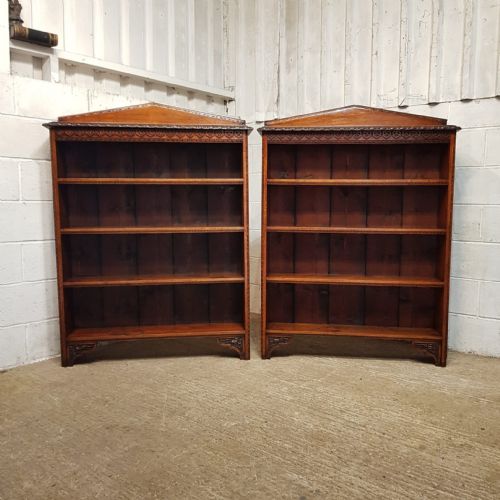
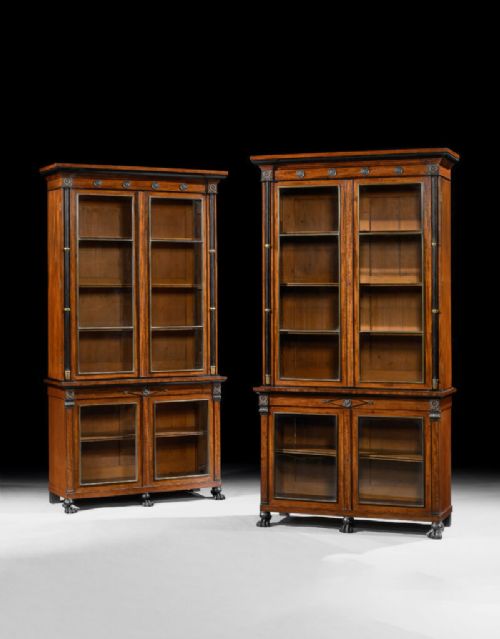

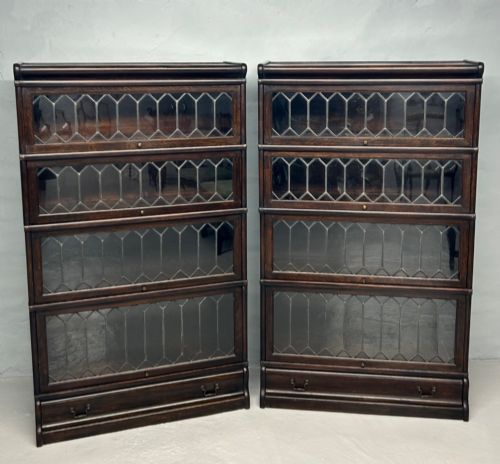


Pair Library Bookcases
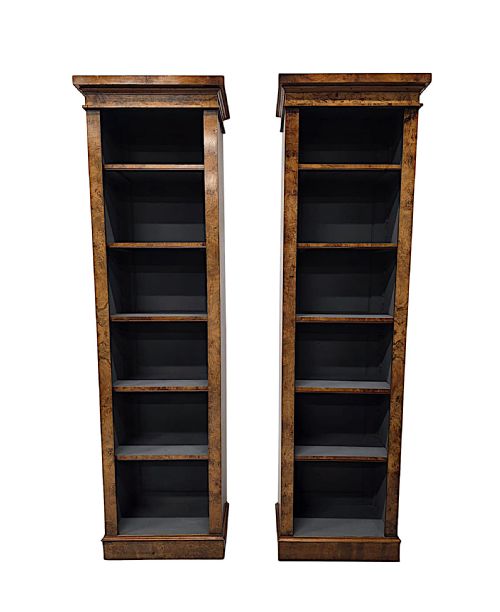
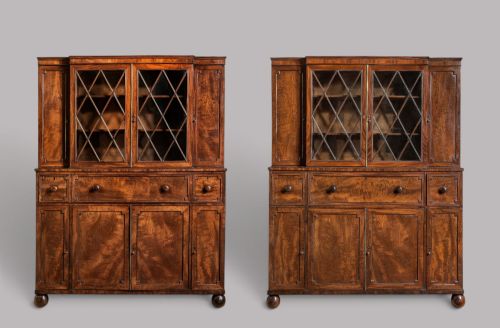
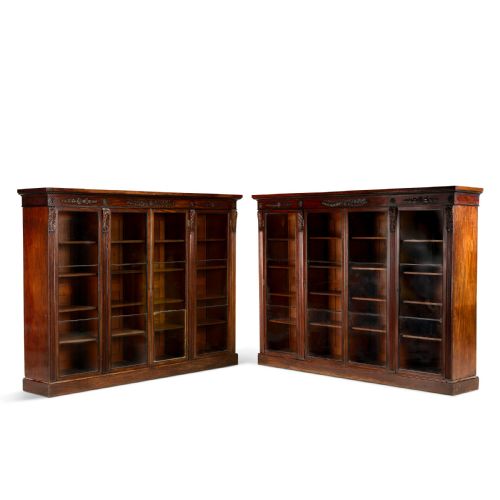
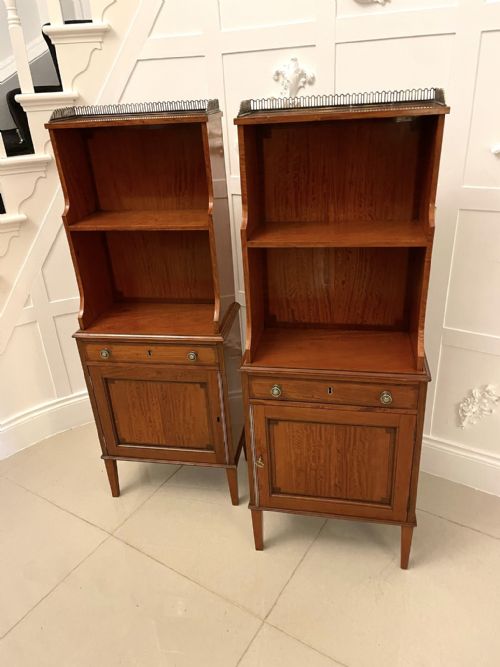
Pair library bookcases are matching sets of dual shelving units designed for holding volumes, spanning periods from the Regency era through to the early twentieth century in mahogany, oak, and rosewood.
Pair Library Bookcases
Pair library bookcases provide balanced dual storage for large collections of books, appearing most frequently in mahogany, oak, and rosewood across this selection. These matching pieces range from open architectural shelving to glazed cabinets designed for grand studies.
The styles span Regency, Victorian, and Edwardian periods, alongside revival movements like the Gothic and Georgian. Buyers encounter both open front versions and sectional barristers or revolving designs.
Origins stretch from English workshops to Scottish and Swedish makers, showing diverse regional interpretations of classical cabinet making. The forms include breakfronts, waterfall shapes, and whatnots alongside standard tall bookcases.
How they were made
Cabinet makers utilised dense hardwoods such as mahogany, oak, and walnut, often accentuating surfaces with satinwood crossbanding or flame veneers. Brass hardware and leaded glass panes frequently complement the timber construction.
Construction techniques involve structural joinery suited to heavy loads, incorporating adjustable shelving systems and sectional stacking mechanisms like those by Globe Wernicke. Glazed doors utilise wooden astragals to hold individual panes securely in place.
Listings feature pieces spanning the nineteenth and early twentieth centuries, constructed primarily from mahogany, oak, walnut, and rosewood.
What varies in quality
The choice of timber grain and veneer selection dictates visual impact, with figured mahogany and burr walnut sitting at the upper end of the scale. Superior examples display meticulous attention to inlaid details and harmonious matching between the two individual units.
Construction integrity relies upon the retention of original adjustable shelving mechanisms, sound structural joinery, and intact glass or brass elements. Attribution to documented makers like Gillows or Marsh & Tatham elevates historical interest.
Gillows·Marsh & Tatham·Robert Strahan·Maple and Co·Richard Bridgens·William Baker and Co
The Pair Library Bookcases Glossary
- Astragal
- Glazing bars forming a grid supporting glass panes in cabinet doors. These wooden strips structure the visual division of library doors.
- Breakfront
- A cabinet design where the central section projects forward from the flanking wings. This creates architectural depth on large library pieces.
- Crossbanding
- A narrow strip of veneer laid border-wise around the edges of a panel. The grain runs perpendicular to the main surface to create a contrasting frame.
- Waterfall
- A stepped shelving form where each tier recedes behind the one below. This style became popular during the later Victorian and Edwardian periods.
- Sectional
- A modular bookcase built from stackable tiers with glass or wooden lifting doors. These units allow customisable height configurations.
Pair Library Bookcases: Frequently Asked Questions
Are sectional bookcases difficult to move?
Sectional bookcases separate into individual stacking tiers, making transport and relocation much simpler than dealing with a single massive frame. Each modular tier lifts off independently.
This design originated to protect heavy volumes and allow easy assembly in upper floor studies or libraries.
How do I date a set?
Dating relies upon timber choice, decorative motifs, and construction methods characteristic of specific eras like the Regency or Edwardian periods. Architectural styling often mirrors broader design movements such as Gothic Revival or Sheraton revivals.
Maker signatures, stamps, or paper labels found inside drawers and on backboards provide precise chronological markers.
Can shelves be adjusted?
Many traditional library bookcases feature adjustable shelving supported by brass rack strips or wooden peg systems. This allows configuration for varying book heights.
Older open versions sometimes utilise fixed shelving integrated directly into the structural uprights during initial construction.