


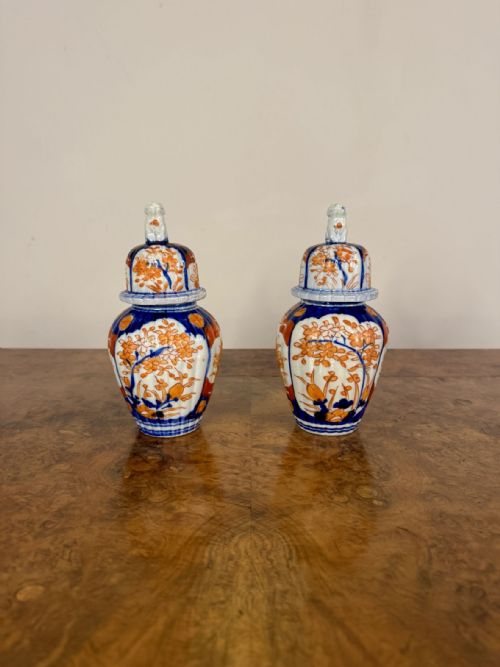





Pair Japanese Covered Vases
Pair japanese covered vases bring robust ceramic presence to a room, offering matched symmetry through porcelain pots and lidded forms.
Pair Japanese Covered Vases
Pair japanese covered vases are matched ceramic vessels complete with matching lids, typically designed as decorative objects rather than utility pieces. Buyers searching this phrase encounter substantial lidded jars and pots originating from the seventeenth century onward.
The selections on this page lean heavily toward nineteenth century examples alongside earlier seventeenth and eighteenth century pieces. Forms range from ginger jars to large Arita Imari lidded vases and cloisonne ginger jars.
Stylistic variations span Japanese Imari, Edo Period, and Japanese Meiji aesthetics, with occasional Victorian interpretations of Japanese Imari style. These objects frequently pair porcelain bodies with decorative covers to present a unified display.
How they were made
Makers utilised porcelain as the primary body material, shaping vessels into jars, pots, and urns before applying intricate enamel and cobalt blue decoration. Many pieces incorporate gilding, gold leaf, or gilt highlights to accentuate the ceramic surfaces.
Certain decorative variants employ metalwork elements such as ormolu, copper, or brass mounts to frame or support the ceramic bodies. The combination of glazed porcelain and detailed enamel work defines the construction methods seen across these listings.
Pair Japanese Covered Vases Retail Price Guide 2026
Typical asking prices for pair japanese covered vases among the pieces listed under this phrase on Sellingantiques today, from the lower quarter to the upper quarter. They describe what is for sale here now, not the wider market.
Victorian potteries admired these Japanese designs so much they happily painted their own versions.
What varies in quality
The execution of the painted enamel and the precision of the porcelain body set individual pairs apart. Finer examples display meticulous brushwork and crisp cobalt blue or polychrome detail, whereas simpler pots show more straightforward decoration.
The integrity of the matching covers and the harmonious balance between the two vessels dictate the overall desirability of the set. Consistency in the glaze and the quality of any applied gilding or metal mounts determine where a pair sits within the range.
The Pair Japanese Covered Vases Glossary
- Imari
- A style of Japanese porcelain decorated in underglaze blue, iron red, gold, and supplementary colours. This decorative approach originated in Arita and became widely imitated in Europe.
- Cloisonne
- An enamelwork technique where thin metal strips are soldered to a base to form compartments filled with paste and fired. Ginger jars in this medium display tactile surface patterns.
- Arita
- The Japanese town central to the production of early export porcelain. Wares from this region form the bedrock of historic ceramic trade.
- Edo Period
- The historical era in Japan spanning from the early seventeenth to the mid-nineteenth century. Pieces from this time reflect distinct cultural and artistic developments.
- Ormolu
- Gilded bronze mounts applied to decorative objects. This French technique occasionally dresses up Asian porcelain forms for Western interiors.
Pair Japanese Covered Vases: Frequently Asked Questions
How were pair japanese covered vases used?
These vessels served primarily as decorative ornaments within domestic interiors, often displayed on mantelpieces or cabinets. Their lidded forms allowed them to stand as sculptural statements rather than functional tableware.
Larger examples commanded prominent positions in reception rooms, while smaller jars added symmetrical accents to smaller spaces.
What is the difference between Imari and Arita?
Arita refers to the Japanese production centre where the porcelain was actually manufactured. Imari describes the distinct colour palette and decorative style associated with the export wares shipped from that region.
Pieces can therefore be both Arita in origin and Imari in style.
How do I date a lidded vase?
Dating relies on assessing the characteristics of the porcelain body, the specific style of the painted decoration, and any associated historical markers. Seventeenth century pieces differ noticeably in weight and cobalt tone from nineteenth century interpretations.
Comparing the potting technique against known period examples helps clarify the timeline.
Do the covers have to match?
Authentic pairs typically retain their original matching lids, which were formed and decorated alongside the base vessels. Consistency in the glaze and pattern alignment between lid and jar confirms a matched set.
Original covers contribute significantly to the integrity of the ensemble.