

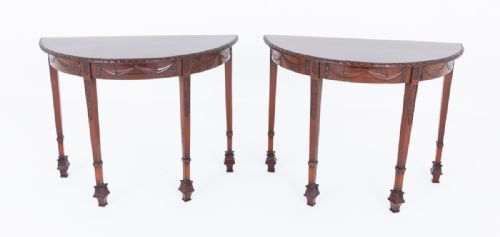


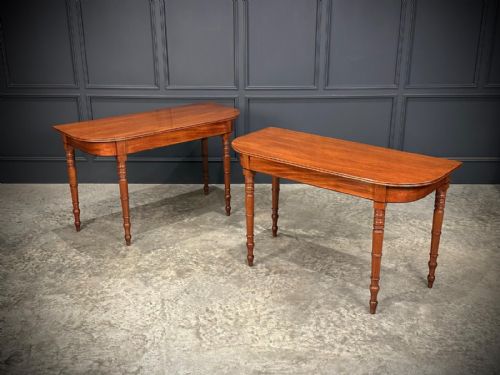


Pair Hallway Console Tables
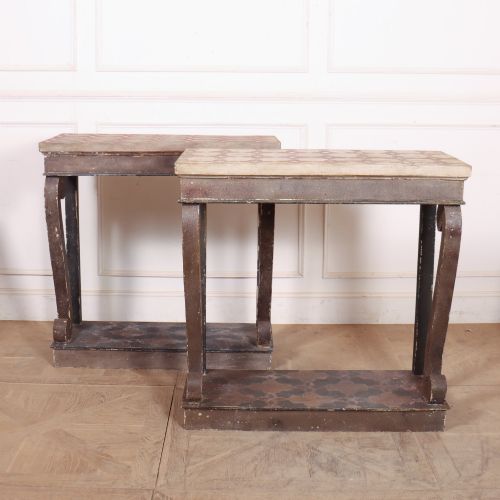
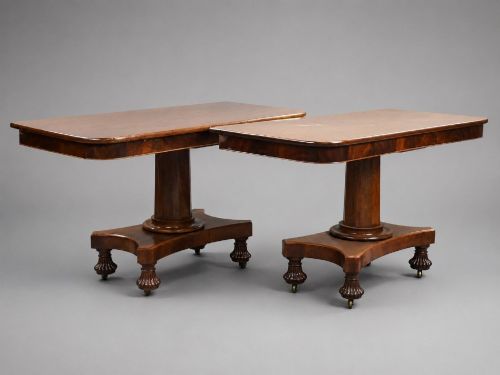
These pair hallway console tables provide matching surfaces for narrow spaces, bringing balance and symmetry to an entrance.
Pair Hallway Console Tables
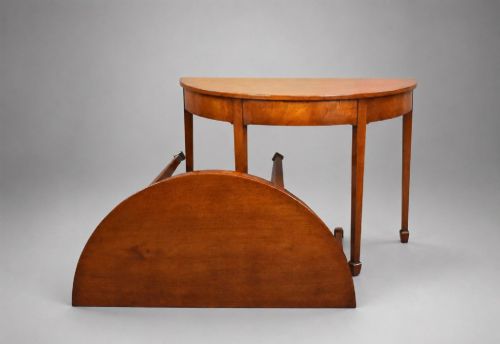
A pair hallway console tables search brings up matching sets of narrow tables designed to sit against a wall in a passage or reception space. You will most frequently encounter Georgian and nineteenth-century examples, often fashioned as demi-lune shapes that fit flush against the plaster.
The inventory on this page spans console tables, serving tables, side tables, and console cabinets. These forms appear in styles ranging from George III and Regency to French Empire, Art Deco, and Gustavian.
Origin points stretch across England, France, Sweden, Spain, and Italy, reflecting diverse regional tastes in domestic furnishing. Many adopt semicircular demi-lune formats to minimise floor obstruction in confined areas.
How they were made
Cabinetmakers utilised dense timbers such as mahogany, oak, walnut, and rosewood, frequently shaping them into curved demi-lune or bowfront profiles. Surfaces often received painted finishes or decorative timber inlays.
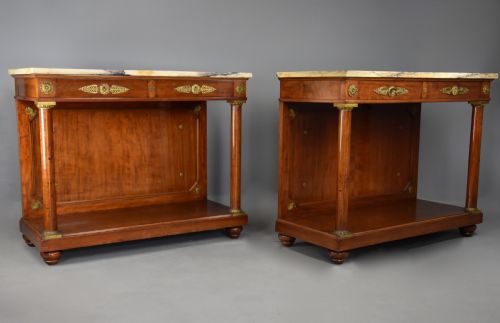
Many examples incorporate polished marble tops, while others feature contrasting brass mounts, ormolu details, and parcel gilt highlights. Construction methods relied on traditional joinery to support heavy stone surfaces and decorative timbers.
Listings feature timber, painted wood, marble, brass, and ormolu across periods spanning the seventeenth to the twentieth century.
What varies in quality
The grade of materials sets examples apart, distinguishing simple timber construction from those featuring figured mahogany veneers, finely carved details, or heavy inset marble slabs. Superior pieces display deliberate proportion and crisp detailing in inlay and mounts.
Execution and origin also dictate standing, with marked pieces or documented regional styles commanding greater attention than anonymous workshop output. The harmony between the matching pair remains paramount for symmetrical placement in a hall.
Krieger Paris·Gillow
The Pair Hallway Console Tables Glossary
- Demi-lune
- A half-moon shape used for table tops and frames. This curved format allows tables to sit against walls while occupying minimal depth.
- Console table
- A table supported by wall brackets or front legs, traditionally designed for placement against a wall. They function as display or serving surfaces in hallways and reception rooms.
- Ormolu
- Gilded bronze used for decorative mounts and accents. It appears frequently on French Empire pieces to highlight architectural lines.
- Serving table
- A large side table used for presenting food or objects. These heavy tables often share similar proportions with large console tables.
- Inlaid
- Decoration formed by embedding pieces of contrasting timber into the primary surface. This technique creates geometric patterns or linear borders on table tops.
Pair Hallway Console Tables: Frequently Asked Questions
Where should I place pair hallway console tables?
These tables suit narrow entrance passages, landings, and reception rooms where floor space is limited. Their matched nature allows them to flank a doorway or sit opposite each other for symmetry.
Because they stand flush against the wall, they provide a surface for lamps and decorative objects without obstructing foot traffic. Placing a mirror above them completes a traditional hallway arrangement.
How do I identify a Regency console table?
Regency pieces often draw on classical architectural motifs, featuring dark timbers like mahogany or rosewood. They frequently incorporate brass inlay, reeded legs, and marble tops.
These tables reflect early nineteenth-century British design trends influenced by ancient Roman and Greek forms. Their clean lines distinguish them from more ornate Victorian or heavily carved earlier styles.
What is the difference between a console and a side table?
Console tables are traditionally designed to be fixed against a wall, sometimes relying on front legs while securing to the plaster behind. Side tables are generally freestanding four-legged furniture items.
In modern usage, the terms often overlap, particularly with demi-lune formats that function interchangeably in hallways. Both serve as narrow display surfaces.