
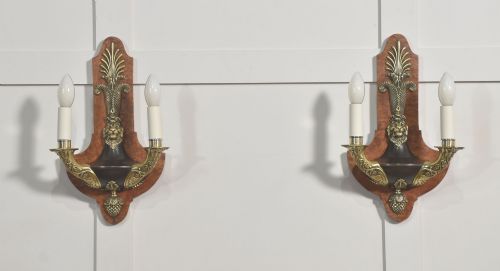
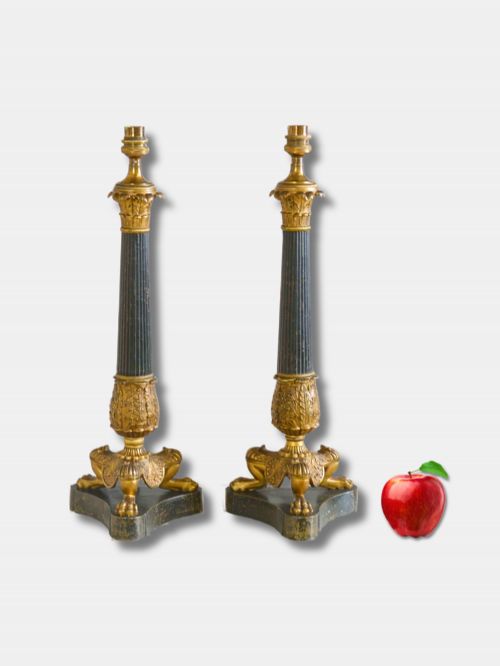


Pair French Empire Lamps
These pair french empire lamps bring heavy neoclassical authority and disciplined gilt metalwork to a room.
Pair French Empire Lamps
A buyer examining pair french empire lamps looks at matched lighting fixtures rooted in the classicism of the early nineteenth century and later revivals. These pieces draw heavily on architectural forms, incorporating columns, urns, and figural supports derived from ancient Greece and Rome.
The versions most commonly met on this page combine cast metal bases with classical proportions, often taking the form of converted candlesticks or column table lamps. Surviving examples frequently span the nineteenth century alongside later twentieth-century revivals in the same strict style.
While table lamps dominate, the selection also encompasses wall lights, brackets, and figural torchères sharing the same decorative vocabulary. Originating primarily from French workshops, they retain a distinct formality through symmetrical design and disciplined ornamentation.
How They Were Made
The construction of pair french empire lamps relies on the interplay of bronze, brass, and ormolu, utilising metal casting and fire-gilding techniques. Founders cast bronze and brass components with sharp detail before applying mercury gilt or surface patination to create high-contrast finishes.
Many examples incorporate secondary materials such as white or coloured marble plinths, cut crystal drops, and turned wood elements like burr walnut or mahogany. Candlestick conversions integrate these structural materials with internal wiring channels while preserving the original metal mounts.
Keep an eye out for hidden cast pineapples waiting quietly among the classical columns.
What Varies in Quality
The integration of materials dictates the overall success of the piece, particularly where marble bases meet cast bronze mounts with tight, seamless joints. Superior models maintain architectural proportions that look balanced from every angle, supported by heavy gauge metals rather than light stamped brass.
François-Christophe-Armand Toussaint
The Pair French Empire Lamps Glossary
- Ormolu
- Gilded bronze produced through an amalgamation of gold and mercury applied to a bronze base. This historic technique creates a warm, durable metallic lustre found on high-end nineteenth-century mounts.
- Patinated bronze
- Bronze treated with chemical solutions to darken the surface, creating contrast against bright gilt details. It adds visual depth to figural subjects and architectural columns.
- Neoclassical
- The dominant design movement of the late eighteenth and early nineteenth centuries drawing upon classical antiquity. It prioritises symmetry, restraint, and direct classical motifs.
- Torchère
- A tall ornamental stand or lamp designed to hold lights, often featuring figural supports. These substantial pieces serve as primary illumination points within large interiors.
- Toleware
- Painted or enamelled sheet metal items produced in various European workshops. They offer colourful decorative surfaces distinct from raw cast metals.
Pair French Empire Lamps: Frequently Asked Questions
How are lamps converted safely?
Most antique lighting of this period started life as candlesticks, oil lamps, or torchères before receiving modern electrical fittings. Professional conversion involves running discreet internal wiring through existing channels without altering the structural metalwork.
Buyers should inspect the cord exit points and ensure the lamp holders match the scale of the original bronze or crystal columns. Modern rewiring preserves the exterior aesthetic while meeting current safety standards.
Where should they be placed?
Their strong vertical proportions and reflective surfaces make these pieces well-suited for commanding positions on sideboards, mantelpieces, or large desks. Paired arrangements work best when balanced symmetrically on matching console tables or flanking a mirror.
Because many examples carry substantial height and weight, they require stable surfaces capable of supporting cast bronze and marble bases. Placing them away from heavy foot traffic protects delicate ormolu highlights from accidental bumps.
How do I clean ormolu?
Gilt bronze surfaces require minimal intervention to preserve the fragile historic gold layer beneath dust and surface grime. A soft, dry microfiber cloth removes everyday particles without risking abrasion to the fire-gilded finish.
Water, chemical solvents, and abrasive metal polishes must be avoided entirely because they strip away the thin original gilding. Professional conservation remains the safest route for removing deep accumulation from chased crevices.
Are they original pairs?
Matching items from the nineteenth century often began as a pair of candlesticks or wall lights produced simultaneously in the same foundry. Minor variations in casting or chasing can occur naturally due to hand-finishing processes in historic workshops.
Comparing the base dimensions, weight distribution, and tool marks helps confirm whether two individual lamps share a common origin. Surviving matched sets command higher interest among collectors than assembled pairs.
What defines the Empire style?
The style emerged during the Napoleonic era, reflecting an obsession with Roman military might, imperial symbolism, and classical restraint. Common motifs include laurel wreaths, sphinxes, eagles, and classical columns executed in heavy metals.
Later nineteenth-century revivals reinterpreted these exact motifs with varying degrees of sculptural ambition. Understanding these design roots helps distinguish authentic period pieces from subsequent revival iterations.