
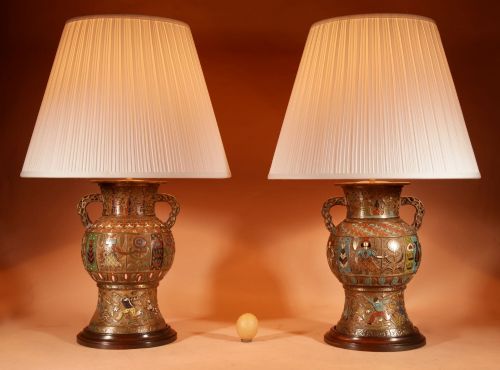
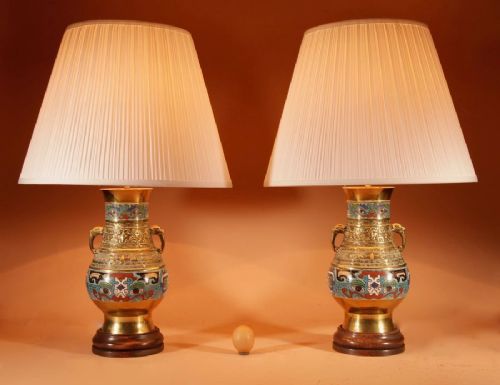
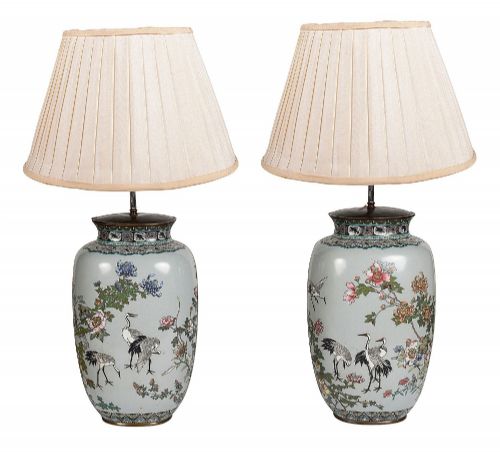


Pair Cloisonne Table Lamps
Pair cloisonne table lamps bring intricate metalwork and vibrant enamels into interiors, offering striking illumination derived from converted vases.
Pair Cloisonne Table Lamps
When you search for pair cloisonne table lamps, you find decorative lighting created by mounting Asian vessels onto fitted bases. These matching pairs usually originate from Chinese or Japanese workshops spanning the nineteenth and early twentieth centuries.
The selection on this page centres on pieces adapted from earlier enamel vases, incorporating styles such as Chinese Export, Qing Dynasty, and the Japanese Meiji period. Many retain their original vessel forms while serving a modern functional purpose.
How they were made
The manufacturing process relies on soldering thin metal wires, known as cloisons, onto copper, brass, or bronze foundations to form intricate compartments. Craftsmen then fill these partitioned cells with coloured enamel paste before firing the piece in a kiln.
Following multiple firings and polishings, many examples receive gilt bronze or ormolu mounts to secure electrical fittings or create stable bases. Fabric shades often complete the conversion from traditional display vases into functional lighting.
Several lamps double as historical survivors that successfully transitioned from Victorian mantelpieces to modern living rooms.
What varies in quality
The refinement of the wirework determines the overall standard, where tighter, more precise geometric patterns require greater skill from the artisan. Superior examples display flawless enamel surfaces without pitting, uneven colouring, or visible repairs.
Mounting quality also separates standard conversions from finer items, particularly where ormolu or gilt bronze mounts integrate seamlessly with the vessel. The weight and stability of the underlying metal foundation further indicate the original tier of production.
The Pair Cloisonne Table Lamps Glossary
- Cloisonne
- A decorative metalwork technique where fine wire creates compartments that hold coloured enamel paste. This method defines the primary surface decoration of these lamps.
- Champleve
- An enamelling technique where troughs or cells are carved directly into the thick metal surface rather than using soldered wires. It appears frequently on Japanese bronze and brass lighting.
- Ormolu
- Gilt bronze mounts applied to furniture and decorative objects to enhance their appearance. In these listings, ormolu often frames the upper and lower edges of the converted vases.
- Meiji Period
- A Japanese historical era lasting from eighteen sixty-eight to nineteen twelve, noted for exceptional metalwork and export ceramics. Pieces from this time often feature highly detailed flora and fauna motifs.
Pair Cloisonne Table Lamps: Frequently Asked Questions
Are these lamps converted from old vases?
Most pair cloisonne table lamps originate as nineteenth-century or early twentieth-century decorative vases that were later adapted for electrical wiring. The conversion process preserves the original vessel while adding functional hardware.
Buyers find both Chinese and Japanese examples ranging from the late Qing Dynasty to the Japanese Meiji period.
How do I date a cloisonne lamp?
Dating relies on examining the metal base, the style of the enamel work, and the wiring components where accessible. Nineteenth-century pieces often display heavier copper or bronze bodies with traditional Chinese Export or Japanese motifs.
Later pieces from the nineteen-twenties show shifts in colour palettes and mounting styles that help distinguish them from earlier nineteenth-century production.
What is the difference between Chinese and Japanese work?
Chinese cloisonne often utilises bolder floral patterns with heavy brass or bronze foundations, particularly during the Qing Dynasty. Japanese Meiji period pieces frequently feature finer wirework, asymmetrical designs, and subtle naturalistic details.
Both traditions result in striking decorative lighting when mounted as matching pairs.
How do I clean and care for them?
Dust the enamel surfaces gently with a soft, dry cloth to prevent accumulation in the wire recesses. Avoid harsh chemical cleaners or abrasive materials that could scratch the polished metal mounts.
Keep the lamps away from direct sunlight to preserve the rich colours of the fired enamel over time.